Legislation proposing dual citizenship may now have to wait for 11th Saeima

Iekšlietu ministrijas vēstule

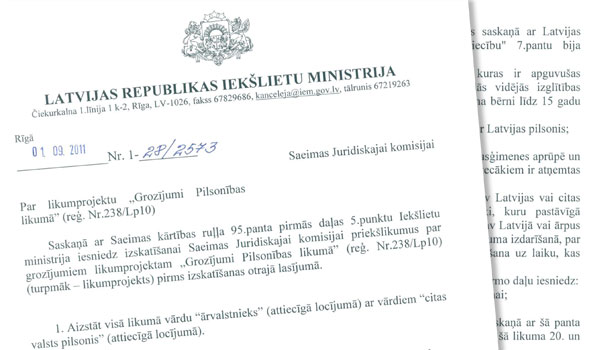
A detailed, 14-page letter from the Ministry of Interior is among documents submitted by Sept. 1 suggesting improvements to proposed amendments to Latvia’s Citizenship Law. (Illustration by Latvians Online)

A proposal to renew dual citizenship in Latvia is among legislation that may fall by the wayside as the 10th Saeima wraps up its work in the wake of the Sept. 17 special parliamentary election.

Even though a special subcommittee was established to review the legislation, and even though several suggestions for improvement were received by the Sept. 1 deadline, the bill appears to stand little chance of making it to a final reading.

In that case, supporters of amending the Citizenship Law—including renewing the possibility for World War II exile Latvians and their descendants to claim dual citizenship—may have to wait for new proposals in the just-elected 11th Saeima.

MP Ilma Čepāne, a member of the Unity (Vienotība) party and chairperson of the Saeima’s Legal Affairs Committee, told Latvians Online in an email that former President Valdis Zatlers’ initiative to dismiss the 10th Saeima and the special election that followed make passage of amendments to the Citizenship Law unlikely.

“Unfortunately because of V. Zatlers’ Order No. 2 and the special Saeima elections, as well as the fact that the agenda for Saeima meetings is set by the president, I very much doubt the possibility that the bill could be accepted on its final, third, reading,” Čepāne said.

Until the 11th Saeima takes office, new President Andris Bērziņš is calling special meetings of the 10th Saeima. He has said that only items on which broad agreement has been reached will be put on the agenda.

The next special meeting of the 10th Saeima is Sept. 22. Amendments to the Citizenship Law are not on the agenda.

In April, the Saeima gave its support on first reading to bill No. 238/Lp10, one of three proposals that reached parliament in the spring. The Saeima also set up a subcommittee of the Legal Affairs Committee to review the legislation and set a Sept. 1 deadline for changes to be proposed.

The subcommittee received several proposed changes, including a detailed, 14-page single-spaced response from the Ministry of the Interior, which included a number of technical corrections.

According to the Saeima website, the last scheduled meeting of the subcommittee was June 1.
Andris Straumanis is a special correspondent for and a co-founder of Latvians Online. From 2000–2012 he was editor of the website.

Seattle, last to file election numbers, will add 125 to Saeima results

The last polling station to report its results in the Sept. 17 parliamentary election will add 125 votes to the totals when officials in Seattle, Wash., complete required paperwork.

Inta Morusa-Vīste (Wiest), chairperson of the local election commission, told Latvians Online that the polling station counted ballots after voting ended at 8 p.m. local time. However, she said Central Election Commission officials in Rīga declined to accept the results until all required forms were submitted, too.

The polling station in the western U.S. city is the only one of 1,027 districts in Latvia and abroad from which the Central Election Commission had not yet published official results by the afternoon of Sept. 18.

Of the 125 voters in Seattle, 43 submitted ballots for Unity (Vienotība), Morusa-Vīste said. The Zatlers’ Reform Party (Zatlera Reformu partija) received 36 votes, as did the National Association (Nacionālā apvienība “Visu Latvijai!”-“Tēvzemei un Brīvībai/LNNK”).

Harmony Centre (Saskaņas Centrs), the party that won the election in Latvia, earned only 4 votes in Seattle. The Union of Greens and Farmers (Zaļo un Zemnieku savienība) got 3 votes. One vote each went to the Šlesers’ Reform Party (Šlesera Reformu partija LPP/LC), the Last Party (Pēdējā partija) and Freedom (Brīvība. Brīvs no bailēm, naida un dusmām).

Official provisional results of the Saeima election are available from the Central Election Commission’s website, www.velesanas2011.cvk.lv.

Andris Straumanis is a special correspondent for and a co-founder of Latvians Online. From 2000–2012 he was editor of the website.

Election turnout abroad best since 1993; London again sees most voters

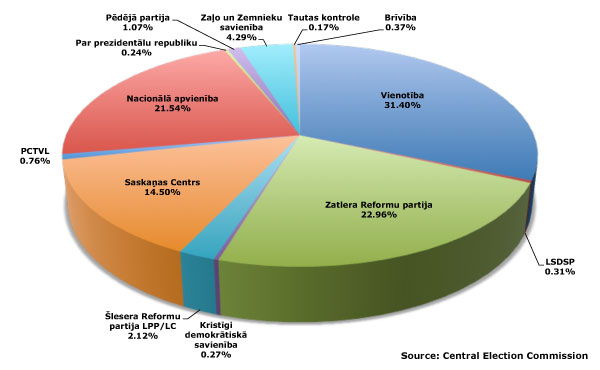
Chart showing voting distribution

According to provisional results, voters abroad favored the centrist Unity and Zatlers Reform Party, as well as the conservative National Association, over the center-left Harmony Centre.

Although overall turnout in the Sept. 17 special parliamentary election was lower than last year, more voters participated outside of Latvia than in any election since 1993, according to Central Election Commission data.

With all but one polling station reporting, provisional results show a total of 14,085 ballots cast in 76 polling stations located in 39 countries outside Latvia. Missing were results from the polling station in Seattle in the United States.

The latest provisional results show that overall turnout in Latvia and abroad was 60.55 percent, down from the 63.1 percent turnout in the October 2010 election.

The increase of more than 10 percent in voting abroad was likely a combination of heightened interest following July’s referendum on dismissing the 10th Saeima and the fact that tourists from Latvia found themselves outside the homeland on election day.

The greatest number of ballots cast abroad in a parliamentary election was in 1993 when 18,413 votes were recorded, according to the Central Election Commission. In the next three Saeima elections, the number of votes abroad declined: 12,525 in 1995; 10,080 in 1998; and 7,350 in 2002. A slight uptick was registered in 2006 when 7,490 votes were cast.

Perhaps because more polling stations operated abroad in 2010—64 compared to 53 in 2006—the number of votes jumped to 12,778.

Just as in voting for the 10th Saeima in October 2010, the polling station set up in the Latvian Embassy in London proved the busiest in this year’s snap election. It saw 1,407 voters.

Second was Stockholm, where the 871 voters included visitors who had just arrived by ferry from Rīga. Third was Dublin with 667 voters.

In Canada, the busiest polling station was in Toronto with 602 voters. Washington, D.C., with 325 voters was the most active in the United States. In Australia, Melbourne drew the most voters with 235.

General results from all balloting in Latvia and abroad gave the center-left and pro-Russian Harmony Centre (Saskaņas Centrs) the victory, following by the centrist Zatlers’ Reform Party (Zatlera Reformu partija) and the centrist Unity (Vienotība).

Voters abroad were of a different opinion, giving most votes to Unity (31.4 percent), the Zatlers’ Reform Party (22.96 percent) and the conservative National Association (Nacionālā apvienība “Visu Latvijai!”-“Tēvzemei un Brīvībai/LNNK”, 21.54 percent). Harmony Centre got 14.5 percent of the ballots cast abroad, according to Central Election Commission data.

Andris Straumanis is a special correspondent for and a co-founder of Latvians Online. From 2000–2012 he was editor of the website.