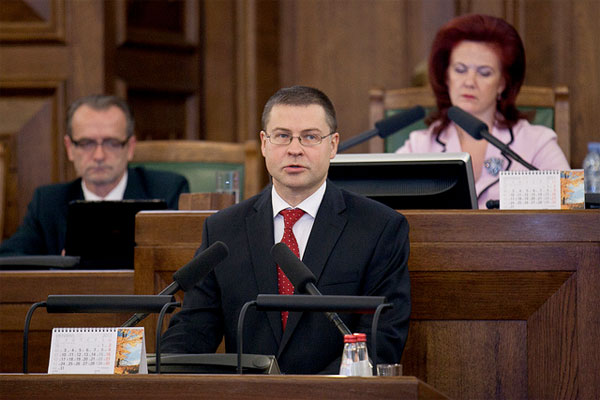
Proposed coalition begins to fray as 6 ZRP deputies turn independent

Just when it seemed Latvia’s political world had reached some sort of equilibrium with news that agreement has been reached on a new coalition government, six newly elected MPs from the Zatlers Reform Party (ZRP) announced Oct. 16 that they turning independent.

The six—Klāvs Olšteins, Elīna Siliņa, Gunārs Rusiņš, Jānis Upenieks, Viktors Valainis and Jānis Junkurs—told Latvian media they are unhappy with what they see as “undemocratic” maneuvering within ZRP, the party headed by ex-President Valdis Zatlers.

Olšteins is the apparent leader of the breakaway group and for some there had been talk in ZRP of kicking him out for his “destructive work” in the party, ZRP spokeswoman Daiga Holma said in a statement.

While politicians were scrambling to salvage the proposed coalition, the breakway MPs demanded that they get to name two of the ministers in the new government, according to media reports. Specifically, they want to pick the ministers of interior and of transportation.

ZRP announced Oct. 14 that it had reached agreement with Unity (Vienotība) and the National Alliance (Nacionālā apvienība “Visu Latvijai!” – “Tēvzemei un Brīvībai/LNNK”) to create a new government to be headed by current Prime Minister Valdis Dombrovskis.

Under the coalition agreement, the minister of the interior would be named by ZRP while the transportation minister would have been non-partisan. According to Holma, Olšteins has declared that he wants to be the interior minister.

The three parties in the coalition would have controlled 56 out of the 100 seats in the Saeima, but with the six deputies announcing that they are leaving it could mean that the coalition could count on only half of MPs to side with it.

The new parliament, elected Sept. 17, is set to meet for the first time on Oct. 17. Under the Latvian constitution, Latvia’s president invites a prime ministerial candidate to form the new government, which must then be confirmed by the Saeima.

Voters left puzzled over weeks of post-election coalition-building

After the extraordinary Saeima elections of Sept. 17, Latvian voters have watched almost with disbelief at a shambles of a search for a viable coalition government.

Bad dealing, contradictions, second-guessing and sudden U-turns were frequent in wrestling with the overwhelming question of whether the Russian-leaning Harmony Centre (Saskaņas centrs), the party with the largest number of deputies after the elections, would form part of a coalition.

The Oct. 10 announcement that a coalition would finally be formed of the three centre-right Latvian parties, while welcome, still seems to have raised more questions than answers. Along the way, political reputations (some very recently established, some of longer standing) have been tarnished, and many voters are more than puzzled by why their party seemingly said one thing before the election and did something else afterwards—not for the first time in Latvian politics.

Harmony Centre won the election convincingly, with 31 deputies in the 100-member Saeima, with the Zatlers Reform Party (Zatlera Reformu partija, ZRP) claiming 22 seats, and the previously leading party Unity (Vienotība) claiming 20. The National Alliance (Nacionālā apvienība “Visu Latvijai!” – “Tēvzemei un Brīvībai/LNNK”) gained 14, while the previously strong and oligarch-aligned Union of Greens and Farmers (Zaļo un Zemnieku savienība, ZZS) trailed with 13 deputies.

Given that the ZRP and Unity appealed to much the same electorate, they took the lead in coalition discussions, but Harmony Centre gained great publicity from its strong showing (an increase of two deputies over the previous election) and seemingly confidently expected to be included in a coalition, despite fears by Latvian nationalists of what this would mean for governance. With the Harmony Centre victory predicted by all polls, speculation was rife as to whether the largely centre-right Latvian parties would countenance a coalition with Harmony Centre. The more nationalistic National Alliance flatly stated it would never be in such a coalition, but all other parties had varying positions. Critical was the attitude of the ZRP, which laid down conditions—very similar to those of Unity—to which Harmony Centre would have to agree: recognise the fact of Latvia’s occupation from 1940 (on which the Harmony Centre had always been equivocal); agree not to drive the budget into further deficit (the Harmony Centre had been claiming to be a socialdemocratic party with an stimulus-directed economic program); and for Harmony Centre to distance itlsef from the small rump of its party constituted by the Latvian Socialist Party, with former Communist First Secretary Alfreds Rubiks at its head.

Meanwhile, from right after the election, Unity had pushed the idea of an alliance between it, ZRP and the National Alliance, who they saw as ideologically most compatible.

In the two weeks after the election ZRP and Harmony Centre clearly moved closer to each other. In a move that has been interpreted in varying ways, Harmony Centre leader and Rīga Mayor Nīls Ušakovs at a foreign diplomatic gathering, speaking in English, referred to Latvia having been occupied for 50 years. Harmony Centre also in other statements agreed to not increase the current budget deficit. Following these events, on Oct. 1, while talks with Unity were still underway, ZRP announced unilaterally that it wished to form a coalition with Harmony Centre, and invited Unity to join. Unity responded angrily to this announcement, which it saw as provocative, and another week and a half of intense negotiation ensued. In this time Harmony Centre also agreed to distance itself from Rubiks, whose small rump has only three of the the party’s deputies.

Clearly, Harmony Centre was willing to agree with any demand made by ZRP simply to become part of the government coalition—a stance that now began to draw even some questioning from its usually supportive Russian-language press. ZRP voters believed they had been duped by the prospect of Harmony Centre as a coalition partner, though the ZRP had clearly alerted its electorate to this possibility in its platform, if anyone had cared to notice. Yet a number of ZRP deputies also expressed their disquiet after the announcement of coalition with Harmony Centre.

Unity believed this invitation was opportunistic and proposed in quick turn two alternative models: a five-party coalition of national unity, an absurd proposal, not least as ex-President Valdis Zatlers had categorically stated he would never work with the ZZS, who he saw as the party of oligarchs. (In a tangled story, it was these people who had persuaded Zatlers to stand for president four year ago, but then turned against him as he increasingly asserted his independence.) The proposal was quickly replaced by Unity’s try for a four-party coalition, bringing in ZRP, and the ideologically utterly opposed Harmony Centre and National Alliance. The National Alliance, with an increased representation in the new Saeima, had become prominent with a number of provocative actions stressing the continuing consequences of Soviet occupation and the dangers that beset the Latvian nation and culture from Russian political influence. It was fantasy to consider Harmony Centre and the National Alliance could ever be in coalition. Yet in fact this was all positioning by Unity to achieve its main aim—get Harmony Centre out of any coalition.

Meanwhile, events were unfolding around the notion of “occupation.” This has been a central and vexed question of Latvian politics, with one wing of pro-Russian sentiment (as with Rubiks) still maintaining that the Baltic states voluntarily joined the Soviet Union in 1940, a position completely rejected by the overwhelmingly majority of Balts. Harmony Centre now devised a truly Orwellian formula that it in turn put forward as its condition of joining a coalition: Latvia had been occupied, but there were now no longer any “occupiers”—okupācija bija, okupantu nav. In other words, no-one of the present was responsible for the occupation. This was to counter the more extreme nationalists who argued occupiers should leave Latvia.

Unity worked very hard behind the scenes, and it was clear that considerable pressure was mobilised to get ZRP to change its stance on coalition with Harmony Centre. Large numbers of Zatlers supporters (openly) and deputies (covertly) urged it to change. The agreement of Oct. 10 in which ZRP agreed to coalition with Unity and the National Alliance, was the result, gained by such tortuous means.

The whole event has shown very starkly the political lack of experience of the ZRP, formed barely three months ago. Zatlers has hardly had time to know his own party people, and his premature desire to be in coalition with the Harmony Centre cost him enormously in political capital.

However, it equally has also revealed either political naiveté or lack of political organisation on the part of the Harmony Centre. Some commenators have argued the party simply expected to be taken into government because of its election victory and offering a few program compromises, but others have argued Harmony Centre did not really want to be in government, given Latvia’s continuing economic woes.

After the Oct. 10 announcement of the new coalition, the Russian-language press predictably and uniformly had front covers denouncing “ethnic discrimination.” Meanwhile, Ušakovs had repeatedly stated that it was not only Russians who voted for his party, but many many Latvians as well. Who is discriminating whom remains the loud but tedious argument that never seems to leave Latvian politics. No wonder the voters—of almost all parties—are puzzled at the last month’s events.

ZRP, Unity, National Alliance announce plans for coalition rule

Latvia’s president is expected to invite current Prime Minister Valdis Dombrovskis to form the country’s next government after the new parliament meets for the first time Oct. 17.

The new government is expected to be a three-party coalition including the Zatlers Reform Party (Zatlera Reformu partija, or ZRP), the centrist Unity (Vienotība) and the right-wing National Alliance (Nacionālā apvienība “Visu Latvijai!” – “Tēvzemei un Brīvībai/LNNK”). Together the three parties will control 56 seats in the 100-seat Saeima.

After nearly a month of negotiations, the parties announced Oct. 14 that they had agreed on who will control which ministry.

Not finding a place in the coalition is the center-left and pro-Russian party Harmony Centre (Saskaņas centrs), which just two weeks ago was in discussions to form either a three- or four-party coalition with the other players. Completely shut out was the center-right Union of Greens and Farmers (Zaļo un Zemnieku savienība), with which the ZRP had said it would not cooperate.]

Ex-president Valdis Zatlers had earlier pushed for a coalition between his party, Unity and Harmony Centre, which would have given him a strong 76-seat majority in the Saiema. However, opposition from voters, as well as debate over Harmony Centre’s willingness to acknowledge the Soviet occupation of Latvia, brought an end to the plan.

By Oct. 10 the three-party coalition of ZRP, Unity and the National Alliance announced they had agreed to form the new government and were continuing negotiation details. But then two days later ZRP announced it was taken a break from the talks, blaming Unity leader Solvita Āboltiņa and National Alliance leader Raivis Dzintars with making public statements that suggested their parties were not serious about promises they were making about reforming Latvian politics and government. Although it seemed the coalition might be in doubt, the parties nonetheless returned to the table.

The 40-year-old Dombrovskis, who first became prime minister in March 2009, would return to lead the coalition government, according to an announcement posted on the ZRP’s website.

ZRP will get to name ministers for foreign affairs; economics; education and science; interior affairs; and environmental protection and regional development. ZRP also will handle social integration affairs, a function that will move from the Ministry of Culture to the Ministry of Education and Science. ZRP also expects to control the parliamentary speaker’s post, a job that Zatlers himself wants, according to press reports.

Unity will name the ministers for finance, welfare, defense and agriculture.

The National Alliance, meanwhile, will name the ministers for justice and culture, as well as the parliamentary secretary for health and the parliamentary secretary for environmental protection and regional development.

The minister for transportation will be nonpartisan, according to the announcement, but will be overseen by ZRP and Unity.

Given that social integration, protection of the Latvian language and reform of the country’s citizenship law continue to be hot-button issues, the coalition also announced plans for how it plans to deal with them.

In the Saeima, a subcommittee of the Education, Culture and Science Committee would be created to address patriotism. The parliament’s Citizenship Law Implementation Committee would be renamed the Social Unity Committee. Both bodies are to be led by representatives from the National Alliance, according to the ZRP announcement.

Andris Straumanis is a special correspondent for and a co-founder of Latvians Online. From 2000–2012 he was editor of the website.