Jēgers records album of sacred songs

Latvian countertenor Sergejs Jēgers has released his most recent album, Ave Maria, a collection of mostly sacred songs recorded in the Rīga Cathedral, accompanied by organist Diāna Jaunzeme.

This is now the fourth compact disc that features Jēgers and his unique voice. His debut solo album was 2006’s Ave Musica, a collection of baroque era songs. That was followed by 2007’s duet album with saxophonist Artis Gaga entitled Duende, and interpretations of Latvian folk songs accompanied by the Sinfonietta Rīga orchestra on 2009’s Dziesmiņās remdējos.

Jēgers has performed internationally, including many European countries as well as the United States and Canada. He is a graduate of the Latvian Academy of Music, where he is now a lecturer on early music. Jēgers is also very involved in philanthropy and charity work, and he has his own charity fund, the Sergeja Jēgera Labdarības fonds.

Jaunzeme is also a graduate of the Latvian Academy of Music, having been taught by one of Latvia’s premiere organists, Tālivaldis Deksnis. Jaunzeme has also been collaborating with Jēgers for the past few years.

Tracks on Ave Maria, released on the Latvijs koncerti label, include:

  1. J. S. Bach / Ch. Gounod, “Ave Maria”
  2. H. Purcell, “Fairest Isle” (from King Arthur)
  3. G. F. Händel, Almirena’s aria “Lascia ch’io pianga” from the opera Rinaldo
  4. H. Purcell, “Music for a While”
  5. G. F. Händel, “Dignare from Dettingen Te Deum”
  6. P. Tosti, “Ave Maria”
  7. Anonymous 19th century author, “Pietà, Signore”
  8. C. Saint-Saëns, “Ave Maria”
  9. C. Franck, “Panis angelicus”
  10. G. Fauré, “Pie Jesu from Requiem”
  11. Unknown 18th century author, “Caro mio ben”
  12. G. F. Händel, Xerxes’ aria “Ombra mai fu” from Xerxes
  13. H. Purcell, “What Power Art Thou” from King Arthur
  14. G. Caccini, “Amarilli, mia bella”
  15. V. Vavilov, “Ave Maria”

A brief video (in Latvian) on the album can be found on YouTube.

For more on Jēgers, visit his website, www.sergejsjegers.lv.
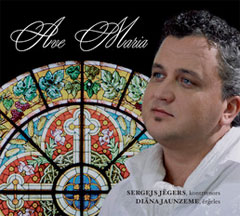
Sergejs Jēgers, Ave Maria

The latest album from countertenor Sergejs Jēgers is Ave Maria.
Egils Kaljo is an American-born Latvian from the New York area . Kaljo began listening to Latvian music as soon as he was able to put a record on a record player, and still has old Bellacord 78 rpm records lying around somewhere.

Commission clarifies referendum question; absentee ballot requests due Feb. 4

Reacting to concerns that the upcoming referendum on Russian as a second official language was worded unclearly, Latvia’s Central Election Commission has approved a new version that offers greater explanation.

Citizens on Feb. 18 will now be asked to vote par (for) or pret (against) a referendum question that reads, “Vai jūs esat par likumprojekta ‘Grozījumi Latvijas Republikas Satversmē’ pieņemšanu, kas paredz krievu valodai noteikt otras valsts valodas statusu?” (“Are you for adopting the proposed legislation ‘Amendments to the Constitution of the Republic of Latvia’ that would grant Russian the status of the second state language?”).

Previously, the question merely asked if voters were for or against amending the constitution, with no mention of the underlying issue.

The Central Election Commission, meeting in Rīga, voted unanimously Jan. 10 to make the change, according to spokeswoman Kristīna Bērziņa.

The commission’s decision came after the six independent MPs in the Latvian parliament asked for the referendum question to be clearer. They said that as originally worded, the referendum question could lead to citizens becoming confused and voting differently than they intended.

The hot-button language issue has come before voters as a result of an initiative that gathered more than 183,000 signatures from citizens seeking to make Russian a second state language.

Under current wording of the constitution, Latvian is the only official language. The proposed amendments would change five paragraphs, allowing for Russian to also be used. Paragraph 4, which establishes the official language, may only be changed by national referendum.

The election commission also approved creation of two informative posters that will be displayed in voting booths, as well as two television public service announcements, one about the referendum question and one about voting at home for those citizens who for health reasons are unable to make it a polling station.

At least half of all eligible voters, or about 772,000 citizens, would need to vote in favor of the referendum for the amendments to be approved. Political observers have said the referendum most likely will fail. However, a growing number of commentators are arguing that citizens should still participate in the referendum, voting pret to show support for a basic value of the Latvian state.

Voting abroad

Voters abroad who want to participate in the referendum through absentee ballots will have until Feb. 4 to submit applications, the election commission announced Jan. 10.

A total of 21 embassies and honorary consulates around the world will accept the applications, including offices in Australia, Brazil, Canada, Germany, Ireland, Sweden, Russia, the United Kingdom and the United States. A complete list is available for download from the Central Election Commission’s website web.cvk.lv.

An application form and the voter’s current Latvian passport must be submitted to receive an absentee ballot.

On Feb. 18, voters also will be able to vote at a number of polling stations abroad. Polls will be open from 7 a.m. to 10 p.m. local time. The full list of polling stations will become available Jan. 20, according to the election commission.

Andris Straumanis is a special correspondent for and a co-founder of Latvians Online. From 2000–2012 he was editor of the website.

British police distribute poster as probe continues in teen’s murder

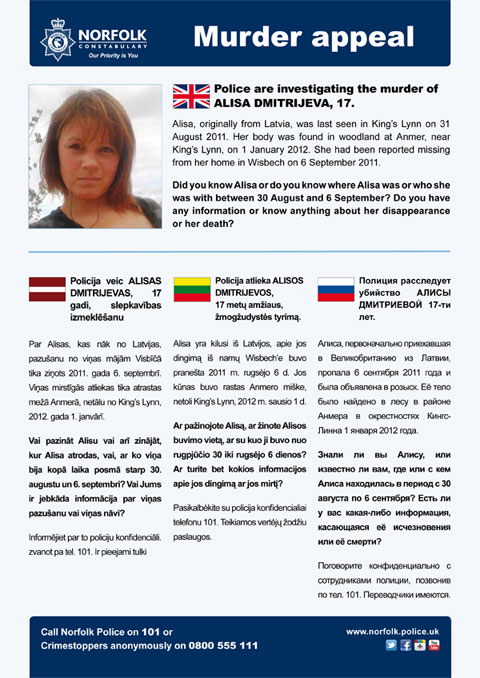
British police are distributing posters in four languages, including Latvian, as they seek information into the murder of 17-year-old Alisa Dmitrijeva, whose body was found New Year’s Day on the royal family’s Sandringham Estate northeast of London.

Police confirmed Jan. 8 that the body, which may have been in place for up to four months, is that of Dmitrijeva. The young woman, who was born in Latvia and moved with her family to Great Britain in 2009, was last seen alive in late August.

Detective Chief Inspector Jes Fry, head of the Joint Norfolk and Suffolk Major Investigation Team, said he hopes people from within Eastern European communities in King’s Lynn and Wisbech may be able to assist.

“Alisa socialised within her own ethnic community and so those people may remember seeing her in the timeframe we’re looking at, between midday on Tuesday, 30 August, 2011, and midnight on Tuesday, 6 September, 2011, or may have heard something about her disappearance and death,” Fry said in a press release from the Norfolk Constabulatory.

The posters were issued Jan. 10.

“We have access to a language line and interpreters who can help anyone calling Norfolk Constabulary,” Fry added.

Anyone with information about Dmitrijeva’s disappearance and death may contact the Joint Norfolk and Suffolk Major Investigation Team at Norfolk Constabulary on +44 01953 424242, or Crimestoppers UK at +41 800 555 111.

Dmitrijeva poster

Police in Great Britain are distributing a poster printed in four languages, including Latvian, as they seek clues in the murder of Alisa Dmitrijeva.