Court allows Feb. 18 referendum, but will consider law’s constitutionality

The Constitutional Court will take up a case questioning aspects of Latvia’s initiative and referendum law, but it will not stop the Feb. 18 vote that could make Russian the country’s second official language.

After Jan. 20 deliberations in Rīga, justices decided to leave the referendum in place, a move that President Andris Bērziņs called correct and historic. Proponents of the referendum, led by Vladimirs Lindermans of the pro-Russian Dzimtā valoda (Native Language) organization, had threatened street protests if the vote was canceled.

Thirty members of the parliament, led by the right-wing National Alliance (Nacionālā apvienība “Visu Latvijai!” – “Tēvzemei un Brīvībai/LNNK”), on Jan. 12 asked the court to stop the referendum and consider the constitutionality of two paragraphs in the law.

“It is self-explanatory that we are seeking to eliminate shortcomings in the law that have led us to the point where doubt is cast on the basic values of the nation and its people,” Justice Minister Gaidis Bērziņš, a member of the National Alliance, said in a Jan. 12 press release.

If passed, the referendum would force adoption of five amendments to the constitution, giving Russian equal status to Latvian as an official language.

Although political observers have said the referendum has little chance of passing, opponents argue that it will be a test of Latvian unity in the face of those who seek to destabilize the country. Proponents—including Rīga Mayor Nils Ušakovs, an ethnic Russian—argue the referendum is really a vote on the economic and social policies of the national government.

While the court will look into the legitimacy of the initiative and referendum law, justices also ruled that the constitution does not grant them the right to interfere in the legislative process. For that reason, they will not stop the Feb. 18 vote, court spokeswoman Līga Pauliņa said in a press release.

National Alliance leader Raivis Dzintars said his party will respect the court’s decision. He called on citizens to go to the polls and vote against the referendum, according to party Press Secretary Ieva Līne.

“The National Alliance has done all it can, to put an end to ideas about bilingualism in Latvia,” Dzintars said in a press release. “After today’s decision by the Constitutional Court we see that we have not been able to do so alone. Now everyone must participate in the planned referendum and vote against Russification.”

The Constitutional Court has set a deadline of June 20 for preparing the case, after which a hearing date would be set.
Andris Straumanis is a special correspondent for and a co-founder of Latvians Online. From 2000–2012 he was editor of the website.

Barikadopēdija details history of Latvia’s steps to renewed freedom

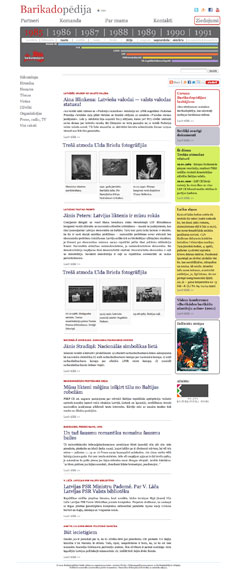
Barikadopēdija, an online encyclopedia examining the history of the barricades movement in Latvia, opened Jan. 19 at www.barikadopedija.lv.

The Latvian-language site is built as a Wiki. Members of the public eventually will be able to add their memories to the collection of text, photographs, audio and video material, according to the website.

Led by Editor Andrejs Cīrulis, Barikadopēdija provides a timeline-driven look into the Third National Awakening period of the late 1980s and early 1990s that led to the restoration of independent Latvia. The barricades, set up by civilians in January 1991 in Rīga and other cities to defend institutions from feared attacks by Soviet forces, were part of a broader indpendence movement.

Latvia formally broke away from the Soviet Union in August 1991.

The Barikadopēdija site features an interactive timeline stretching from 1985-1991. As users click on specific months, they reveal details on important events in the independence movement. Unfortunately, on a smaller computer screen some of the longer lists are cut off at the bottom.

A navigation menu allows readers to drill down for further details about specific categories from aviācija (aviation) to žurnālistika (journalism); themes, such as the activities of Latvians abroad; places; individuals; and organizations. For now, the details come mostly from articles in the Latvian press of the period.

Among material already available on the site are photographs of the independence movement by noted Latvian photojournalist Uldis Briedis, as well as video from a January 2011 conference on memories of barricades participants, during which Cīrulis first talked about the idea for Barikadopēdija.

In the near future material also will be available in English and Russian, Eduards Cauna, the site’s development director, told Latvians Online in an email.

Barikadopēdija is supported by the Barikadopēdijas fonds, which is seeking donations for its work to continue.

Barikadopēdija

The Barikadopēdija site provides information on the history of Latvia’s renewed independence.

Andris Straumanis is a special correspondent for and a co-founder of Latvians Online. From 2000–2012 he was editor of the website.

Census reveals population plunge, but greater proportion of Latvians

Latvia’s population plunged 13 percent during the first decade of this century and stood at less than 2.068 million last March, according to provisional results of the census announced Jan. 18. The census counted how many people were living in Latvia on March 1, 2011.

Meanwhile, the proportion of ethnic Latvians in the population rose to 62.1 percent, according to data released by the Central Statistical Bureau in Rīga. In the 1935 census, ethnic Latvians accounted for 75 percent of the population.

The loss of population is attributed to a low birth rate, meaning that not enough children are being born to replace persons who die, as well as to emigration. According to the census, 119,000 of the lost population is due to the birth rate, while emigration is responsible for 190,000.

The province of Latgale, in eastern Latvia, saw the greatest population decline—21.1 percent—followed by Vidzeme with a loss of 17.5 percent. However, the region around the capital city of Rīga saw a population increase of 3.2 percent.

All of Latvia’s major cities lost population, the census reveals. Daugavpils lost the most: 19.3 percent, or almost a fifth of its residents.

The greatest decrease in ethnic population has been among Russians. Almost 147,000 fewer ethnic Russians lived in Latvia in 2011 than in 2000, a decline of 20.8 percent. Ethnic Latvians decreased by about 86,500, or 6.3 percent.

However, some smaller ethnic groups have seen even more significant declines relative to their numbers. Belarussians, for example, saw their population decline by nearly 29,000 from 2000-2011, representing an almost 30 percent drop. The Ukrainian population dipped more than 28 percent to a total of 45,699.

The population of ethnic Jews, which now is just 6,416, dropped by more than 38 percent.

More than 170 different ethnic groups live in Latvia, according to the Central Statistical Bureau.

Other census findings highlighted by the statistical bureau include:

  • The proportion of men to women has decreased. Women now make up 54.2 percent of the population, while men make up 45.8 percent. The least amount of men are found in the Cēsis district, where they account for 44.9 percent of the population.
  • Latvia is trending older. The proportion of people age 62 or older is 21.8 percent, 3.5 points higher than in the 2000 census. Children to age 14 make up 14.1 percent, or 4 points lower.
  • Citizens now make up 83.8 percent of the population, up from 74.5 percent in 2000. Noncitizens number 290,660, accounting for 14.1 percent of the population. Foreigners living in Latvia account for 2.1 percent of the population.
  • Persons with higher education now make up 23 percent of those age 15 and older, compared to 13.9 percent in 2000.
  • A total of 57.5 percent of people age 15 or older are economically active, meaning they are part of the labor pool.
  • Latvia has 1.023 million housing units. Of those, 68.8 percent are apartment buildings, 28.9 are individual houses, 1 percent are semi-detached houses and 0.6 percent are row houses.

Census data were gathered from March 1 through June 10. Information about 30 percent of the population was gathered during the first 12 days of the census, when for the first time people could complete questionnaires online.

Andris Straumanis is a special correspondent for and a co-founder of Latvians Online. From 2000–2012 he was editor of the website.