Son’s music tribute is good, mixed bag

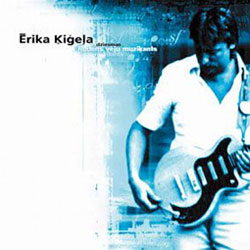
On Rudens vēju muzikants Feliks Ķiģelis, the son of the late Latvian rock composer Ēriks Ķiģelis, brings together an all-star group of Latvian musicians to pay tribute to his father and his music.

Ēriks Ķiģelis was the guiding light behind the famous Latvian rock group Līvi. Up until his untimely death in 1985, he was the main composer for the band. His musical talent is apparent in many well-known Latvian songs including “Zīlīte”, “Saldus saule”, “Aprīļa pilieni” and “Kurzemei – Saules ceļš”—a song that, although he did not live to see it completed, was finished and presented on 1988’s self-titled Līvi album.

Ēriks was a great influence on many Latvian acts. Not only can his spirit still be found in the recent records of Līvi, but, judging by the varied performers found on the Rudens vēju muzikants collection, he has influenced many other rock and pop performers. Famous names such as Igo, Gvīdo Linga, Guntars Račs and past and present members of Līvi have come together to pay tribute to Ēriks and his music. The testimonials from many famous Latvian names contained in the compact disc booklet attest to his great influence. It was a great loss to Latvian rock music when he died.

However, this is not the first tribute record to Ēriks Ķiģelis. The 1997 Līvi album Bailes par ziņģēm was dedicated to his memory and included many re-recordings of Ēriks’ songs. It would seem inevitable that Rudens vēju muzikants would inspire comparisons to Bailes par ziņģem as there are five songs that can be found on each record.

I have heard very little of Ēriks Ķiģelis’ original works. The only song that I have heard the original version of was “Zīlīte,” included on the Mikrofons 1982 collection, so I am unable to compare these versions to the originals (except for the posthumously recorded and released “Kurzemei – Saules ceļš”). Hopefully this record will generate enough interest in Ķiģelis that MICREC can dig into its vaults and re-release all of the old recordings by Ēriks, since as far as I am aware, they are not available anywhere. That’s a shame, because by listening to the songs on Rudens vēju muzikants one can tell that Ēriks was a great musician and songwriter who was taken away too quickly.

As with many of the Latvian compilation and collection CDs, the results are a mixed bag. While there are many strong tracks, there also are tracks that do not live up to expectations. However, there are enough songs on the album to make it a worthwhile purchase to those unfamiliar with Ēriks Ķiģelis and his work.

Rudens vēju muzikants starts off with a rousing instrumental—“Mazais sapnītis”—which teams up Feliks Ķiģelis with current Līvi guitarist Ainars Grodums, who makes many appearances on the album. On “Mazais sapnītis,” as well as every song on the album, Feliks plays guitar.

Gvīdo Linga adds his vocal talents to “Elektriskā zivs,” which is followed by Igo taking over the vocal responsibilities on “Istabā tumsā” (with distorted vocal effects, no less!). “Zušu sziesma,” featuring Māris Žigats on vocals, is one of the weaker entries on the album, as it tries a funkier approach to the song, but the desired effect is not achieved—and the vocals are nothing special.

The strongest track on the album is “Deviņvīru spēks”—which is one of the sections of the previously mentioned Līvi epic “Kurzemei – Saules ceļš.” Aivars Brize, the ex-lead singer for Līvi, as well as the original vocalist for the song, returns to replay the piece in all of its original heavy glory. This time, the song is given an electronic feel, which strengthens it and perhaps makes it superior to the original recording. “Deviņvīru spēks” is one of my favorite Līvi songs, mainly due to the great guitar part, as well as the great riff that opens up the song.

Another Līvi member, current guitarist and lead singer Ainars Virga, returns to sing (well, growl would be the better word!) and play bass guitar on the song “Durvis,” another less memorable track on the collection. “Svētelis,” one of my favorite Ķiģelis songs, is assisted by Inguss Ulmanis on vocals and by Guntars Račs, famous Latvian producer, on drums, who also appears on “Zīlīte,” the next track. “Zīlīte” is the only song on the album that features a female vocalist, Agnese. Her vocals add greatly to the song and make “Zīlīte” another standout track on the album.

Zigfrīds Muktupāvels appears on “Kurzeme,” which, although a good song, does not really differ from the original much. Gunārs Kalniņš appears on the song “Kursas putni,” and Feliks Ķiģelis himself takes over vocal duties on my all-time favorite Ēriks Ķiģelis song, “Saldus saule.” Though Feliks has a great voice, the rather slow tempo he takes with the song gives it a plodding feel.

The verdict? Well, I believe Bailes par ziņģēm is the stronger record and perhaps a better introduction to the works of Ēriks Ķiģelis. However, hearing other artists’ interpretations of Ēriks’ works is worthwhile. It would have been nice to have the song lyrics as well. For those who might have heard and enjoyed Bailes par ziņģēm, I would recommend this record. I would also recommend this record for those who enjoy Latvian rock music, as it is a solid effort, though not very memorable.

Details

Rudens vēju muzikants

Ēriks Ķiģelis

MICREC,  1999

Egils Kaljo is an American-born Latvian from the New York area . Kaljo began listening to Latvian music as soon as he was able to put a record on a record player, and still has old Bellacord 78 rpm records lying around somewhere.

Labvēlīgais Tips offers 17 songs on ‘best of’ album

Tipa labākās dziesmas

It was late one Jāņi (or was it really early?) several years ago. The Latvian-Americans around the bonfire were beginning to dwindle, their steady offering of folk songs interrupted by longer and longer spells of silence. All at once, a group of Latvians from Latvia broke into a sloppy rendition of “Vecpiebalgas cūku māte,” a favorite song from the 1995 Alumīnija cūka album by the pop jokers Labvēlīgais Tips. I’ve always liked that song. It’s among the songs I wish the group had put on Tipa labākās dziesmas, released this past April.

Labvēlīgais Tips has managed to find an audience in Latvia that each year awaits April 1, when—in the spirit of the day—the group has released its new album. I suppose it’s only fitting that in this fifth year the group would offer a “best of” album. Surprisingly, Labvēlīgais Tips isn’t as well known among Latvians in North America. Perhaps it’s because the group has never toured Latvian colonies here. Perhaps it’s because the group is a post-1991 phenomenon, while some Latvians on this side of the Atlantic still only have memories of Jauns Mēness, Jumprava and Pērkons. Perhaps it’s because a certain amount of the group’s material takes a somewhat sardonic view of life in Latvia, often seeming like a “you had to be there” joke.

I suppose the same could be said of Čikāgas piecīši. A Latvian from Latvia might have difficulty understanding the cultural relevance of the piecīši. For us, it just makes sense because we’ve lived it.

And it’s that difference that makes Labvēlīgais Tips so welcome. The group performs songs that, even for someone not well-acquainted with daily life in Latvia, provide a window into the ironies of existence. Songs such as “Pumpa,” about a man’s troubles with a pimple on his rear end, are prima facie funny, but also are a sad commentary on life. The main character in the group’s songs often seems to be the schlemiel, in other words, you or me.

Western listeners might better understand a song such as “Mans brālis Čikāgā,” sung from the perspective of a Latvian in exile who laments not being in the homeland, but questioning whether it’s not all for the best, given conditions in Latvia today. The lyrics make one stop and think—and I wish Labvēlīgais Tips would perform more such songs.

All but three of the 17 songs on Tipa labākās dziesmas were originally heard on the four earlier albums, Alumīnija cūka (1995), Pilots Antons Šmits (1996), Pumpa (1997) and Tā, lūk, man iet (1998). Taken from Alumīnija cūka are “Alumīnija cūka,” “Džins ar toniku”, “Koki,” “Lodziņš” and the popular “Zivis.” From Pilots Antons Šmits we get “Omnibuss” and “Aija” (renamed from the original “Aijai”). From Pumpa come “Atlantīda,” “Mans brālis Čikāgā,” “Pumpa” and “Šī nav tā dziesma.” And from Tā, lūk, man iet there are “Desmitais tramvajs,” “Princese un Cūkuģīmis” and “Tā, lūk, man iet.” Three songs—“Tu saki Jā,” “Kas tā dara” and “Lai”—are new.

Musically, Labvēlīgais Tips seems at home in the pop genre, but floats easily into schlager, rock and a few other musical forms—whatever suits the mood. At the core of the group is Andris Freidenfelds, who also is known as a morning disc jockey on Radio SWH.

If you’re familiar with the originals, you’ll soon appreciate that the “best of” versions are not just lifted from old masters. Instead, these are new recordings, often adding new sounds or twists.

In an interview with the daily newspaper Neatkarīgā Rīta Avīze shortly after the album appeared, Elita Mīlgrāve, director of the MICREC record company, suggested that the popularity of Labvēlīgais Tips comes from the good-natured humor of their songs. She suggests that the songs don’t have a deep subtext, nor are they meant to be. One could argue, however, that Labvēlīgais Tips has struck a chord that resonates in listeners precisely because their songs sometimes don’t need much thought to understand. They are songs to which a listener could easily answer: “Ain’t that the truth!” But perhaps that’s over-analyzing Labvēlīgais Tips.

Details

Tipa labākās dziesmas

Labvēlīgais Tips

MICREC,  1999

MRCD 112

Andris Straumanis is a special correspondent for and a co-founder of Latvians Online. From 2000–2012 he was editor of the website.

Running as fast as they can

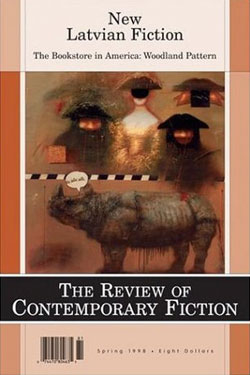
New Latvian Fiction

Latvian writers have spent much of the 20th century in their own or in Soviet company, cut off from Western literary developments. Now they are catching up with a vengeance, as demonstrated in "New Latvian Fiction," an issue of The Review of Contemporary Fiction produced with the support of Soros Foundation Latvia.

Reading this volume (meticulously guest edited by Nora Ikstēna and Rita Laima Krieviņa) is a bit like a jog with the Red Queen in Alice in Wonderland—a breathless, exhilarating and sometimes confusing experience.

Some stories can be completely understood only from within the culture; Pauls Bankovskis’ "The Week of Golden Silence," for example, hinges on a children’s rhyme that loses something in the translation. The story portrays love as a child’s game; a bet of silence leads to the realization by two lovers that, really, "There’s nothing to say."

Several authors are engaged in late-blooming love affairs with post-modern literary techniques. In "Beckett is Alive: Texts to Myself," Guntis Berelis speculates on knowledge and reality: "If we assume that Beckett isn’t dead then we can never be completely convinced that he isn’t dying at this very moment … Beckett is continually dying." Aivars Ozoliņš’ "Tale No. 13" is a playful and ultimately exhausting set of variations on a story; literature is a game to this author, who claims that words "have a hollow centre." Jānis Vēveris takes it one step further—his story "Eventide" begins as poetic stream of consciousness but ultimately turns on itself and on its narrator, telling him that his cleverness and facility are merely the failure of his art.

Other stories have a deep and sensual connection to the real, as opposed to the literary, world. Andra Neiberga’s "Summer Log (The Zone)" is a slow, quiet meditation on the city and the country, encompassing the death of the village and of rural life in Latvia: "In the city my soul runs a chronic high fever and has an irregular pulse," while "in the countryside there is no fear of death." An excerpt from Gundega Repše’s "Stigmata" appears to be a realistic story told through the dialogue of argumentative travellers; it acquires mythological overtones in the course of their journey to what may be the end of the world. God becomes a fellow traveller—the ambivalent and sometimes irrational God of the dainas who is not necessarily in a position to help: "You’re old and tired, Your knees are made of shadows and Your hair is made of twilight, Your chest is the desert and Your genitals have dried up…You tyrant of chaos, You old elephant…"

Dream and reality mix in Aija Lace’s "The Stairs," which recounts how a woman’s refusal, in childhood, to follow a dream leads to its malignant opposite in later life, and perhaps to death. In "Pleasures of the Saints" by Nora Ikstena, the two lovers Theresa and Augustine, two raindrops in a round bed, tell each other their dreams. Martins Zelmenis’ story "Storm Approaching" is a day in the life and also a life in a day; the details of a farm woman’s life fuse with the larger elements of myth and folklore.

"The Flying Fish" by Rimants Ziedonis (son of the poet Imants Ziedonis) is a mischievous skein of literary invention that defies description. At the outer fringe of fantasy, Arvis Kolmanis’ "Veronica, the Schoolgirl" takes place in some future or parallel Latvia where men carry vaguely illicit "motors" in their pockets and women form what seem to be sexual liaisons with white slug-like organisms called "Sophias."

These stories demonstrate a characteristically Latvian love of the unexpected simile, of the metaphor that delights. Among the most artfully deployed are those of Jānis Einfelds, who is a sort of enfant terrible of Latvian letters. His stories—"Cucumber Aria," "The Wonderful Bird," "Fate," "Etude with a Bullet," "Nice Guy Moon" and "Dundega Mornings"—are reminiscent of the blunt grace of Aleksandrs Čaks, their random brutalities overlaying a bitter romance.

To several authors, words themselves have become suspect. Bankovskis alleges that "talking makes no sense anyway; a person can only harm himself by uttering words, because in response he is barraged by a reciprocal flood of words that literally knock him to the ground." Have Latvians found their own words only to abandon them so quickly? Fortunately there seems to be no ebb in the flow of words coming from Latvian writers, and the stories that claim to distrust words are by no means the shortest in this invigorating collection.

(Editor’s note: This article originally appeared on the SVEIKS.com site.)

Details

New Latvian Fiction

O’Brien, John, ed.

The Review of Contemporary Fiction,  1998

ISBN 156478178X