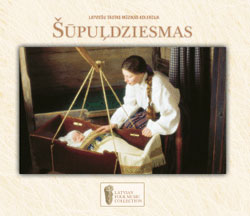
This album will put you to sleep

Šūpuļdziesmas

After a visit from his grandparents, many sugary foods and being cooped up in the house for a long, rainy afternoon, our two-year-old was definitely overstimulated. He was having a tantrum just as I put this compact disc in to listen to for the first time. By the third or fourth song, he had quieted down and was playing and babbling by himself. I like to think it was this music that calmed him. And it really might have been. After all, these are lullabies, time-tested melodies that are specifically meant to calm a baby.

The first song on this newest album in the Latvian Folk Music Collection, Šūpuļdziesmas (Lullabies), is slow to develop. But, then, lullabies are supposed to put you to sleep, aren’t they? I don’t mean that as a criticism—actually, I think this is a beautiful recording! This album is produced by Ilga Reizniece and Māris Muktupāvels, both of the post-folklore group Iļģi. Although Iļģi have moved on to much more modern and upbeat renderings of Latvian folk tunes, this album reminds one of their earliest recordings. It is simple, traditional, meditative and, above all, very calming.

Šūpuļdziesmas sounds very “live”—it often seems like you’re right there on the bed next to the child being sung to. The singers sometimes repeat verses, improvise, hum—just as any mother does when her child has not yet fallen asleep by the end of the song.

Many of the songs are accompanied by only one instrument. A full third of them are sung a capella. A couple of the songs, for example “Aijā, Ancīt’, aijā,” are new arrangements, but most are just simple, straight-forward lullabies. It is, for the most part, not the typical lullaby repertoire that most Latvians in North America heard as young children, but they are all bona fide traditional Latvian melodies and texts. The liner notes tell of the hope that these lesser known lullabies will not take the place of our “old favorites,” but rather inspire us to learn new ones.

The lullabies on this album are sung and accompanied by well-known musicians in the the Latvian folk and folk/rock scene. My favorite is Biruta Ozoliņa, who has a whole album (Bolta eimu) devoted to her music in the Latvian Folk Music Collection. Her voice just seems so perfect for this. She sings, as usual, in the Latgalian dialect. I was happy to hear “Aijā, žūžu, lāča bērni” and “Pele brauc, rati čīkst” sung by men and fathers. When a child’s name is called for in certain lullabies, the singers name their own children, giving the songs a truly personal touch.

My only complaint about this album is the use of the synthesizer on a few of the tracks. It’s fairly inconspicuous on the first and last songs, but I really don’t like the trite New Age feeling of calmness that it is trying to evoke on “Velc, pelīte, bērnam miegu.” It’s a beautiful song, but the accompaniment kind of ruins it.

Interestingly, songs No.1 (”Čuči, guli, mazbērniņš”) and No. 12 (”Čuči, guli, mozi bērni”) are so similar that I had to compare them several times before figuring out that they are two different melodies. No. 1 is in fact a song that Iļģi recorded back in 1987 and 1989. The arrangement, though, has changed a bit. Those older Ilgi recordings of lullabies placed more emphasis on the instruments, and the vocals were more arranged. Their lullabies back then seemed to be arranged more for performance than the Šūpuļdziesmas album.

I tried playing this CD several days later when our son was again in a really irritable mood, this time specifically to see if the music would calm him. And it worked again! This time, about half way through the album, he even said, “Mamma, I want to be in that song.” Wow!

For you Latvians out there, this album will give you some simple, fresh ideas to expand your lullaby repertoire (in case you’re sick of “Aijā, žūžu”). Sing them to your child, your dog, yourself or your significant other.

For everyone else, put this CD in at the end of a long day and just enjoy the relaxing music!

Details

Šūpuļdziesmas

Latviešu tautas mūzikas kolekcija

UPE Recording Co.,  2000

UPE CD 018

It takes a Lett to play the pipes

Recently a superb recording has come out featuring Latvian folk music played on bagpipes. The album, Dūdas Latvijā (Bagpipes in Latvia) sports a picture of a young, bagpiping lad in the arch of castle ruins. It is an excellent compilation of Latvian songs ranging from majestic, energetic and uplifting music to matter-of-fact and haunting pieces. This album is the most recent addition to UPE Recording Co.‘s Latvian Folk Music Collection and is a welcome one. While some may complain that there are no English translations of the songs, something better rewards the reader. It is a wonderful essay, written by world-class ethnomusicologist Valdis Muktupāvels, explaining about bagpipes in Latvia.

Bagpipes always have their majestic appeal; some like them more than others. This fact holds true to the chagrin of bagpipers’ neighbors. Referring to its loudness, one bagpiping enthusiast bluntly put it, “How else can you have something as loud as an electric guitar but with no cord?” Having won an international audience with younger audiences with such groups as Dead Can Dance, this instrument hides its long folk history in Latvia. What has been forgotten is that large numbers of festive bagpipers would congregate, playing through the night on the hills and shores of Latvia

Since this long bagpipe tradition has a vivacious presence still found in Latvia, Dūdas Latvijā is an album that conveys many moods. Near the beginning there’s a nice beer-drinking song with warm-hearted camaraderie, “Alus dziesma” (the Beer song) sung by Vidvuds Mednis and friends. Midway in through this song are some interesting refrains, sounding like the chanting and singing found in American Indian pow-wows. Later music in the album, like in the selections “Vaidi” (performed by Valdis and Māris Muktupāvels) and “Dūdu sauciens” (played by Rasa) transports the listener to other eras. A slow version of “Garais dancis” (Long dance) evokes a stately and majestic promenade of kings and queens. The whole album creates a feeling of movement and energy even in its tenderest, quietest movements, as in the song “Mildas dziesma” sung by Iļģi.

One foggy night in Old Rīga I walked home, having helped close a bar. Snow silently had fallen a few hours earlier and the air had warmed up again, bringing together in springtime a rare snow and fog. Both snow and fog were catching light and creating a soft omnipresent glow. It was in muffled, foggy, early morning air that I first heard the haunting, beautiful sound of bagpipes in Rīga. Two bagpipers, with what I later learned were bagpipes common to Central Europe, played at the base of “Milda,” or the Freedom Monument. They played as a slightly amused police officer and I watched. I could only stand in amazement and observe in admiration. After blurting out how I always wanted to learn the bagpipes, the players gladly introduced me to a third set of bagpipes. It was magical. Consequently I have learned enough about bagpipes to deeply appreciate this smaller cousin of the Scottish bagpipes. I easily hear when bagpipes are used, even in the most unexpected and delicate of songs like “Mildas dziesma” (Milda’s Song) Eventually, I got my own bagpipes and am now trying to slowly relearn music. With that, I should be considered a biased judge in rating this album, but a discerning one all the same.

So, what awaits the audiophile who listens to the whole collection?

Much! One song, “Pīmiņ, brōļ’” near the end of the album impressed me with its brotherly love, sung in the Latgalian dialect. The piece played by Rasa, “Aiz Daugavas vara dārzs,”; at first sounds like medieval music brilliantly coming alive and it then carries through with a delightful melody that can happily stick in one’s ear. Towards the end of the CD there is a collection of songs that convey a type of sentiment and emotion that only bagpipes can, a contemplative, yet fierce awareness. In the beginning there’s a playful, carnival, festive feel heard in “Dūdu sauciens.” A summer ball held in the fields with its own homespun music is conjured up from “Dūdu balss un zaglis” (Bagpipes’ Voice and Thief). The hypnotic song “Dūdas balss” (The voice of the bagpipe ), played by Grodi, feels mysterious and seems almost Arabic. It could be like what one might hear for the music inside a sheik’s tent where he was being served his pleasure. Contrasting that song’s sultry feel, we hear a cheerful chorus sing in “Ai, dū makaidū.”

Bagpipes can voice a heavy, foreboding and ponderous message that can put off some people. Yet bagpiping can vary and create expressions of joy, beauty, freedom and wildness. Dūdas Latvijā does this. The songs on this album create a warm, energetic air, good for a gathering of friends. While heard at keg parties or at funerals or at parades, the best bagpipe music is what you can play at home and with friends. This album does this and so much more. Dūdas Latvijā gets a “two thumbs up” in my judgment.

Details

Dūdas Latvijā

Latviešu tautas mūzikas kolekcija

UPE Recording Co.,  2000

UPE CD 017

Done with Latvia, Berzins tries murder

Death in the Glebe

On the second day of spring a body is found, rolled up in a blood-soaked rug and stuffed behind the boiler of a run-down apartment building. It is identified as the body of Ida Tepper, an eccentric and vain woman who spent the previous day on frivolous pursuits: "If Ida Tepper weren’t so rich, she’d be locked up," her hairstylist said when she arrived for her appointment. Ida Tepper felt no presentiment of disaster; in fact, she was buoyed by the sense of a new life beginning. And, in a way, it was.

Death in the Glebe is set in a fashionable area of Ottawa. Inhabitants of the Glebe, we are told, are willing to pay exhorbitant rents to live there, even in mansions-become-tenements like Hardon Hall, where the body is discovered. The tenants of Hardon Hall are an unsavoury lot. From the top floor, where "slum landlord extraordinaire" Kevin Hardon abuses drugs and his wife, to the basement, where various street people and petty criminals hide from the light, the layers of Canadian society are stacked in order of importance.

None of these characters are sentimentalized—if anything, they are so unsavoury as to be off-putting. Readers of Ilze Berzins’ previous book, the autobiographical Happy Girl, will recognize the moral relativism that does not render any of her characters fully sympathetic. All of them, from Jerry, the seedy caretaker, to Robert, Ida Tepper’s resentful gigolo, have their own agendas; several have reason to wish Ida dead. The women are more favourably portrayed than the men, though they tend toward victimhood of one kind or another. The most likeable character is a pet-loving artist named Doreen, who attracts the romantic interest of one of the detectives assigned to the case. Doreen’s boyfriend has recently left her for another woman; devastated, she takes refuge in her painting, concluding that Art and the company of dogs are more sustaining than human relations.

Death in the Glebe follows the conventions of the murder mystery, though the solution of the puzzle is disappointing in its dependence upon a botched autopsy and the inability of the police to locate a bloody murder scene in the very building in which it was committed. It is depressing enough to imagine that such things may happen with regularity in the real world; it is one of the hopeful conventions of detective novels that they do not. The outcome, which is inventive, should not hang on such unsatisfying devices.

Justice, if it can be said to be done, is approximate, and a broad strain of social satire runs through Death in the Glebe. "Money creates justice," Detective Barry Mullins says soon after the discovery of the body. He knows that the murder of a wealthy woman will remain central until the perpetrator is found, while the unsolved murders of the powerless will be forgotten. There is no expectation of justice for crimes committed against the socially insignificant. Petty criminals can slide away out of sight, confident that the police will not find it worthwhile to pursue them. Special barbs are reserved for cults that prey upon the needs and neuroses of their followers, seemingly impervious to police intervention.

The episodic structure of Death in the Glebe is similar to that of television crime shows and, while this gives the story a certain momentum, it can be disorienting until the many characters are sorted out. In spite of its deficiencies, the story progresses with unflagging energy, and the broad and sometimes maliciously drawn characters do eventually overcome their own sketchiness. The book succeeds best in being wildly personal, as the thoughts and prejudices of the author are never far from the surface.

This is a portrait of a society in which money and status determine all. Only money can afford protection to women, and single women without it are particularly vulnerable. Even those with money and position, like the unfortunate Ida Tepper, may find themselves vulnerable in unexpected ways.

(Editor’s note: This article originally appeared on the SVEIKS.com site.)

Details

Death in the Glebe

Ilze Berzins

Halifax, Nova Scotia:  Albert Street Press,  1999

ISBN 0-9686502-1-X