Mielavs frustrates, but holds out hope

Es nāku uz Taviem smiekliem

Every time listening to this album, I am reminded of a January afternoon in Old Rīga, sitting across a cafe table from Ainars Mielavs. He seemed uncomfortable in the role of interview subject, even though the interview was not about him but about his recording company. I left frustrated because Mielavs had not opened up more, but I was just as frustrated with myself, wishing I had posed my questions differently. Yet I also felt empathy. And so it goes with this album: frustration with Mielavs, frustration with myself, but with a sense that I know what he’s singing about.

Es nāku uz Taviem smiekliem (I Come in Response to Your Laughter) is Mielavs’ debut solo effort. This is Mielavs without the folk-rock influence of Jauns Mēness and without the masterful compositional hand of Imants Kalniņš, with whom he has released three albums. Es nāku is a showcase for Mielavs’ lyrical talent—it is a remarkable one—and for his musical skills, although he does get a hand from guitarist Gints Sola, who carries the brunt of the instrumental work on most of the tracks.

Almost all of these are love songs. They are presented in a variety of musical styles, from blues to jazz to pop. Several are painful yet optimistic love songs that dig into the relationship between two people. For example, the first track, "Labradors" (Labrador), tells of a volatile, crumbling relationship and a man’s hopeful search for his beloved’s conscience: "The walls collapsed in hatred / With dampened emotions / And all the ordinary days / Became the best of days."

These also are simple songs, with direct, strong imagery in the lyrics and—in most cases—a minimal musical underlayment.

It is this simplicity that in part leads to frustration. Mielavs in his lyrics relies often on lists of similes, of opposing thoughts, or just things. He’s done this in the past with Jauns Mēness songs, and does it here on at least five of the 12 tracks. For example, there’s "Dvēselu noliktava" (Warehouse of Souls), which has lines such as "Fame is a net which entangles / Fame is 100 proof rum / Fame is thin air on which to climb / Fame is an overthrow of values." And in "Visvairāk un vismazāk" (The Most and the Least), we have verses such as "There are books that I read the most / There are weaknesses I reveal the most / There are hopes I believe in the most / There are people I feel the most." It’s a simple and often effective songwriting technique, but when the technique begins to overpower the lyrics, perhaps it’s time to explore other forms. How about a ballad, Ainar?

Mielavs also often repeats verses, as if he were telling the audience, "Listen carefully to what I just said." In songs such as "Es izvēlos būt" (I Choose to Be), the technique at times left me thinking that additional lyrics could have been just as helpful, but at other times found me listening intently.

Musically this album has Mielavs’ voice supported on most tracks by unembellished, controlled guitar work, with an occasional banjo or mandolin. But again, too much simplicity can be frustrating. If Mielavs isn’t going to explode, at least the guitar could! Fortunately, the album is fairly well-paced. The first two melancholy tracks, "Labradors" and "Es nāku uz Taviem smiekliem" are followed by a slightly uptempo "Par un pret" (For and Against). And all the tracks seem to build toward the big finish that is the final song.

The final track, "On My Way to the Big Light," is the only song in English. Written by Mike Scott, the Scottish-born singer known for his work with The Waterboys, it is performed by Scott and Mielavs. It’s an uplifting tune, somewhat out of synch with the rest of the tracks, but nonetheless appropriate with its chorus of "All love to the Love / All flame to fire / All wings to the wind / All that lives, higher!"

The album as a whole is frustrating, but I find that it keeps digging into me—and that’s frustrating, too. My favorite tracks have become "Labradors," "Es nāku uz Taviem smiekliem," "Visvairāk un vismazāk," and "Tavu acu augstumā" (On the Level of Your Eyes), which is a gentle song, it seems, about a short woman.

This is a collection of songs that demands a careful ear, that requires listening again and again to understand fully. More so than other recent Latvian recordings, this album asks the listener to think about their own experiences in life. And the more I listen, the more I understand.

A final note: UPE has been doing a nice job with liner notes on all its recent releases, and this album is no exception. Lyrics are included in Latvian and English, with some of the translation done by Mielavs’ friend and Latvia’s former ambassador to the United States, Ojārs Kalniņš.

Details

Es nāku uz Taviem smiekliem

Ainars Mielavs

UPE Recording Co.,  2000

UPE CD 015
Andris Straumanis is a special correspondent for and a co-founder of Latvians Online. From 2000–2012 he was editor of the website.

Choir’s recording highlights Rīga venues

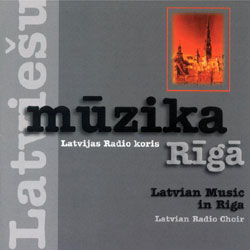
Latviešu mūzika Rīgā

Latvians call themselves a "singing people." Wherever Latvians gather, a choir is inevitably formed! While the musical ability of many amateur choirs is admirably high, elite and professional ensembles also have an important role in inspiring and performing more difficult and challenging music and presenting Latvian music internationally.

Prominent among these is the Latvian Radio Choir. Established in 1940, it was dubbed the "Teodors Kalniņš Choir" during the latter period of the Soviet occupation in honor of its founder, but since Latvia’s return to independence has again been known by its original name. A flexible ensemble ranging from five to 90 singers allows them to perform music of many styles and eras. The singers’ professional ability and the talented leadership of Sigvards Kļava have raised them to a remarkable level of virtuosity and skill. A prominent Latvian composer recently told me this is the only choir in Latvia currently capable of properly performing this composer’s very difficult vocal music.

The particular interest and value of this new recording, Latviešu mūzika Rīgā, is that it mostly features recent music the average listener wouldn’t usually seek out or encounter. Even "A Birch in Autumn," by the "old master" Jāzeps Vītols, is not among his most frequently performed works. An ethereal, subtle nature evocation, it’s beautifully rendered here with sensitive vocal blending by the Chamber Singers of the Latvian Radio Choir. Ably conducted by Kaspars Putniņš, this ensemble also performs two other works. Pēteris Plaķīdis’ brief setting of the traditional Latin text "Domine salvum fac populum" (Lord, Save Thy People) is propelled to its conclusion by an effective use of repeated figures. In Romualds Kalsons’ harmonically imaginative "In the Sounding Hill," the choir vividly portrays repeated echoes.

Artistic Director Sigvards Kļava leads the full choir in the rest of the program, most of which is also of a spiritual nature. For me, the most impressive discovery was Maija Einfelde’s "Psalm 15." This powerfully expressive setting subtly builds dense dissonances resolving in calmer, more peaceful passages. This is uncompromising, sincere music of harsh beauty. Juris Ābols offers an impassioned setting of "Ave Regina coelorum" (Hail, Queen of Heaven). The "Agnus Dei" from Artūrs Maskats’ "Mass" forms an emotional arch, from a peaceful beginning, building to a dramatic organ passage, then subsiding to a calm conclusion. Andris Dzenītis is the youngest composer represented here (born in 1978), in a lengthy, intense, often anguished setting of "Ave Maria."

St. Francis of Assisi’s writings inspired Pauls Dambis to compose his cycle, "Canti Francescani," from which two sections are heard. In "A Prayer," alternating soprano and baritone soloists’ chantlike passages elicit choral responses. Repeated cries of "psallite" are prominent in "A Song for Sister Death." Pēteris Vasks has come to be contemporary Latvian music’s best-known exponent internationally. The beauty and radiance of his "Dona nobis pacem" never fail to carry the listener along. Aivars Kalējs accompanies impeccably on the organ.

Two secular works fill out the program. Though Imants Kalniņš is known as "the people’s composer," his music never condescends. His special talent for making fresh and imaginative use of simple ideas is effectively heard in "Cinderella." Juris Karlsons’ brief "My Song" is a lovely, engaging piece, sounding "Latvian" (at least to another Latvian) without retreading old formulas.

Another interesting aspect of this release is that every composer’s music was recorded in a different venue in Rīga: churches, university and museum halls, and a recording studio. Not only do the locales sound acoustically splendid and well-suited to the music, but the engineering is remarkably consistent, so there is no jarring change from one acoustic environment to another. The artistically handsome accompanying booklet is filled with photographs of the various locales with interesting historical information. Notes are in Latvian and excellent English, though the latter is sometimes not idiomatic. One other minor caveat: Latin pronounciation is sometimes irritatingly "Latvianized."

This is a magnificent production worthy of the widest dissemination and exposure. Hats off to Kļava for his brilliant conducting and sensitive interpretations, and to the choir for their skill and artistry. Though much of this program is challenging and intense, requiring thoughtful listening with receptive ears and an open mind, it is definitely not a compilation of avant-garde gimmicks or polemics. Latvian composers are clearly aware of international musical trends and techniques in addition to local traditions and practices, and have transcended both to produce music of substance and variety, with both emotional and intellectual appeal.

(Editor’s note: This article originally appeared on SVEIKS.com.)

Details

Latviešu mūzika Rīgā

Latvijas Radio koris

Latvian Radio,  1999

Experience is key to Toronto festival

While there’s always something to criticize if you’re Latvian, most early reviews of the recent 11th Latvian Song Festival in Canada have been favorable. And, according to the man who led the festival’s organizing committee, it is Toronto’s long experience that helped make the Canada Day weekend (June 30-July 3) a success for an estimated 5,000 participants and spectators.

Arvīds Purvs, chair of the committee and one of the conductors during the large choir concert, should know: He’s been involved with the Toronto song festivals since 1959 on both the administrative and artistic sides.

“Toronto is the largest Latvian center…and the other smaller Latvian centers are around Toronto: Hamilton, London, St. Catherine’s, Niagara,” Purvs noted. Plus, Toronto has the facilities for large-scale events.

Toronto’s experience has evolved into a formula that appears to work, Purvs said. He said he doesn’t see the need to change much in the way things are done.

Several events during this year’s festival were sold out and had people talking about the performances. Among the highlights:

  • The chamber choir concert, featuring performances by well-known artists from Latvia (such as Dita Kalniņa and Arvīds Klišāns) as well as from the North American Latvian community (such as Rasma Lielmane, Artūrs Ozoliņš and Pēteris Zariņš).
  • The three-day run of "Minhauzena precības," a play by the late Mārtiņš Zīverts directed by Gunārs Vērenieks. Among the actors were Tālivaldis Lasmanis of the Drama Theatre of Valmiera and Mirdza Martinsone of the Dailes Theatre of Rīga.
  • The New Choreography Show in which top honors went to young choreographers Ināra Blatchina and Katrīna Tauriņa of Toronto for their children’s dance, “Vasaras rotaļa”; Iveta Asone of Indianapolis for her dance, “Mūsu pulkā nāc,” designed for fewer than eight pairs of dancers, and Zigurds Miezītis of Toronto for his “Dīžā žīga,” a choreography for eight or more pairs of dancers.
  • The spiritual music concert, featuring the women’s choir Ausma from Latvia as well as a number of choirs from Canada and the United States.

The first song festival in Canada was held in Toronto in 1953, only a few months after Latvians in Chicago organized the first song festival in the United States. And even though the number of Latvians who attend song festivals has dropped in recent years, the Toronto organizers did not question whether a festival should be held this year.

“The biggest unknown is how much the Latvian public is collapsing,” Purvs said in a July 2 interview in the Sheraton Hotel, headquarters for this year’s song festival. “If you look through the Latvian newspapers (in North America), then almost two pages are full of death notices. Those are people who at one time went and sang and danced and attended events, and now they no longer will go.”

Not knowing how many might come to the festival forced the Toronto committee to put together a conservative budget. Initial results, according to Purvs, appeared better than expected.

Profits from this year’s festival probably will not be as great as in years past, when the nonprofit society that runs the song festival in Canada was able to use proceeds to offer scholarships and other funding to Latvian organizations. More likely, any profits will be churned back into financing the next song festival—and Purvs is sure there will be another song festival in four years.

“One of the main reasons (to continue the festivals) is to support the work of choirs and folk dance groups,” Purvs said. “If there’s not a song festival, then the choirs will not be as active, they don’t have a goal.” Of course, he added, choirs and folk dance groups don’t exist just for the festivals, but the festivals do serve as milestones.

Canada’s experience with the song festivals actually goes back to 1952, when the Daugavas Vanagi veterans aid group organized a day of song on Sept. 6, similar to those held in Displaced Persons camps in Europe, according to a history of song festivals written by Valentīns Bērzkalns. About 2,000 people attended the event in Toronto’s Massey Hall.

The first song festival in Canada took place in October 1953. Attendance was in part dampened by the fact that the first festival in Chicago had already taken place in May, according to Bērzkalns’ book. An estimated 3,200 people listened to the joint choir concert, the festival’s main attraction.

Over the years, attendance and participation grew, reaching its high point during the fifth festival, when 10,600 people listened to the joint choir concert, according to song festival records. However, the renewal of Latvia’s independence in 1991 sharply cut into attendance. Only about 4,400 people attended the joint choir concert that year, a nearly 50 percent plunge from attendance at the previous festival in 1986. This year’s joint choir concert was expected to draw an audience of 2,800, Purvs said.

The numbers continue to be low, yet Purvs said he senses a resurgence of interest in the song festival and other Latvian community activities—despite the naysayers who predicted the end of song festivals outside of Latvia. Even though many Latvians now spend the summer months traveling from North America to Latvia, the initial euphoria has worn off.

“People began to slowly realize…we’re not returning home to Latvia. We’ll live right here and probably die here,” Purvs said. “And we need our own festival.”

Although for years many of the same people worked on arranging the festival, younger faces are now seen more often among the organizers. But, Purvs added, the younger organizers have grown up with the festivals.

However, he does not expect that the number of younger organizers and participants will replace the numbers of song festival veterans who have passed away.

(Editor’s note: This article originally appeared on SVEIKS.com.)

Arvīds Purvs

Arvīds Purvs is chair of the Toronto song festival’s organizing committee. (Photo by Andris Straumanis)

Andris Straumanis is a special correspondent for and a co-founder of Latvians Online. From 2000–2012 he was editor of the website.