Nesaule’s book reveals ‘riches of the heart’

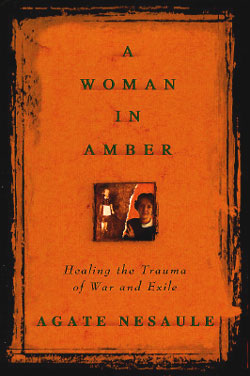
A Woman in Amber

A book should serve as an axe for the frozen sea within us.—Franz Kafka

"I must not speak and I must not cry….It was essential to be compliant and to pretend to be all right."

These are the lessons of war that six-year-old Agate Nesaule learns when her family is evacuated by the Germans from Latvia toward the end of the Second World War. They are conscripted to work at Lobethal, a home for the mentally ill. When the Germans are routed and conquering Russian soldiers burst into the basement where the refugees huddle, their only hope for survival is to become invisible. The men, Agate’s father among them, are marched away to an unknown fate. These are among moments Nesaule reveals in her memoir, A Woman in Amber.

The Russian soldiers begin to drag young women behind a partition, where their cries are plainly audible to those on the other side. Agate and her sister Beate are too young to understand what is happening, but eventually the soldiers forego the partition. When their mother is not quick enough to cover their eyes, they learn how women become the spoils of war. For Agate, these memories will remain unspoken for more than 40 years.

But A Woman in Amber is not so much an account of wartime atrocities as of their aftermath, the devastation that floats like an iceberg through refugee lives, freezing emotion while remaining nine-tenths submerged. It is about the circularity of personal history and how the past forces its shape on the future.

Agate’s family spends five years in British camps for displaced persons. "The riches of the heart do not rust," says a frequently quoted poem by Karlis Skalbe, and the Latvians take these riches to mean education. The resourceful refugees organize schools, musical groups, cultural events.

When Agate finally arrives in America, she is given to understand that she is safe at last. When her nightmares pursue her, she feels guilt and self-loathing; after all, things aren’t so bad, she is alive. Others are so much worse off. "It was disgraceful not to be thankful for everything."

It is difficult, but Agate learns to function in the new country. "Learning English was thrilling, the most wonderful part of learning America." A teacher encourages her to write, gives her The Diary of Anne Frank. At the library, Agate obsessively studies photographs of concentration camps, looking for Anne. The mountains of eyeglasses convince her again that her own sufferings are trivial: "How dare I even think of writing about my own minor inconveniences, my privileged existence?"

Above all, no one must know what happened to the women in the basement at Lobethal. When the local Latvian center holds a debate to establish who suffered more in the war, men or women, it is a foregone conclusion that it is the men who suffered most. They have the statistics to prove it. The few women who disagree (Agate’s mother is one of them) are shouted down; what are their losses by comparison? "There are worse things than death,’ they say, but the word ‘rape’ cannot be spoken. Otherwise they will be ostracized, blamed for their own tragedy. Agate puts up her hand to vote "with the winning side."

When she makes an unsuitable marriage before completing her education, her father says, "How could you do this to us?" Her mother echoes the sentiment. "You’ve chosen between me and him," she tells Agate, "you’ve abandoned the Latvians for the Americans, go on, go with him." And Agate too feels that she has "abandoned Latvia itself." Only her grandmother calls her back to bless her with the gift of a few bed sheets and a handful of change, because now she will be "alone in a strange land."

It takes an acutely perceptive therapist to extract her story from Agate. The telling of it breaks the ice of her emotional life. She will still dream of soldiers and trains, of being pursued or separated from her loved ones. But there will also be opportunities for healing and growth, and the ability to trust in the small gestures of care and love that still exist in spite of cruelty and destruction.

This is a beautiful and complex book, full of the contradictions and ambivalence of life. Kindness can come from any unexpected quarter, as can cruelty. Victors are not always villainous, the vanquished not always innocent. A Woman in Amber is like a painful blessing. If the last part of the book—in its concentration on the therapeutic solution—seems less vibrant in comparison to the richly textured past, one cannot begrudge the author her hard-won epiphanies, or wish her anything but the happiest of endings.

Details

A Woman in Amber: Healing the Trauma of War and Exile

Agate Nesaule

New York:  Soho Press Inc.,  1995

ISBN 1569470464

Where to buy

Purchase A Woman in Amber: Healing the Trauma of War and Exile from Amazon.com.

Note: Latvians Online receives a commission on purchases.
Bumerangs perfects craft of schlager

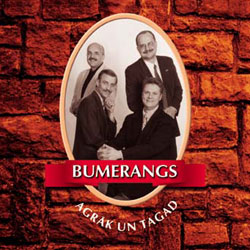
Agrāk un tagad

One of the hardest things to define in the Latvian music world is šlāgermūzika. It sounds as if it is rooted in Latvian folk music, but with traces of American country and a few parts pop—and with an accordion thrown in for good measure. The best I can say is that you will know it when you hear it. And hear it I do on the Bumerangs "best of" compilation called Agrāk un tagad, which includes songs from all of its 14 years together as a band.

The group is made up of Aivars Trēziņš on voice and accordion, Vents Krauklis on voice and clarinet, Juris Skrajāns on voice and guitar, and Edmunds Mednis on voice, drums and synthesizers. Mednis also wrote a few of the band’s songs as well. Bumerangs was also one of the hardest-working bands in Latvia (the liner notes mention that in 1988 they played 332 concerts in one year). I even saw it play one time in the early 1990s in Limbaži. However, the band is currently on extended hiatus, as Mednis has moved to the United States.

This album is packed. The recording is almost 80 minutes long. Also, as seems to be the trendy thing to do these days, these songs are not the originals, but re-recorded versions of the band’s hits (as Labvelīgais tips and Zeļļi have done on their "best of" collections as well). Although I’m not a fan of bands rerecording their songs (especially if I’ve gotten attached to the originals), these songs are not much different than the originals.

A novel thing that Bumerangs does is to take a standard Latvian folk song, change the melody around and sometimes add additional words. The result is a completely different song. Sometimes this works very well, sometimes the results are… a little unusual. One of my favorite songs on the album is the Bumerangs version of the Latvian folk song "Līgo laiva uz udena." The band’s version is more uptempo than the more somber song that I remember. The lyrics of the song itself are very sad, telling the story of a poor guy who says that if he doesn’t marry a particular ploughman’s daughter, he will die of sorrow. He goes on to give detailed instructions about where and how he is to be buried.

Another folk song that gets the Bumerangs treatment is the classic, "Pūt, vējiņi!" This time, except for a few verses of the original, the song would be completely unrecognizable as the band adds a lot of new words to the song and offers a much more uptempo version. Also, in a move that apparently caused some controversy at a Gaŗezers concert a while back, during the verses the band adds the Russian words "Ochen horosho!" (Very good!). I guess some of the old-school Latvians didn’t like their folk songs being tainted with Russian words. Though the original version of "Pūt, vējiņi!" is one of my favorite Latvian folk songs, I do actually like this version, too.

Bumerangs also does a song called "Klētiņa" that listeners might know as "Mīļā mazā Lulu, sapnoju par tevi vien." This is a song I used to sing in summer camp and one I originally heard on the Trīs no Pārdaugavas debut record. In an attempt to show the band’s linguistic talent, the entire song is sung in Italian! The novelty of this wears off in a hurry, as I would have preferred to hear the song in its original Latvian.

Not all of Bumerangs’ songs are joyful and happy. In fact, its version of the soldiers’ song "Baltā roze" is one of the saddest I have ever heard. The song is about a soldier leaving his loved one. It begins with the lyrics "Baltā roze nozied dārza malā / Velti lūpas tavu vārdu sauc" (A white rose wilts at the edge of the garden / In vain my lips call your name) and gets more depressing from there. It is a very beautiful song, and will move even the most hard-hearted of listeners.

Bumerangs even has some songs that are more intended for "mature" audiences. Take a listen to its version of "Meitas mani aicināja," another Latvian folk song, complete with anatomical references and double entendres.

Another favorite on the record is the band’s version of the Raimonds Pauls ditty "Varbūt," a song that the aforementioned Trīs no Pārdaugavas did on its Mīkstas mēbeles record many years ago. The vocals have a bit of a lounge feel to them (given that it is a Pauls song, that should not surprise me). Also listen to "Vilciens Rīga-Valka," a sad song about yet another poor guy who meets a girl on a train and makes plans to see her later… and wouldn’t you know, she doesn’t show up. (This is another song that Trīs no Pārdaugavs did on its No tālām robežām record.)

Other oddities on the record include "Pretī (Tavs logs pretī manējam)," in which Bumerangs attempts a reggae-influenced song. There is also "Pūš sejā," a rare, politically themed song. Also, the brief song "Bez mājas tā lieta neiet" sounds more like a commercial jingle for the mortgage department of Unibanka (one of the sponsors of the album).

A recurring complaint I have in my reviews is "Please include the lyrics!" Besides making my job easier, it also helps the listener develop a greater appreciation for the band and its songs, especially if your band has not released any compact discs prior to this one (and, as it appears, will not be releasing any more CDs in the future).

All in all, this is a good record and a good retrospective on a band that was at the forefront of šlāgermūzika throughout its extended career. If you can’t stand šlāger, this album won’t exactly make a believer out of you. If you don’t mind listening to šlāger, then you will appreciate this record, as Bumerangs has perfected its craft.

Details

Agrāk un tagad

Bumerangs

Platforma Records,  2000

PRCD 043

Egils Kaljo is an American-born Latvian from the New York area . Kaljo began listening to Latvian music as soon as he was able to put a record on a record player, and still has old Bellacord 78 rpm records lying around somewhere.

A charming guide, but not enough dill!

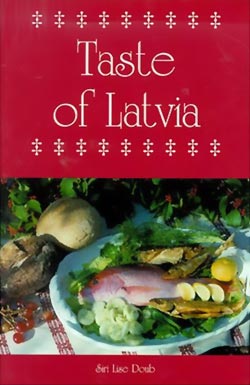
To see one’s culture through the eyes and experiences of someone outside that culture is fascinating. In her travel and cookbook, Taste of Latvia, author Siri Lise Doub takes us with her on a meandering exploration of the four corners of Latvia. She stops along the way to visit common tourist sites, and also invites us into the homes of families she visits. Photographs accompany the stories and show us the sites. The narratives are intertwined with translations of poetry and folk songs, mythology, traditions and even superstitions. Vignettes of Latvia’s history are included to round out the picture.

But Taste of Latvia is not only a collection of experiences of the author as a tourist. It is a cookbook as well.

A friend once asked me, “What is the basis of Latvian cuisine?” I answered: “Pork, onions and potatoes in infinite combinations with other things.” The recipes in this book seem to bear out my observation. Breads, fish, soups and dairy products round out the menu. Included are more than 100 recipes that are simple and useful for every day. The food is hearty and filling. A few of the recipes are for foods defined as holiday specialties.

I am glad that some of what might be considered “odd” about Latvian cuisine is explored and discussed. I refer to the sections on milk soups, on salads that contain no lettuce, homemade cheese and drinks that are boiled juices. We who have grown up with these foods understand how good they are, but sometimes find it hard to explain to folks trying them for the first time.

For someone looking for an introduction to a new culture, this guide would provide easy reading. However, for those of Latvian descent, there are a few jarring problems.

Some translations from Latvian to English really miss the mark. I had never heard the word “Dievs” (God) translated as “Bright Sky” or “Bright Sun.” In the wedding customs, “mice” is described as the ancient word for marriage, in translation “taking off the crown,” when in actuality, “mice” is from the German “muetze” meaning cap or hat.

Grammar in the Latvian texts is inconsistent, at times including diacritical marks, in other places ignoring them. Explanations of traditional holidays, costumes and superstitions are colorful and plentiful but some contain small factual errors. These might be due to variations in local customs or just relying on personal opinion instead of research.

Home-brewed beer was rarely mentioned, although beer is the traditional drink on various holidays. Some Latvian beers are now being exported, for those who want to try them.

A short note about the recipes: Not enough dill! Many salad, potato and fish recipes list chopped parsley, when more commonly dill would be used. Feel free to make this substitution. Add caraway to any cabbage or sauerkraut dish, or any rye bread.

Overall, Taste of Latvia takes the reader on a charming “armchair tour” of Latvia, and whets the appetite for travel and for cooking!

(Editor’s note: This article originally appeared on SVEIKS.com.)

Details

A Taste of Latvia

Siri Lise Doub

New York:  Hippocrene Books,  2000

ISBN 0-7818-0803-0

Where to buy

Purchase A Taste of Latvia from Amazon.com.

Note: Latvians Online receives a commission on purchases.
Patik dziedat un spelet; dancot vairs ne.