Solstice album sounds too polished

Kalado

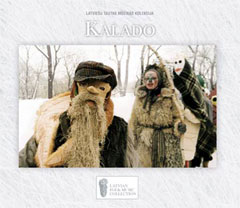
The most common refrain to the winter’s seasonal music is “kalado,” hence the name of this album, Kalado, devoted to the music of the winter solstice, or Ziemassvētki. These are not Christian Christmas hymns or “Jingle Bells” translations. All of the songs on the album are from the ancient folk traditions, which are still familiar to Latvians but not widely practiced.

I got my copy of Kalado only after New Year’s, so the music on it already sounded out of season to me. But traditionally Latvians went ķekatās from the Mārtiņi celebration on Nov. 10 all the way to the Meteņi celebration on Feb. 10. One of the signatures of Latvian winter celebrations, ķekatas are people in costume going from house to house, barging in with loud dances and songs, demanding food, and basically making a lot of noise and a big ruckus, sometimes even causing trouble (think Halloween, Mardi Gras or English mummers).

Overall, I’ve been very pleased with UPE Recording Co.‘s “Latvian Folk Music Collection.” But the album Kalado, which features all previously recorded material by various folklore groups, kind of bugs me. And what bugs me most is that I just cannot put my finger on exactly what it is that bothers me.

It begins with a beautiful, gentle song by Iļģi, but the song really has nothing to do with the winter solstice. The second song jars you awake with an energetic rendition of “Nerejati, ciema suņi” by the group Auri. It’s fun at first, but the song just won’t stop, and quickly becomes annoying. The beginning of the third song, “Svātki gōja, svētki gōja,” sounds almost Middle Eastern. Then you hear good old Skandinieki singing “Ziemassvētki sabraukuši,” which is much more like what I’m used to hearing at winter solstice celebrations. “Es čigāna dēliņš biju” is a catchy tune about ķekatas. “Es bej vīns kuplys līps” is a dance game that unfortunately does not make me want to get up out of my chair, while “Vylks dora olu” and “Čigāniņi, bāleliņi” do just the opposite. I like the question-answer lyrics and “kalado” drone of “Ej peleite zerņu zogtu.”  The album ends with a complex arrangement of “Sidrabiņa lietiņš lija” (performed by Rasa) and a meditation on the “kalado” refrain.

I find it hard to get a consistent feel for the album. The beginning leads me to expect music as calm as a Christmas snowfall, but the bulk of it is impatient, nervous, restless and even frenzied. The end of the album is again calm and meditative. Maybe this is what bothers me. The beginning of the album throws me off, and I never quite seem to find my footing after that.

In a way, though, this is appropriate. Solstices and equinoxes in all cultures have been times of the year when everything is on edge. They are often socially acceptable times to “let loose.” The borders between worlds blur, and the earth stands still for a moment while the sun and earth figure out which direction to follow. One must be very careful for one’s self until things fall back into a normal cosmic rhythm. Kalado definitely evokes this skittish and jittery feeling of unrest (in Latvian, nemiers). After all, one never knows what the ķekatas will do. Will they eat up all the food and leave us to starve? Will they steal something? Will they scare the children? Or will they be friendly? Who are they, anyway?!

On Kalado you’ll notice repetition of the lyrics within a song and from song to song, and you’ll also notice that the melodies tend to be quite narrow in their range. If you’re in a large gathering (such as a solstice celebration) where everyone wants to sing along, lots of repetition is necessary. Simple melodies and repeated texts make for easy learning and participation. The repetition can even become intoxicating—like a trance—when you take part in it. But on a recording one can grow tired of it after a very short time.

Taken alone, there are some wonderful arrangements on Kalado. I know and appreciate the artistic exploration in these ensembles’ music, but in a recording like this—which I assume is devoted to introducing people to winter solstice songs and traditional Ziemassvētki celebrations—I’d like to hear simpler and less exotic arrangements. The music at the solstice celebration I attended several weeks ago sounded little like this album (except, of course, the selections by Skandinieki and Rasa, who stick to very traditional renditions of folk songs), and therefore I expected Kalado to sound less polished and complex.

Details

Kalado

Latviešu tautas mūzikas kolekcija

UPE Recording Co.,  2000

UPE CD 022
Comfort food for the singing soul

Skaistākās dziesmas

Modern interpretation of the most beautiful Latvian folk songs? Being that I like my folk music to be fairly traditional, I’ll admit that I was a bit skeptical when I first heard about UPE’s collection Skaistākās dziesmas (The Most Beautiful Songs). Curious, but skeptical.

But the album started off just right, with Ainars Mielavs’ (the founder of UPE and lead singer of the pop group Jauns Mēness) distinctive voice singing “Tumša nakte, zala zale”—a favorite in our family. The next song, “Sarkandaiļa roze auga,” was an old favorite of my mother’s (and therefore also often heard at our house), albeit with a variation in the lyrics. Should I have been surprised that those two songs were also somebody else’s favorites?

The songs on Skaistākās dziesmas stand on their own, which is probably why they’re considered favorites by so many people. In other words, the songs’ beauty does not rely on elaborate vocal arrangements and instrumentations, but rather only on the traditional melody and text. In fact, only “Tōli dzeivoj muna meilō” has a sung harmony.

There’s no question that Latvians like songs in minor keys and sad lyrics! There are plenty of examples on Skaistākās dziesmas. I guess the minor keys “speak to our souls.” It’s funny, though: in our folk music not all songs in minor keys are sad. It’s also kind of odd that a third of the songs on this album have to do with war. Maybe that’s because Latvia has experienced so much of it. In any case, Skaistākās dziesmas covers a large spectrum of songs.

“Jūrā gāju naudu sēti” and “Div dūjiņas” are sorrowful songs about drowning and war, while “Čuči, guli, līgaviņa” is a tender lullaby and love song. “Visu dienu bites dzinu” is one of hundreds of orphan songs. “Snieg sniedziņis, putināja” and “Tumša nakte, zaļa zāle” are about the horse, a Latvian’s favorite animal. “Saulīt vēlu vakarā” is possibly the all-time favorite Latvian folk song. “Caur sidraba birzi gāju” is definitely not one of my favorites (it reminds me of singing class at the obligatory Latvian school every Saturday morning of my childhood), but it is very widely known. “Es izjāju prūšu zemi” sounds conspicuously like Jauns Mēness, and although a very catchy tune, seems slightly out of place on this compilation. Maybe it was included for the sake of variety. The more I listen to the album, though, the more I’m beginning to like “Es izjāju.” Could be that Mielavs and Ilga Reizniece are on to something!

Mielavs and Reizniece (of the post-folk group Iļģi) collaborated on choosing the songs for this very personal project. Any more people and the songs probably would not have fit together as well as they do. But what a daunting job: to come up with a dozen or so marketable favorites out of literally thousands upon thousands of folk songs. How do you maintain objectivity and yet remain true to your own aesthetic sense? After all, my own list of the most beautiful Latvian folk songs would be quite different, and so would yours (which is why I call this such a personal project). In any case, Mielavs and Reizniece have done a good job. The more you listen to Skaistākās dziesmas the more it grows on you.

All of the selections on the album are “interpretations of Latvian folk songs in the year 2000.” But that does not mean rock or pop. It means that the guitar, which is definitely not a traditional Baltic folk instrument, provides the only accompaniment to the songs. (After many listenings, though, I think I heard a kokle in one isolated spot. The kokle is a very traditional instrument.) The acoustic guitar’s calming and peaceful strums, though, lend themselves well to these serene songs. “Modern interpretation” also means that the singers are not specialists in folklore; they’re normal, everyday people like you and me (except that they make a living singing and composing modern music). In fact, the liner notes hint that the singers—including such pop artists as Ingus Ulmanis and Rolands Ūdris—are new to singing these timeless folk songs.

But don’t expect much gusto. This is more of a nostalgic, easy-listening, background-music album, rather than a “catch-you-by-the-collar-and-demand-all-of-your-attention” album. Except for the two or three more lively men’s songs, the acoustic guitar and mild voices pretty much all blend into one another. Although I realize that it’s largely a matter of singing style, some of the singers could enunciate their words a bit better. In part, it is this weaker enunciation that makes some of the songs sound nonchalant.

The pleasant and subdued voices of Skaistākās dziesmas sing very nice, comforting folk songs. It almost sounds like a few friends getting together over a glass of wine and then pulling out the guitar and singing for themselves (in Latvian: savā nodabā) the quiet old favorites that bring back memories. These are favorites pretty much the way you and I sing them—no fancy accompaniments, no messing around with melodies or texts, no embellishments. You’ll be able to sing along to this album right off the bat, and there will hardly be any new texts to learn. If you happen to not recognize some of the songs, this is the perfect album for learning them, because the songs are sung very straight-forward, and all of the texts are written in the liner notes. The liner note translations, though, should have been proofread for spelling errors and awkward expressions, and I’d also like the liner notes to show who sings which song.

Details

Skaistākās dziesmas

Latviešu tautas mūzikas kolekcija

UPE Recording Co.,  2000

UPE CD 021

Like squeezing blood out of a stone?

As I was flicking through a photo album containing photographs of past pupils of the Sydney Latvian School and recognising faces I had known in my childhood, I came to realise that about 80 percent of these faces I hadn’t seen since my days at this school where I learnt to read and write in Latvian on Saturday mornings. I can’t say for certain that this vast majority of my peers has never shown their faces in the Latvian community since their school years. But I do know for a fact that when I visit my hometown and venture into the Sydney Latvian House to attend a cultural performance, I would be surprised if I caught sight of any of those faces (slightly older, but still recognisable I’m sure!).

The same goes for the Melbourne Latvian community—which I am more familiar with now as I have been living here for more than 10 years—and for most Latvian communities in the United States, Canada and other countries where Latvian communities flourished and within which schools were founded and operated for many years.

In most of the major Latvian centres around the world to a greater or lesser degree there is still a handful of active second and even third generation Latvians still interested in maintaining the Latvian language, culture and doing their best to pass it on to their children. These Latvians still view this as a priority in their lives and put in much effort and still devote a great deal of their time to this pursuit. Yet a large proportion of this generation has drifted away from most Latvian community activities and can rarely be seen attending, let alone being involved in, the many organisations that still exist where Latvian communities are still active.

I do realise that it is 50 years since Latvians emigrated to these countries and that it sounds like a big ask for all second-generation Latvians (i.e., those who were born outside Latvia), let alone third-generation Latvians, to retain their interest in things Latvian, yet I still wonder about this phenomenon. Hundreds of Latvian kids, born in the United States, Canada, Australia or the United Kingdom over the past 40 years, have gone through the emigre Latvian education system, have attended these schools on a weekly basis, learnt the language and much about its traditions, spent their summer vacations in Latvian camps, high schools and so forth. Even if only an inkling of what they have learnt remained buried deep in their subconscious, one would like to hope that they would still retain some degree of interest in the fatherland of their grandparents, a task that these Latvian schools had taken on to perform.

Do these Latvians still maintain some contact with other Latvians within a family or social setting? Do they identify themselves as Latvian and maintain some interest in Latvia and Latvians? Have they ever been to Latvia or intend to visit it some time in the future?

A vast majority of these second-generation Latvians have graduated from Latvian school or maybe abandoned their schooling earlier simply out of a lack of interest—not always on their part but more often that of their parents. Their parents and grandparents (or their Latvian-speaking parent) spoke to them in the emigre country’s local language because it was much easier and did not take that much interest in their Latvian schooling. As a result of this lack of support within the family structure, this interest in their Latvian identity was fragile if not even non-existent and there was little hope of breathing life into this identity during these few hours spent at Latvian school over the weekend.

This brings me to the crux of my musings: without the support and interest within the immediate family, there is little hope of achieving much at Latvian school. It would be like squeezing blood out of a stone.

In some cases, even though these Latvians do identify themselves as Latvian and still speak (or understand) the language, their experience at Latvian school may not have been too positive, either at a social level or at the educational level. As this may have been their only contact with Latvians outside their family, the connection with other Latvians was not found and hence the loss of interest.

Another likely reason for abandoning Latvian community activities probably was a lack of interest in these activities or the inability of these activities to fulfill their needs. When you graduate from Latvian high school, what can you do within the Latvian community? You can still be part of a Latvian folk dancing group, choir or theatre troupe, play sport, take part in activities organised by ALJA or LNJAK (or LJAA in Australia, when it was still active) or join a sorority or fraternity (korporācija) if you are studying and others of your age group have joined. But a few years down the track, what then? Most of the Latvian organisations that do still exist are run and attended by the older generation of Latvians who have different perspectives and different life experiences.

Then there is another group of Latvians of my generation who have simply experienced Latvian "burn out." They have participated in every Latvian event under the sun, have danced and sung and played an instrument and organised this, that and the other event till one day they have had enough. They simply want a rest. So they do…and find that immersing themselves in the local (be it American, Canadian, British or Australian) culture is much easier and less demanding.

The smallest percentage of my generation has gone to Latvia to live. These are mostly Latvians who were in their early to mid twenties when Latvia regained its independence in 1991. They had not established themselves in family life or a career at the time and had nothing to lose when they made the decision to try their hand at living in their parents’ or grandparents’ "homeland."

A small proportion of second-generation Latvians appear "lost" only to return when they have had children of their own. These Latvians might come to the realisation that they do want to pass on their heritage to their children, and Latvian school (if it is still operating in their community) is the best place to do this.

As this is not a detailed academic study, I don’t intend to draw any conclusions or offer any solutions. However, I would like others of my generation (those who are 20-50 years old) to contribute their experiences within the emigre Latvian school system. Were you happy with your experiences or do you only remember it as a negative time in your life? Did you get involved in other Latvian activities after you graduated from Latvian school? Do you still speak the language? Do you regret that you don’t any more?

Daina Gross is editor of Latvians Online. An Australian-Latvian she is also a migration researcher at the University of Latvia, PhD from the University of Sussex, formerly a member of the board of the World Federation of Free Latvians, author and translator/ editor/ proofreader from Latvian into English of an eclectic mix of publications of different genres.