Detlef Zoo, the band, comes out of the closet

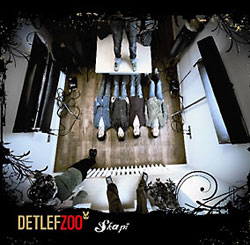
Skapī

Detlef Zoo (formerly Detlef) has always been a band. However, there seemed to be a misconception that it was really just a solo act, singer Uldis Dirnēns doing all the work, especially after the release of the band’s first album, Tu izliecies par sevi (You’re Pretending to be Yourself), back in 2004.

Go to the band’s Web site and you immediately understand differently. After a brief and nonchalant mention of Dirnēns’ reality music show stint, it is made quite clear that although some of the members have since changed, the band now known as Detlef Zoo is a collective of four “equal and like-minded friends.”

The 2004 album had its success, but I can only recall one song from it and can sadly only pretend to remember the rest of the tracks. But two good things come with the band’s sophomore album Skapī (In the Closet), released in December 2007. First, it is an excellent and at times fairly bad-ass “chill out” album. Second, it is proof that there is strength in numbers because as a “recognized plural,” these guys just plain sound better.

Alt-rock band Detlef Zoo is Mareks Ameriks (drums), Kaspars Ansons (guitar and vocals), Dirnēns (vocals and guitar), and Martins Millers (bass and vocals).

The first and title track of the album is a straight forward mantra of “let us go where we want” with text that is not only mature, but a little ironic, as the band is more out in the open than locked away. There isn’t much to write home about for this one, but it’s conceptually good and paves the way for the rest of the album.

The second track, “Love Town,” is a Blur-meets-Queens-of-the-Stoneage track that is in English and confuses me. I’m not talking grammar (for once), but rather subject matter. It’s about love in all forms, yet the song is riddled with phrases like “I’m happy alone” and “It’s a perfect day to get away.” At least is has a strong beat.

The next two tracks, “Par nozīmītēm” (For Badges) and “Lēts triks” (Cheap Trick), are quite similar, though the former urges people to get over themselves and look at what’s going on in the world and the latter is, from what I gather, a slightly duty-bound look at relationships, as well as musically somewhat superior.

Track five, “Funny Girl” is another English tune with a nice drum groove. The text kind of pokes fun at all of the commercialized songs—specifically about love—that are out there.

At this point I could note that the album seems to be a fan of the percussion and rhythm aspects of music, which is also reflected in the sixth track, “Mana dārgā” (My Dearest). With its abundance of drum set, highlighting cymbals, the track is immediately heavier sounding than its predecessors and has an additional “far away” feel to it.

The pace of the album picks up drastically in the next track, “If It Makes Us Happy”, with a balance of aggressive music and soft vocals. The lyrics kind of connect back to the first track of the album, but in contrast express the mortality of a band as a concept. Its members are aware of how easily something can fall apart, but for now, it works and feels good, so it’s meant to be.

Track eight, “Labrīt, miesniek!” (Good morning, Butcher!), is my one of my favorites. What I like about it is the almost too-slow molasses movement of the lyrics. The line “Dievs, lūdzu izsit pienzobus man!” has a strong sense of immediacy without sounding like it. There’s no “I want to go through years of life to gain experience”. It’s “Give me experience! NOW!” Someone, anyone, please use this song for a slow-motion or reflective moment scene in a coming-of-age or action movie, where a young person has to learn to fight the bad guys to survive. Just make it good or you’ll ruin the song.

“Zaļais krekls” (The Green Shirt), the next track, makes you wonder if you’ve missed something. It may be because it’s a happier sounding song and very different from a good deal of the rest of the album. Or maybe it’s the Telletubbyesque “la-la-las” at the end of the song.

Track 10 is my absolute favorite. The breakdown of “Ar vienu savu silūetu” (With One of Silhouette) is as follows: guitars = love them; percussion = love it; vocals = love them; lyrics = love them. This song could be in that same action movie. Remember? The one that isn’t a flop.

The next three tracks make up what is the collectively strong close to the album. “So Sophisticated” is like “Funny Girl” but with different lyrics. “Ja vien…” (If only…) is melancholy in text and instrumentals, but a very beautiful song, though nothing more. “So Cold” is a heavy final track, but doesn’t offer any “Pow!” to the album.

Skapī ends up being another one of those albums where, though there aren’t many individually striking songs, the overall whole is where it’s at. With songs ranging from cynical outlooks on relationships to social topics and with a very high cool factor, this whole certainly leaves a good impression.

Details

Skapī

Detlef Zoo

MICREC,  2007

Track listing:

Skapī

Love Town

Par nozīmītēm

Lēts triks

Funny Girl

Mana dārgā

If It Makes Us Happy

Labrīt, miesniek!

Zaļais krekls

Ar vienu savu siluetu

So Sophisticated

Ja vien…

So Cold

Where to buy

Purchase Skapī from Amazon.com.

Note: Latvians Online receives a commission on purchases.
Kids’ adventure shows life in Latvia

Kur pazudis Elvis?

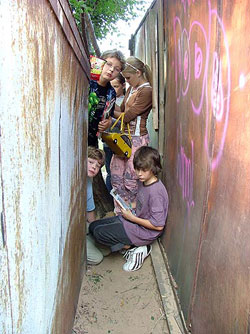
When their classmate goes missing, a group of Latvian schoolchildren takes up the search in the new film Kur pazudis Elvis?, which is directed by Una Celma.

The new Latvian children’s film released Oct. 25, Kur pazudis Elvis?, is a cause for celebration. Una Celma, director of various feature films over the past few decades (Olu kundze, Augstuma robeža and others), has taken on the task of depicting the kids of today in a realistic adventure film.

Since Latvia regained independence in 1991, the film industry has seen better times. Producers have not had a guarantee of government funding, which was the case during the Soviet era. New film production companies have emerged, but they have all had the same financial worries as the state-run film industry. The release of Latvian childrens’ films, in particular, is a rare event. And as the country is inundated with foreign films—the main cinema in Rīga, Coca Cola Plaza, mainly screens U.S. titles and Russian films are also not hard to track down— movies showing everyday issues in Latvia are few and far between, but always welcome.

Kur pazudis Elvis? provides a glimpse into the daily lives of five 5th grade children. Central to the plot is a 5th grade pupil, Elvis, a good student who doesn’t turn up for classes. The teacher seems disinterested in tracking him down (“I’ve tried calling his mother on various phones and can’t get through on any of them—what am I to do?” is the only attempt she makes), dumping the task onto one of her pupils. The boy takes it on himself to tackle this problem head on. With the help of a few classmates he begins the sleuthing job, trying to piece together the puzzle of where their classmate has disappeared to.

The adults in the film, even the powers-that-be don’t seem to appear sympathetic or helpful in any way, leaving the children to their own devices. One is left with the overwhelming feeling of the individual left to fend for themselves at an early age, always a shock to the system in Western countries.

Although this is an adventure film, the most memorable parts are the seemingly mundane, everyday ones: the latch-key kid who comes home to an empty house and ends up staring desolately at his pet tortoise; the heart-breaking phone conversation where a mother regrettably informs her daughter she won’t be able come back from Ireland for her daughter’s birthday; the overworked, disinterested father who has a phone permanently attached to his ear. It seems all the families in this film are dysfunctional, leading one to the question if there are any “average” families left anywhere in the world today? And what kind of a future can these children hope for? The situations are not confined to Latvia; they could be easily transferrable to any other country in the Western world.

Some of the characters are classic stereotypes. Villains are either bumbling clown types or of the Addams family type, complete with the mansion on “Zirnekļu iela 13.”

The kids are the stars here. They are very believable, complete with Russian-Latvian slang and an acute imagination. The insight into the behaviour in the Latvian classroom and the reality faced by teachers and kids is a real eye-opener. Sensitive pre-teens the world over face their own age-old issues: budding relationships, bullying, loneliness, finding themselves. Many of these are briefly touched on in Kur pazudis Elvis? Kudos to the director for combining all these elements and bringing them to the big screen.

Latvia is a like a big country town. The same actors from the Rīga theatres and TV soap operas appear sporadically on the big screen. So it was no surprise to see New Rīga Theatre (Jaunais Rīgas teātris) actors Baiba Broka and Guna Zariņa as well as Daile Theatre (Dailes teātris) actors Ģirts Ķesteris, Ieva Pļavniece, Harijs Spanovskis, Rēzija Kalniņa and Ilze Vazdika all cast in the “minor” adult roles in this movie.

It would be interesting to see how taking part in this movie will influence the 11- and 12-year-old child-actors and if their futures will evolve in this direction. They have certainly shown talent in the brief opportunity they have been given here.

Details

Kur pazudis Elvis?

Una Celma, director

Latsfilma,  2008

Notes: In Latvian. Feature, 78 minutes, in color. Cast: Emīls Desainis, Matīss Kaža, Mārtiņš Ivanovs, Gerda Grobiņa, Margareta Cilinska, Harijs Spanovskis, Ieva Pļavniece, Zane Daudziņa, Andris Bērziņš, Juris Gornovs, Ilze Vazdika; camera: Jānis Eglītis; screenplay: Ingrīda Elerte.

Daina Gross is editor of Latvians Online. An Australian-Latvian she is also a migration researcher at the University of Latvia, PhD from the University of Sussex, formerly a member of the board of the World Federation of Free Latvians, author and translator/ editor/ proofreader from Latvian into English of an eclectic mix of publications of different genres.

Čikāgas piecīši returns to Rīga for a concert from the heart

Čikāgas piecīšu koncertu afiša

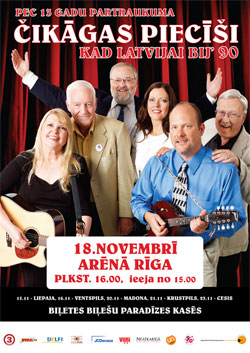
A poster advertises the Čikāgas piecīši concert in Rīga, as well as performances in five other Latvian cities.

A great Latvian word is the adjective sirsnīgs. Roughly translated, it means “from the heart” or “warm hearted” or “sincere.” It is one of the most complimentary things one can say in Latvian. If I were to sum up my thoughts in one word on the sold-out Čikāgas piecīši concert, “Kad Latvijai bij’ 90,” in the Arēna Rīga on Independence Day, sirsnīgs would do nicely.

Though members of the group have made sporadic appearances in Latvia in the past years, the last true full band performance of the group in Latvia was in 1995. For this year’s concert tour, the performers were stalwarts Alberts Legzdiņš (vocals, guitar and group founder), Armands Birkens (vocals, guitar), Uldis Streips (bass guitar, vocals), Alnis Cers (guitar), and the returning Laurie Cinkuss (vocals) and Janīna Ankipāne (vocals, guitar).

This was actually the first time that I had seen the group in concert. Alhough I grew up in the United States, I never managed to see Čikāgas piecīši. So I was very much looking forward to seeing the group when it performed Nov. 18. It has been a very long time since the group was in Rīga, but time doesn’t seem to have had much effect on its members, particularly on Ankipāne and Birkens, who sound just like they did 30 years ago.

As the group has not had a new album since 1994’s Vai debesīs būs Latvija?, the concert—the third of a six-city tour of Latvia—focused mainly on the many hits Čikāgas piecīsi has had throughout the years, particularly from the 1970s and ‘80s.

For the most part, the audience in Arēna Rīga was rather subdued. The loudest applause was saved for Birkens’ performance of “Mūsu mīlestība” and his duet with Cinkuss on “Lai visa pasaule to redz.” Other highlights included Ankipāne’s performance of “Sapnis par Latgali,” the ever-popular “Pazudušais dēls,” the poignant “Kurzemnieki Viskonsīnā,” “Es redzēju bālēliņu” (which Cinkuss was quick to point out was not a folk song, though it has all but become one), and the rarely heard Birkens solo number “Roze.”

Guests included Māris Muktupāvels (of post-folk group Iļģi) on accordion for a few songs; men’s choir Gaudeamus, beer steins in hand, singing along with “Man garšo alus” (which featured notably different lyrics than the original recording); and a number of Latvia’s children’s ensembles performing on several songs.

The comedy skits that are often part of the Piecīši’s performances were minimal this time around, likely due to the fact that the group’s main skit writer, Uldis Ievāns, suffered a stroke a few years ago. However, Legzdiņš did provide a bit of comedy with a copy of the newspaper Diena, cracking wise about the newly opened Dienvidu (Southern) Bridge in Rīga, as well as the results of the latest U.S. presidential election. Another bit of comedy was in the song “Latviešu sievietei.” The original version of the song featured the line, “Nav viegli latviešu sievietei būt” (It is not easy to be a Latvian woman). But, in today’s environment, it was changed to “Nav viegli latviešu vīrietim būt” (It is not easy to be a Latvian man), with a man now expected to be as intelligent as former president Vaira Vīķe-Freiberga, not to mention as attractive as Latvian singer Linda Leen.

Were I to be pressed to say anything critical of the concert, I would point out the subdued audience, who, though very polite, didnt much participate in the concert by singing along. Legzdiņš himself had to plead with the audience (with little effect) to sing along. Perhaps this was due to the early starting time of the concert (4 p.m.), so not enough beer had been ingested yet. It would have been nice to hear more of Ankipāne. Though she certainly did get many chances to sing, her solos such as “Staburadze” or “Nāk rudentiņis” were missed. Also, I would have liked to hear a few more of the group’s 1960s songs. And, sorry gang, I could probably do without hearing “Sekss ir labs” for a while!

Latvia, being the home of so very many talented professional musicians, has many excellent concerts. Because so very many Latvians take their music so very seriously, many concerts wind up being over-professional, and, to some extent, even a bit “cold.” This was certainly not the case with the Piecīši concert, where one could tell that the members of the group were overjoyed to be back and performing on Latvia’s Independence Day in front of such a large crowd. Hopefully we won’t have to wait another decade for another concert!

Details

Kad Latvijai bij’ 90

Čikāgas piecīši

Rīga, Latvia:  2008

Egils Kaljo is an American-born Latvian from the New York area . Kaljo began listening to Latvian music as soon as he was able to put a record on a record player, and still has old Bellacord 78 rpm records lying around somewhere.