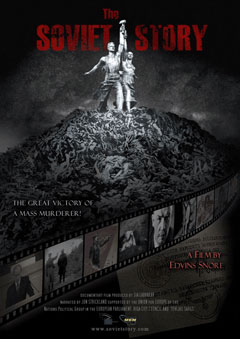
Writer-director Edvīns Šnore’s powerful film, The Soviet Story, seems suddenly dated, overshadowed by current events. Or, perhaps, those events add deeper resonance to the film’s message. Different audiences will react differently. The release version I saw needed some fixing; through no fault of its own, it now needs a whole new ending in order to maintain a place in what is fast becoming “The Russian Story.”
As I write this, the West denounces the Russian invasion of Georgia and refuses to recognize Russian occupation of South Ossetia and Abkhazia. Though U.S. Secretary of State Condoleezza Rice reminds Russian Prime Minister Vladimir Putin that “this isn’t Czechoslovakia” (which the West sold out to Adolf Hitler for the illusion of “peace in our time”, then stood idly by while Soviet forces invaded in 1968 to reverse peaceful reforms), Red Army tanks continue to roll as they please. Putin nakedly threatens Poland and Ukraine, cuts military co-operation with the NATO defense alliance, and offers puffed-up “foreign threats” as distractions from festering domestic problems. An old recipe. Perhaps “things have changed,” as Rice said, but behaviour of ugly regimes toward their neighbours has not. Former U.S. national security advisor Zbigniew Brzezinski compares Putin to Hitler. A comparison to Joseph Stalin would have been more apropos. Both, according to the recent Prague Declaration on European Conscience and Communism, operated equally criminal regimes. The eastern half of the tandem, unchecked, carries on the old tradition.
Šnore’s film shreds the myth—still percolating in liberal circles, in the Hollywood “mentality”—that Hitler’s Nazis were the lone 1930s and 1940s evildoers. Based on meticulous, irrefutable research (facilitated by European Parliament deputies Inese Vaidere and Ģirts Valdis Kristovskis of Latvia), The Soviet Story demonstrates that Stalin’s Communists were natural partners-in-crime for the Nazis, sharing territorial ambitions (via the secret protocols of the Molotov-Ribbentrop Pact, for example) and the same totalitarian (socialist) ideology. Both deployed vicious large-scale methods to crush domestic opposition: the forced Ukrainian famine, oppressive control of media, secret police, concentration camps for “undesirables,” and so on. Russian Communists were the experienced teachers, the Nazis eager pupils.
Doctrinaire Western left-wing “intellectuals” like George Bernard Shaw (Jean-Paul Sartre and others could have been mentioned) end up in history as propagandists and apologists for crimes against humanity. More could have been said about roles played by Western Communist parties (fomenting a civil war in Greece, for example, or destabilizing coalition governments in France and Italy), the Comintern, surrogates (like Cuba), and various “little wars” in Korea, Vietnam, Angola and on and on.
In the end, Nazi pupils were defeated. The teachers and their heirs, however, remain in control of Russia to this day, never challenged to reveal the truth of their programmed cruelty. The film missed one passing irony: at the Nuremberg “trial of the Nazis” (the losers), Western allies allowed their sleazy “partner” (Communist Russia) to sit in judgment of its former co-conspirators. Those Russian “judges” must have been laughing all the way back to the Kremlin.
There has never been a Russian Nuremberg. Should there have not been, after Russia decisively lost the Cold War? It is as though the Gulag (and its 20-million-plus victims) was a fiction, as if KGB batallions tasked to torture and murder as instruments of party policy never existed. Russians feel no guilt for barbaric acts like the Katyn massacre of Polish officers, for example, because they know little or nothing about them. (The recent passing of Alexander Solzhenitsyn and what he wrote as witness would have been another reminder.) Instead—as the film points out—we have KGB alumnus Putin moaning about the collapse of the Soviet empire as “an historical tragedy,” restoring Stalin’s hymn and re-establishing the red star as symbol for the “new” Russian army. (Those signals were barely noticed in the West. Peace in our time, again?) Russian murderers enjoy state pensions and brag about their exploits. The “new” KGB radioactively poisons whistle-blowers in foreign countries. This is hardly fertile ground for democracy.
Another nice end-piece for the film would have been Ukrainian President Viktor Yushchenko’s speech to the Canadian Parliament. He did not hesitate to say that the main reason his country—like Georgia—wants to join NATO is to eliminate the possibility of future Russian-inflicted atrocities. Prophetic. Not well received in Moscow, but truth never has been.
The film reminds us that Putin is hard-core KGB (pictures of him at a podium, intermixed with snaps of KGB crimes). But it fails to highlight other key links in the chain:
- The organizer of the Ukrainian famine, Nikita Khrushchev, pounding a desk at the U.N. with his shoe, almost provoking a world war by stationing missiles in Cuba—but considered by Western experts to be a “liberal.”
- Long-time KGB operative Yuri Andropov, later the “progressive” Soviet chairman, who while ambassador to Budapest co-ordinated the crushing of Hungarian resistance in 1956,
- Mikhail Gorbachev’s foreign minister Edvard Shevardnadze, former head of the Georgian KGB, later overthrown as Georgian president due to corruption and excessive catering to Moscow’s wishes.
- Gorbachev himself, a man British Prime Minister Margaret Thatcher said she “could do business with,” ordering bloody suppression of dissent in Tbilisi and Vilnius.
- Putin, into whose heart George W. Bush once said he looked and found “a good man,” now pushing invasion. (Putin, too, must have been laughing all the way back to the Kremlin.)
Does it not, as police investigations of serial killers often establish, amount to a predictable pattern? We have short memories. They could have been jogged more forcefully.
The film does make the general point that anyone aspiring to join Russian leadership circles must come with “dirty hands” (as did hard-core Latvian Communist Boris Pugo, who is not mentioned), so that responsibility for ugly collective action can be shared. But The Soviet Story could have done a better job connecting dots from a bloody past to present-day adventurism. Was Afghanistan mentioned? I can’t recall. The never-solved murder of one dissenting Russian journalist was—but not the fact that 12 others also died in mysterious circumstances during Putin’s watch as president. No sense of Ukraine’s “Orange Revolution” that rejected Putin’s selected (and blatantly supported) puppet-candidate. Yes, a hint of Russia’s “natural gas weapon”—fuel on which much of Europe’s economy depends (and so keeps politicians’ mouths shut when issues of principle hit the fan).
But without explanatory captions few North American viewers would recognize the faces of former French President Jacques Chirac and former West German Premier Gerhard Schröder (now a mouthpiece for Gazprom) in the crowd enjoying the Red Army’s “victory” celebrations. Come to think, why no mention of former Latvian President Vaira Vīķe-Freiberga’s appearance—lone among Baltic leaders? How one could, in any way, at any time, “honour” Russia’s main instrument of oppression is beyond my humble comprehension.
Other niggles:
- A graphic, “bleeding map” point could have been made about bully Russia’s bite-sized thefts of territory from frightened neighbours: Karelia from Finland; parts of the Narva region from Estonia; Abrene from Latvia; parts of Moldavia from Romania; half of Kamchatka and the Kuril islands from Japan; now South Ossetia from Georgia, and so on. Apicture is worth a thousand words.
- What about the cancer of Kaliningrad (formerly Königsberg), injected into former Lithuanian, Polish and German territory? What about pushing Poland 100 kilometers to the west (at the expense of Germany) in order to create a subservient Belarus? Another pattern. Deposits of unwanted Russian colonists into “liberated” areas and then the need to “protect their interests”—another pattern. Russia has never been called to account for its expansionism and imperial ambitions, a theme this film should have explored more fully.
- I may have missed it – but why no mention of the heroic Red Army standing by while Nazis decimated Polish resistance in Warsaw in 1939? This would have been a perfect sequel to a nicely documented segment about the Molotov-Ribbentrop Pact and its secret protocols. And that segment could have used a reminder about how long it took the new Russia to “discover” a copy of that infamous treaty in its secret archives, why the Russian public still has no idea and why its historians continue to deny the obvious.
- Absent from the film is a clear picture of the extent to which, in former Soviet colonies, ex-Communist and ex-KGB cadres still hold positions of power or have morphed into cabals of respectable businessmen, often financed by earlier theft of state assets. Yes, this may have been outside the scope undertaken. But, if the film chose to mention Chirac and Schroeder, surely it could have given us some sense of times not changing quite as much as they should. at the local level. In other words, how free, really, is Eastern Europe? Latvian audiences, certainly, should like to see more about ex-Soviet apparatchiks walking around free in their country, and wonder why seized KGB archives have still not been opened to public scrutiny, as they have been elsewhere, notably in the former East Germany.
- I would have welcomed a segment focused on Western stupidity—starting with British “peace in our time” illusions, Franklin D. Roosevelt’s weakness at Teheran and Yalta, American preoccupation with the Suez crisis while Russia crushed Hungary in 1956 (similar to our preoccupation with the Olympics while Russia attacked Georgia). And why no mention of another British sell-out: delivery of pre-war Latvian gold reserves to Moscow? (That event, if we have forgotten, came not so long after Russia extracted similar concessions from Spain in exchange for help during its civil war.) The Legion of Honour that France awarded to Putin would have been icing on the cake.
- Why no mention of Solidarity and the Bulgarian (KGB subsidiary) secret service assassination attempt on the Pope?
All in all, the film could have made a sharper point about small Eastern European countries not being able to entirely trust the West—based on incident after incident—unless, as is the case now for a good number, they form part of a strong alliance (NATO). Would Russia have attacked if Georgia had been a member? Not likely. And it goes to prove, again, that trusting Russia to behave like a civilized nation is a serious mistake at any time.
When you watch a documentary like this, you wonder: What was the intended audience? Latvian exiles in the West don’t need reminders, this material is old news. Latvians in Latvia? Could be, if they still care enough. (The film was shown on Latvian TV, despite Russian pressure, and at the Occupation Museum in Rīga.) Perhaps European diplomats and bureaucrats are so ignorant of history that they need a refresher? Maybe (it was shown in Brussels). Some press comments from these circles seem to indicate a sickening sense of surprise, as though 50 and more years on they, too, had no idea, as though they resent having to wake up from stuporous decades of Russian-induced disinformation and propaganda.
But the general Western public is seriously disinterested, and wishes to remain comfortably in that condition. The Soviet Story will not be able to make an impact without substantial revisions. Perhaps this is a central flaw in the film’s character (and unfortunate timing): What was its intent? Strong on documenting Soviet-Nazi collaboration, it is weak on showing how our ignorance allows one unrepentant regime to continue its evil ways. Even Ronald Reagan, no great intellect, called it an “evil empire.” Can the film make us think otherwise?
Here’s an unresolved technical problem: editing by Nic Gotham. The 86-minute private-screening version I saw (thanks to arrangements by the Latvian Embassy in Ottawa and the Ottawa Latvian Heritage Society) had been obviously cut for television, with typical transition headers every 20-30 minutes. But the same brooding introductory segment (featuring Lenin and then bits of Soviet atrocities) becomes repetitive and then annoying in a straight-through documentary. Two versions, please: one for TV, one for cinema. In the cinema version, space taken by “TV reloads” should be filled by covering some of the niggles mentioned earlier. Covering those niggles would have enforced continuity.
Finally, a word about propaganda. The Russian ambassador to Latvia, having seen a few excerpts, characterized this film as propaganda. Inconvenient truths are often painted this way by people who have much to hide. Less understandable are Western voices who take a similar position. What is their problem? The fact that, after a half-century of uncontested Russian propaganda, we finally have a solid reply? That folks have to make a judgment based on facts?
If “Propaganda is the deliberate, systematic attempt to shape perceptions, manipulate cognitions and direct behaviour to achieve a response that furthers the desired intent of the propagandist” (Garth S. Jowett and Victoria O’Donnell, Propaganda and Persuasion), Šnore should proudly plead guilty on intent. Certainly he wants to change perceptions. Don’t we all want a more responsible Western response to the lessons history offers? On the question of content—the whole tactical panoply of selective truths, half-truths, lies big and small—Šnore is entirely innocent. He offers no deceptions. His collage of Soviet-Nazi similarities could have gone on for another hour. There is not a false note in it. There should be, as earlier comments suggest, more of a continuation theme, but that is a sin of omission, not commission, notable only because “things have changed.”
Sponsors of the showing I attended told us that general release of the cinema version is not possible in North America until rights have been cleared for some documentary film clips used. I understand that several Latvian organizations are raising money to make that possible. The Soviet Story will be shown as the Boston Film Festival. But I want to caution all involved, before exposing the as-is version (have they seen it?) to local audiences, that it is not ready for prime time. At a minimum, I would urge those responsible for fund-raising to take a closer, critical look before wholeheartedly embracing a flawed, somewhat dated product. At least conclude the film, I suggest, with footage of Russian tanks rolling in Georgia—over the caption “Again?”—to make it more immediately relevant.
That said, all of us should welcome this long-needed start to setting the historical record straight. Such efforts are never propaganda. I am reminded of Jack Nicholson’s line in A Few Good Men: “You can’t handle the truth!” But Putin’s Russia aims to keep on distorting it. A proposed new Russian history text, designed to ruin the minds of future generations, will teach that the mother country has every right to exert influence and control in territories that once were a part of some greater Russian empire, with a view to annexing them altogether (again). If nationalist thugs are needed to put down minorities inside Russia and cause disturbances close by, so what? Sounds like Hitler’s brownshirts all over again, doesn’t it? Triumph of the Will (a Nazi propaganda film by Leni Reifenstahl) is a distant memory. It shouldn’t be. It, too, should have been mentioned. The same dark forces it glamorizes so well are marching again.
I like The Soviet Story for the effort it has (finally) begun. We need more like it. (When can we expect the commercial Western blockbuster that exposes the damage Communism has done, to counterbalance endless, formulaic exploitation of Nazi evil?) I salute it for destroying reams of Russian disinformation, whatever Moscow says. But it is far from complete in carrying out its mission—if some part of it was intended to alert us to present-day dangers.
An old Eastern saying tells us if you wait long enough by the riverbank, you will see the body of your enemy float by. I do not believe that we have this luxury of time, despite Russian male life expectancy falling by 10 years (to just 56, a Third World level) since the arrival of “democracy” in 1992. “The Russian Story” could also be a reminder—to Russians—that behaving poorly, and ignoring responsibility, invites deadly consequences.
Details
The Soviet Story
Edvīns Šnore, director
2008
Notes: In English. Documentary, 85 minutes, in color and black and white. Written by Edvīns Šnore. Narrated by Jon Strickland. Edited by Nic Gotham.