Guide provides ideas for bilingual families

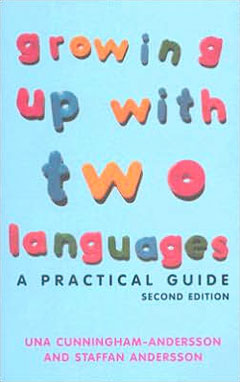
Growing Up with Two Languages

I recently took a look at the second edition, published in 2004, of Growing Up with Two Languages: A Practical Guide by Una Cunningham-Andersson and Staffan Andersson. I read the first edition (1999) almost 10 years ago, but was curious to see the book again.

Growing Up with Two Languages is a manual for families living with two languages, written by a couple who have not only gone through the experience themselves, but also have the professional credentials (senior university lecturer in English language and linguistics) to back up their observations and recommendations with current linguistic research. The book is nevertheless easy to read and focuses much more on practical suggestions than scientific explanations.

The main readers in mind are those parents and families who are generally not part of an established bilingual community and also not native to their country of residence. For this reason the book may seem a bit simplistic and self-evident to those Latvians who have the luxury of being rooted in—often to the point of actually being born into—an established minority community. But it is still an interesting and informative read that will raise parents’ awareness about bilingual family life. It raises many issues to think about, such as bilingualism vs. biculturalism, children’s culture, semilingualism and community.

The first three chapters focus on preparation: reasons for and circumstances of bilingualism, issues in mixed-culture marriages, making plans for the minority language and culture while expecting a child, developing a two-language system, and various types of bilingualism.

Chapter 4 deals with more technical aspects of bilingualism, including general linguistic development in children, interference and mixing of languages, and a look at the “critical period hypothesis” of language acquisition.

After that the book delves into the emotional and psychological aspects of bilingualism in children, parents, and families, such as the advantages and disadvantages of bilingualism, being different at school, and competence in two cultures. It also offers many practical suggestions for parenting in a bilingual home.

Chapter 8 addresses problems that families may encounter, such as poor quality of input (how well do the parents themselves speak?), semilingualism, changed family circumstances, and children with special needs. The last chapter focuses on motivation, identity and older children, including teenagers. One suggestion the authors give is to not call children “half this and half that,” but rather both Irish and Swedish, as is the authors’ case. They also suggest that parents reevaluate their family’s motivation for maintaining two languages, since pleasing the parents is no longer enough of a motivation for older children to speak in the minority language (and may even be a reason not to speak it).

At the very end of the book the authors provide suggestions on how to organize a workshop on raising bilingual children and how to begin a minority language play group or Saturday school. These are phases that most Latvian communities abroad have already gone through, but which the newest wave of immigrants might find useful as they confront issues of retaining the Latvian language. One of the appendices provides information on how to document a young child’s linguistic development, which can be exciting even for those parents who are not linguistics geeks.

The book offers lots of advice and ideas from other parents of bilingual families, some of whom grew up bilingually themselves. Sometimes this advice is contradictory, but it underscores the underlying theme of the book: do what feels comfortable for you and your family. One father goes so far as to remind readers that “…some kids may well not want to be bilingual. It is, after all, a personal decision… I think parents should respect the kid’s decision” (pg. 115). That definitely os not popular with trimda-era Latvians, but nevertheless a legitimate opinion that can stimulate interesting moral discussions.

Growing Up with Two Languages offers practical insight into bilingual life, such as “A child with two languages needs to work and play more with language than a monolingual child who has two parents giving input in a single language” (pg. 77). The authors also encourage teaching children to read in the minority language, because reading is a very efficient way to enlarge vocabulary and open a wide door to further language learning. One suggestion the authors give for encouraging reluctant readers is to find or make taped recordings of books so that the children can listen to and follow the text at the same time. Another suggestion is outright bribery, for example, 15 minutes of reading in the minority language in return for 15 minutes of computer time.

Some of the book’s suggestions for, say, a child’s refusal to speak the minority language, are in my opinion wishy-washy and too weak. But the authors don’t tread on anyone’s feelings and accept that some parents are satisfied with their children having only a passive knowledge of the minority language, meaning that they understand it but are not able to speak it. I presume that this will be too liberal a view for many Latvians, and it is for this reason that I was critical of the book when I read it the first time around. Maybe I’ve since grown more tolerant or am now more relaxed about my own children’s language situation, but I like the book better now. It does not provide all the answers, since real life is messy and there really is no one correct way to live with two languages. But it does give parents much food for thought and get them thinking about language. It offers good practical suggestions and should be required reading for all families dealing with two languages.

Details

Growing Up with Two Languages

Una Cunningham-Andersson and Staffan Andersson

London:  Routledge,  2004

ISBN 978-0-415-33332-0
A rising piano star performs Garūta, Messiaen

Zvaigznes skatiens

Among the many rising stars in Latvian classical music is young pianist Dzintra Erliha. A 2007 master’s graduate of the Latvian Academy of Music, she has already built up a very impressive résumé, including performances worldwide (Canada, Estonia, Brazil, Iceland and Latvia), collaborations with well-known Latvian singers such as soprano Maija Kovaļevska and bass Krišjānis Norvelis, and work with famed pianist Arturs Ozoliņš.

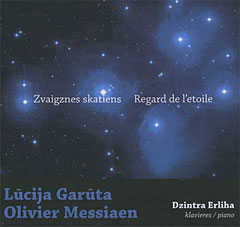
One thing that becomes immediately clear when reading her credentials is her fondness for Latvian composer Lūcija Garūta. It should come as no surprise then that on her first self-produced compact disc of solo piano music, released in 2008 and entitled Zvaigznes skatiens / Regard de l’etoile, she focuses on Garūta, as well as on French composer Olivier Messiaen. In fact, the CD was dedicated to the 100th birthday of Messiaen (in 2008) and the 105th birthday of Garūta (in 2007).

Garūta is probably best known for her cantata “Dievs, Tava zeme deg!” and, as part of the cantata, the choral arrangement of “Mūsu Tēvs debesīs” (The Lord’s Prayer). It is a staple and beloved work that most every Latvian choir performs. The cantata is hauntingly beautiful and tragic at the same time, considering it was composed in 1943 in the midst of World War II. To most listeners, it is the only work of Garūta’s they know, as it was with me prior to hearing the CD. This is a shame, really, since the piano works here are truly as engaging and captivating as the cantata.

The works by Garūta on this CD include “Sendienas”, “Etīde Teika” and four preludes (B minor, E Major, C sharp minor and D flat major). “Sendienas” (The Old Days) is particularly notable for Erliha’s reflective, yet not overwhelmingly sentimental (if a bit melancholy), performance. There is also the wondrous, fantastic feel of “Etīde Teika” (Etude Legend), as if Erliha was describing something amazing and unbelievable in her performance.

Messiaen is represented by selections from his “Vingt regards sur l’enfant-Jésus” (Twenty Gazes on the Child Jesus) suite for piano, considered one of his greatest works. Of the 20 gazes, seven are heard on the CD. The series of works was written at a time when France also was experiencing the horrors of World War II. Interestingly, at first listen, these works do not sound much like traditional sacred works. They all have a very modern and unique style. For example, Erliha ably performs with the gravity required in Gaze No. 12, “La parole toute-puissante” (The All Powerful Word), as well as the celebratory yet deeply serious Gaze No. 13, “Noël,” and the meditative and tender Gaze No. 19, “Je dors, mais mon coeur veille” (I Sleep, but My Heart Keeps Watch).

The accompanying booklet contains biographies of Erliha, Garūta and Messiaen in Latvian, English and French.

Erliha’s Zvaigznes skatiens is certainly worth checking out for any fans of Latvian or French piano music, as you have impeccable performances of piano works by both Garūta and Messiaen. Particularly noteworthy are the performances of the works of Garūta, who, apart from her cantata, is underrepresented in recent recordings of works by Latvian composers. This excellent CD goes a long way to correct that. It is clear that Erliha is truly a rising “star” among Latvian pianists.

Details

Zvaigznes skatiens / Regard de l’etoile

Dzintra Erliha

2008

Track listing:

Sendienas

Etīde Teika

Prelīde si minorā

Prelīde mi mažorā

Prelīde dodiez minorā

Prelīde rebemol mažorā

Nr.1 Tēva skatiens

Nr.2 Zvaigznes skatiens

Nr.4 Jaunavas skatiens

Nr.9 Laika skatiens

Nr.12 Vārds ir visuvarens

Nr.13 Ziemassvētki

Nr.19 Es guļu, bet mana sirds ir modra

On the Web

Dzintra Erliha

The artist’s Web site includes her résumé, news of concerts and downloads of music. EN LV

Where to buy

Purchase Zvaigznes skatiens / Regard de l’etoile from BalticMall.

Purchase Zvaigznes skatiens / Regard de l’etoile from BalticShop.

Note: Latvians Online receives a commission on purchases.

Egils Kaljo is an American-born Latvian from the New York area . Kaljo began listening to Latvian music as soon as he was able to put a record on a record player, and still has old Bellacord 78 rpm records lying around somewhere.

Comedy about Midsummer fails to impress

Midsummer Madness

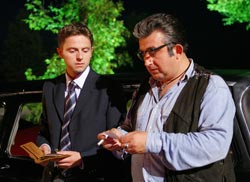
Orlando Wells (left) as Curt and Gundars Āboliņš as taxi driver Oskars are among the various actors in the comedy Midsummer Madness. (Photo courtesy EastWest Filmdistribution)

Much like every other culture and ethnic group, Latvians have their particular quirks. Celebrating the ancient pagan festival Midsummer (Jāņi) is just one of many. Besides singing songs, drinking a lot of beer, eating a lot of cheese and jumping over the bonfire, there is also the quest for the allegorical “blooming fern.” One might think that a reasonably funny and interesting film could be made about experiencing this in Latvia, which is what the comedy Midsummer Madness attempts.

The film was released in 2007 and the DVD (for Regions 2 and 5) became available in 2008. The movie was directed by filmmaker Alexander Hahn, who was born in Latvia in 1967 and immigrated to Germany in 1977, according to the Internet Movie Database. Perhaps it was the childhood in Latvia that compelled him to not just direct but also co-write the screenplay.

Though based mostly in Latvia, the film isn’t really directly about Latvians. It is more a collection of various stories of foreigners and their experiences in Latvia during the Līgo celebration (June 23) as well as Jāņi the following day (June 24). Several for the most part unrelated stories are contained in this film—perhaps too many. We have the story of the French woman Livia (Maria de Medeiros, Fabienne from Pulp Fiction), who has recently lost her husband, whose wish was that his ashes be dispersed in the Hill of Crosses in Lithuania. Joining her on this mission is Toni (Dominique Pinon, Joseph from Amélie), as well as their driver, Pēteris (played by Austrian Tobias Moretti, perhaps best known to Latvian audiences as inspector Richard Moser in the television series “Kommissar Rex”).

There is also the story of sex-crazed Aida (Chulpan Khamatova, Lara from Good Bye Lenin!), who is bringing home yet another new boyfriend, Yuki (Benito Sambo) from Japan, to meet her parents.

British firefighters from Liverpool, Lewis (James-William Watts) and Mike (Victor McGuire), meet Latvian fire chief Purviņš (Dainis Porgants) and, while celebrating with the Latvian firemen, go off looking for the mythical fern with, perhaps, unexpected results. Russian businessman Leonid (Yevgeni Sitokhin) tries to close some sort of deal with the Austrians Karl (Roland Düringer) and Axel (Detlev Buck). And Foma (Daniil Spivakovsky) and Jānis (Janis Blums) try to make their fortune by tapping into an oil pipeline.

Finally, there is the story of and American named Curt (Orlando Wells, from the British television show “As If”), whose father is dying. Curt is searching for his half-sister Maija (Birgit Minichmayr, Gerda Christian in Downfall) with the help of friendly taxi driver Oskars (Gundars Āboliņš, who is the only Latvian with a major role in the film), who provides Curt with some helpful notes about Latvia and Latvians (like how most every male name ends in “s,” and how you always bring a gift when visiting someone, even if you are meeting them for the first time).

If that sounds like there is a lot going on, well, there is a bit too much going on. Due to the number of stories, none of them get developed well enough to inspire more than a passing interest in any of them. The story that would have benefited the most from further development is Curt’s search,. However, at the start, Curt is made out to be an extremely unsympathetic and hostile character (given that his father is dying, this might be understandable though), so much so that the viewer may lose sympathy and not really care if he finds Maija or not.

Though meant as a comedy, some of the jokes are of the more obvious type. “Latvia? Lithuania? There’s a difference?” Check. Bribing corrupt policemen? Check. The Latvian city of Ogre pronounced a la Shrek? Check. Crazy old lady with a shotgun (always good for a chuckle)? Check.

The movie has other elements that perhaps only Latvians or those living in Latvia might find annoying, such as the taxi trip from Rīga to Ogre starting in broad daylight and ending in the dead of night (which, during Jāņi, is maybe about 3 a.m.). This implies that the taxi ride took about six hours, if not longer, when it should take no less than one!

I do think that there is potentially a very funny movie to be made about Latvia and Latvians and all the things that happen in the country, particularly during Jāņi, but Midsummer Madness is not quite there. Not quite straight comedy, and not quite the hyperactive ethnic comedy of, let’s say, one of Emir Kusturica’s films, it doesn’t flush out any of its stories. There are a few chuckles along the way (particularly the random kangaroo appearances), but not enough to sustain interest in the film. Mildly amusing at times, the film, bogged down with too many storylines and limited development, does not leave much of a lasting impression.

Details

Midsummer Madness

Alexander Hahn, director

Fischer Film, Steve Walsh Productions and Kaupo Filma,  2007

Notes: In English. Comedy, color, 90 minutes. Principal cast: Dominique Pinon, Maria de Medeiros, Tobias Moretti, Chulpan Khamatova, Orlando Wells, Birgit Minichmayr, Detlev Buck, Roland Düringer, Gundars Āboliņš, James-William Watts, Victor McGuire, Dainis Porgants, Yevgeni Sitokhin, Daniil Spivakovsky and Janis Blums; screenplay: Alexander Hahn, Alexander Mahler and Norman Hudis; director of photography: Jerzy Palacz; production designer: Ieva Romanova; costume designer: Thomas Oláh; editor: Justin Krish.

Egils Kaljo is an American-born Latvian from the New York area . Kaljo began listening to Latvian music as soon as he was able to put a record on a record player, and still has old Bellacord 78 rpm records lying around somewhere.