
In Nesaule’s novel, tenderness prevails tentatively

In Love with Jerzy Kosinski

Fans of Agate Nesaule’s 1995 memoir A Woman in Amber have been eagerly awaiting her first novel. Now, 13 years after her memoir received an American Book Award and international praise, it has arrived.

In Love with Jerzy Kosinski explores some of the same issues as A Woman in Amber in a fictional context: immigration, exile and the search for an authentic self after the trauma of war. It’s the story of Anna Dūja, an immigrant to America who escaped from Latvia as a child during the Second World War. Now 43, Anna finds herself in a trap largely of her own devising.

Anna is married to Stanley, an occasionally charming but manipulative Polish-American man. It’s a relationship that is at best disappointing. Stanley undermines Anna‘s self-esteem by offering a punishing kind of love, and the assurance that no one else could ever love her.

She finds solace in an imaginary love affair with the novelist Jerzy Kosinski, author of The Painted Bird, a book Anna reveres. (In A Woman in Amber, Nesaule described teaching this book to her American students.) Kosinski, she feels, is someone who could understand her fractured past, her post-traumatic present. They could comfort each other.

But even in her fantasies Anna has to admit that it’s unlikely that she could ever encounter the glamorous Kosinski in the northern Wisconsin countryside where she and Stanley live. Anna’s feelings of isolation there are reinforced by the fact that she can’t drive and must rely on Stanley or her neighbors to go anywhere.

Into the lake of her discontent Anna drops a tiny pebble: she learns how to drive.

The ripple effect is far reaching. One act leads to another, and eventually to the demise of Anna’s marriage. Though she remains susceptible to Stanley’s guilt-mongering and attacks on her self-worth, she begins to act in her own defence and on her own behalf, sometimes in surprisingly vigorous ways. 

Once established in her own apartment, Anna must deal with the usual struggles of a newly single middle-aged woman and face the challenges of anxiety and loneliness. She longs for companionship, for love. Her neighbor Molly tells her: “In real life it’s always women who find men. Always. So let’s get busy.” Nesaule doesn’t shrink from detailing the discrepancies between feminist beliefs and female actions and longings.

Here the novel flirts with the outlines of what can almost be called a genre: the middle-aged woman who leaves an unsatisfying marriage to find herself. Thus we are not surprised when a younger lover shows up in Anna’s life, nor that she discovers in her new relationship that the patterns of a lifetime die hard and can sometimes reincarnate in surprising guises. 

Perhaps not wishing to retrace territory already covered in A Woman in Amber, Nesaule reveals Anna’s traumatic wartime history in brief, dream-like fragments. She deals more directly with the personal histories of others. One is a Jewish survivor named Sara who becomes a friend (”…did all exiles automatically recognize and respond to each other like this? Did a complex past unite people even when they did not talk about it?”). The other is of course Jerzy Kosinski, whose autobiographical details become increasingly suspect over time. Are the events of The Painted Bird really based on his own experiences, as he once claimed? Or is the book a self-serving betrayal of those who helped him during the war? Are the growing criticisms of him, including accusations of plagiarism, true?

There is a book that Anna keeps hoping Jerzy Kosinski will write, one that will illuminate her own story as well as the stories of others. It will explain what happens when you live on the edge of war, even if you’re not one of its direct victims. When, in a line of stalled traffic, she hears that Kosinski has committed suicide, Anna thinks she knows why: “He was a child during the war: he was one of the hunted; he was one of the millions marked for death.”

One of the questions Nesaule asks in In Love with Jerzy Kosinski is about the purpose of retelling all the different narratives of suffering, of victimhood. What is the point of reliving these stories, of telling them? She comes up with a tentative possibility: “Maybe instead of clashing and competing, all the stories will weave together into a great tapestry, each thread part of an intricate, somber pattern. Maybe tenderness will prevail.”

Through her stubborn, almost unconscious quest for happiness, in the end Anna learns to have some tenderness, some compassion for herself as well. She finally manages to extricate her fate from that of the beloved Jerzy, “her idol, her soul mate, but not her twin.”

I wondered about Anna’s last name, Dūja. It wasn’t a word I recognized. My Latvian-English dictionary translated it as both “pigeon” and “dove.” In fact the two birds are close relatives and belong to the same family. Both have mournful songs and tend to build relatively flimsy nests, often in insecure places. But they are the strongest fliers of all birds, and are highly manoeuvrable in flight.

Details

In Love with Jerzy Kosinski

Agate Nesaule

Madison, Wis.:  University of Wisconsin Press,  2009

ISBN 978-0-299-23130-9

Where to buy

Purchase In Love with Jerzy Kosinski from Amazon.com.

Note: Latvians Online receives a commission on purchases.
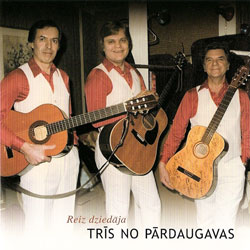
Trīs no Pārdaugavas compilation is essential listening

Reiz dziedāja

In the discography of Latvian music, one of the most glaring omissions has been the availability in digital format of American group Trīs no Pārdaugavas’ albums.

With only Circeņu kāzās—the trio’s album of songs for children—available on compact disc, it seemed as though the rest of Trīs no Pārdaugavas’ classic albums would never make it onto the digital medium. Finally, nearly two decades after the trio’s final recordings, the complete catalogue has been released on an expansive three-CD set entitled Reiz dziedāja. Having these songs on CD, rather than old scratchy and banged up vinyl records, was worth the wait.

Trīs no Pārdaugavas—made up of New Jersey area singers and guitarists Felkiss “Liksis” Ērmanis, his son Mārtiņš Ērmanis, and Vilnis Baumanis—began its work in the late 1960s. Actively performing and recording up until the early 1990s, the trio released a total of six albums and two compilations that included new songs. Mārtiņš Ērmanis died in 2000 and Felikss Ērmanis in 2004.

Reiz dziedāja gathers the albums Trīs no Pārdaugavas, Zilā jūriņā, Dienu virpulī, Mīkstās mēbelēs and No tālām robežām, as well as the new songs released on the compilations Tēvzemei and Ar rozi un ar prievīti.

The collection is a testament to Trīs no Pārdaugavas’ talent, as well as the trio’s significance in the Latvian-American community. Along with the Čikāgas piecīši, Trīs no Pārdaugavas was one of the most visible, active and beloved Latvian-American groups. The trio even gave a concert in Rīga’s Mežaparks, attracting tens of thousands of listeners.

Why was the trio so beloved? I suppose the reasons include the band’s singing and harmonies (particularly Fēlikss’ resonating voice), Baumanis’ arrangements, and the original songs (with lyrics by Baumanis) that often were about Latvian life in the United States. Or, perhaps, they were just three regular guys who came together and brightened the lives of many listeners. The music certainly is not flashy, nor does it need to be. With just three voices and three guitars (and the occasional bass guitar, percussion and piano), they were able to produce many memorable songs and melodies.

One can trace the evolution of the ensemble through this collection. The trio’s first album, the self-titled Trīs no Pārdaugavas, has a more traditional feel to it in that many of the songs were old Latvian standards, such as “Lulu,” “Lakstīgalu naktī” and “Vēstule no tāluma.” There is also a heartbreaking rendition of the Latvian folk song “Jūras māte,” where the harmonies and the transition from major to minor give the song a particularly emotional feeling.

The influence of American culture was inescapable and can be heard on the trio’s recordings. Witness the songs from Zilā jūriņā, many of which feature an almost hippie influence to them, such as the Baumanis original “Mēs gribām rokās sadoties.” There is also the melancholy “Tauta tālumā,” another Baumanis original that laments the seemingly sad fate that awaits the Latvian people, both abroad and in Latvia—at that time still well under the thumb of the Soviet government.

I like that Trīs no Pārdaugavas did not take the easy route and play well-known Latvian standards. For example, you won’t find such tired songs as “Pie dzintara jūras” or “Še kur līgo priežu meži.” Instead, the trio performed long-forgotten classics such as “Labāk glāzes pilnas liesim,” originally by the pre-World War II Latvian group Brāļi Laivinieki, as well as the tender gem “Klusi klusi ratiņš rūc.” I also like the trio’s arrangements of other songs, to the point where I think the group’s versions are superior. A personal favorite is Trīs no Pārdaugavas’ version of Raimonds Pauls’ “Kamola tinēja,” originally performed by Imants Skrastiņs in a half-sung, half-spoken manner, but now transformed into a beautifully tender song.

During the 1980s, with Baumanis at full strength as a songwriter, the trio recorded a number of classics, such as “Ratiņš” and “Kaimiņš”.

The group’s recording career closed in the early 1990s, with Latvian independence almost in reach.  Songs again reflected the era—including “Šņāc un krāc,” “Pārkārtošanās” and “Latvijā – 1990,” which is about the trio’s experiences performing in Latvia in 1990.

The three CDs gather an impressive total of 70 songs. Included is a very informative booklet that has all the lyrics and also notes by Baumanis on many of the songs. Besides defining some of the Latvian-American jargon used in some of the songs—such as vīkends for weekend, pārtija for party, and kvadrātpieres for squareheads—Baumanis also clarifies some of the lyrics that may not make immediate sense to some listeners. For example, the song “Latvieši kopš seniem laikiem” mentions two Greeks, one of whom stole away with Jacqueline (a reference to shipping tycoon Aristotle Onassis) and another who drinks wine in the White House (a reference to disgraced former U.S. Vice President Spiro Agnew). If I were to find any fault with this collection, it would be that it would have been great to have even more notes from Baumanis on these songs. That would have made for some very fascinating reading.

Even though the trio played its last shows and recorded its last songs at the beginning of the 1990s, and even though two of the three members of the band are no longer with us, the group and its achievements are by no means forgotten. These timeless songs formed a significant part of the fabric of diaspora Latvian life. We are fortunate that Trīs no Pārdaugavas even existed, let alone performed and recorded. This is absolutely essential listening.

Details

Reiz dziedāja

Trīs no Pārdaugavas

EBE,  2008

Egils Kaljo is an American-born Latvian from the New York area . Kaljo began listening to Latvian music as soon as he was able to put a record on a record player, and still has old Bellacord 78 rpm records lying around somewhere.

S.I.L.S. releases debut, then takes year off

Stāsti patiesi un izdomāti

An up-and-coming band on the Latvian rock scene is S.I.L.S., which released its debut album, Stāsti patiesi un izdomāti, in 2008. The group was founded way back in 1999 and has had songs included on various Priekšnams alternative music collections, as well as performing at several of the Bildes festival concerts in Rīga.

The album’s distributor, Platforma Records, describes the band as “post grunge.” Although this is a vague label for music, it usually involves taking the distorted and fuzzy guitar of grunge music, as well as the often angst-filled lyrics, and adding more melodic elements. On its Web site, the band’s music is described as always having been “about pain, love and unfulfilled dreams.”

The name of S.I.L.S., though seeming to be an acronym, is cryptically described on the Web site as being related to viewing the approach of evening through a window in the Ķengarags region of Rīga.

The members of the band are Ģirts Strumpmanis on vocals and guitar, Kaspars Lastovskis on bass and Māris Ozoliņš on drums, with guest appearances by Ronalds Seleckis on guitar. Almost all of the music is written by Strumpmanis, and Strumpmanis and Seleckis wrote most of the lyrics.

The album begins with “Izpratne par skaistumu,” which alternates between melodic verses, with a cleaner guitar sound, and a more distorted chorus. I think the band is more effective when it focuses more on the melodic aspects in its song writing, such as on “Pavasaris,” which is probably my favourite song on the album. Another favorite is “Beigu dziesma,” another one of the band’s more melodic songs. Four songs on the album are in English: “Morning,” “Carousel,” “Trust” and the final “hidden track,” which on the S.I.L.S. Web site is called “DLS2.”

The music and lyrics are, overall, a bit on the dreary side, certainly bringing forward the angst that is heard in other such bands influenced by the grunge style. The main problem I have with the album is that many of the songs are very similar—particularly the alternation between the clean guitar sound and the distorted guitar sound.

The album was mixed and mastered by Gints Sola of Jauns mēness and Mielavs un pārcēlāji. The album art was provided by Otto Zitmanis, who worked on the cover for Prāta vētra’s latest album, Tur kaut kam ir jābūt.

On its Web site, the group has indicated that with the release of this album, band members will take 2009 off to concentrate on their side projects. Certainly S.I.L.S. has presented an accomplished debut album, exhibiting both musical and lyrical talents. Fans of grunge and post-grunge should take a listen.

For more on S.I.L.S., visit the band’s official Web site, www.grupasils.lv, its MySpace page or its page on the social network draugiem.lv.

S.I.L.S. band members

The “post-grunge” band S.I.L.S. released its debut album in 2008, but is taking this year off to pursue other projects. (Publicity photo)

Details

Stāsti patiesi un izdomāti

S.I.L.S.

Melo Records,  2008

Track listing:

Izpratne par skaistumu

5.gadalaiks

Pavasaris

Prieki un mode

Mīlestība nr.2

Morning

Bez pārsteigumiem

Beigu dziesma

Dziesma par sievieti Wāvu no Ruandas

Carousel

Trust

DLS2

Egils Kaljo is an American-born Latvian from the New York area . Kaljo began listening to Latvian music as soon as he was able to put a record on a record player, and still has old Bellacord 78 rpm records lying around somewhere.