A bitter wine turns out flat, emotionless

Still from Rūgtais vīns

Among characters in Rūgtais vīns are Ralfs (played by Normunds Laizāns), Agnese (played by Agnese Zeltiņa) and Donats (played by Kaspars Znotiņš).

Many “character-driven” Latvian films wind up being rather ponderous. The films feature many tortured souls (Nerunā par to, Augstuma robeža and Amatieris come to mind), but they don’t make the stories compelling. In fact, the characters wind up being more irritating than tortured, and one loses interest in whatever happens to them. Something similar happens in the 2007 film Rūgtais vīns (The Bitter Wine), directed by Rolands Kalniņš, written by Jānis Jurkāns, and available on DVD.

The story is about a guy named Donats (played by Kaspars Znotiņš), described in the film’s summary as a “modern day Don Juan,” which I suppose is true as the film gets divided into multiple episodes, each dealing with Donats and one of five girlfriends.

The film is described as a melodrama, which by definition should be a film with amplified, even exaggerated, emotions. However, since many of the characters in the movie (and in many other Latvian films) talk like robots, with little or no emotion, I’m not so sure I would call it a melodrama. The main question I had at the end of the film is how Donats, who exhibits minimal personal charm, and whose emotions seem to limited to the tiny space between not smiling and faintly smiling, is able to have so many women fall for him. Must be some really powerful pheromones, I guess.

Donats apparently drives all women who come into contact with him mad, including Baņuta, played by Rēzija Kalniņa; the artist Anna, played by Aurēlija Anužīte-Lauciņa; the older Regīna, played by Regīna Razuma; and even Ieva, played by young singer and saxophonist Liene Šomase. However, he seems to have been stymied by Agnese (played by Agnese Zeltiņa), his boss at the graphic design studio where he works. Agnese appears to be an unrealized conquest, but that is likely due to her overprotective and jealous husband Ralfs (played by Normunds Laizāns), a very successful, if slightly menacing, architect who sports curious fashions combos, like a grey suit, purple shirt, and black and white tie.

The film’s climax comes as Ralfs gets progressively more and more jealous of Donats (with one scene of Ralfs angrily playing pool to drive the point home) and then makes a few ominous but vague threats of poisoning. Donats backs off, but I am not really sure, because the ending is ambiguous.

The only character who exhibits something close to a personality is Donats’ older and wiser colleague Varis (played by Pēteris Liepiņš), who halfheartedly suggests to Donats to change his ways, but looks on in amusement as the situation between Donats and Agnese develops. There is also what I assume to be an homage to Federico Fellini’s La Dolce Vita, with a similar fountain bathing scene involving saxophonist Ieva.

The film is short, but those 80 minutes go by pretty slowly. I hesitate to call the film tedious, as it does try to analyze all of its characters and tries to show that Donats is doomed to unhappiness as he juggles these five relationships. But, by the end, it remains unclear if he repents or suffers for his “sins.” Even W. A. Mozart threw his Don Giovanni into the depths of hell at the end of the opera, but nothing so dramatic or interesting happens in Rūgtais vīns. Donats seems to just glide between all of his relationships, with none of them appearing to be at all fulfilling or satisfying. Perhaps that is the point. He is supposedly a passionate lover for Baņuta, who complains about the inept flirting of the men at her workplace, but their conversations wind up being rather banal, with them halfheartedly discussing a ski trip to Norway. Baņuta offers vague compliments. “Dažreiz tu esi jauks” (Sometimes you are nice) is about the most passionate and emotional thing she says—not that Donats says anything more romantic. Baņuta then disappears from the screen, never to return or even be mentioned again, begging the question of why was she there in the first place?

What is the point of this film? I am not really sure. Znotiņš surely is an excellent actor, but this dreary dialogue and the minimal emotion he is allowed to express do him no favors. Why does he have all these girlfriends? Is he happy or unhappy? Will he ever change, or will he continue to bounce around among many women? Who really is Donats? Where did Ralfs get that fabulous purple shirt? I don’t know the answer to any of these questions. For all of his supposed charm, Donats seems like a rather empty guy, which makes for a rather empty movie.

Details

Rūgtais vīns

Rolands Kalniņš, director

Platforma,  2007

Notes: In Latvian. Drama, color. 80 minutes. Screenplay by Jānis Jurkāns; camera: Gvido Skulte; art director: Kristaps Skulte; costumes: Ieva Kundziņa; makeup: Sarmīte Balode; music: Valts Pūce; sound: Anrijs Krenbergs; editor: Sandra Alksne; producer: Guna Stahovska; principal cast: Kaspars Znotiņš, Agnese Zeltiņa, Normunds Laizāns, Rēzija Kalniņa, Liene Šomase, Aurēlija Anužīte-Lauciņa, Regīna Razuma and Pēteris Liepiņš.

DVD is in PAL format with Region 2 and Region 5 encoding.
Egils Kaljo is an American-born Latvian from the New York area . Kaljo began listening to Latvian music as soon as he was able to put a record on a record player, and still has old Bellacord 78 rpm records lying around somewhere.

Zigrīdas Kalpi serves up twist to traditional songs

Zigrīdas kalpi

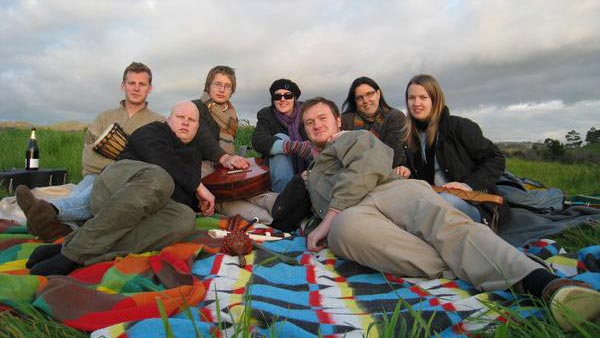
Zigrīdas Kalpi unites two Latvian-Australian folk ensembles, Zigrīda Ansamblis and Kalnu Kalpi. (Publicity photo)

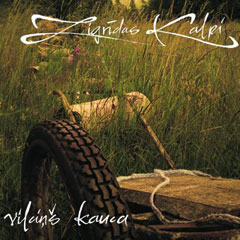
Vilciņš kauca

Vilciņš kauca is an EP compact disc released by Zigrīdas Kalpi, a collaborative project between seven third-generation Latvian-Australians living in Adelaide and Brisbane.

These talented musicians, inspired by traditional Latvian folk music, arranged their favourite songs and produced the recording. The songs are well-known Latvian folk melodies, but the group’s unique interpretations are refreshing. Even the most familiar tunes ring with a new quality.

Kalnu Kalpi is a male folk group from Adelaide that sings ancient Latvian war songs and Zigrīda Ansamblis is a female kokle group from Brisbane. The two groups have been playing independently for many years, performing at Australian Latvian arts festivals such as Jaunatnes dienas and Kultūras dienas. Through their common interest in Latvian folk music, members of the two groups forged friendships and developed a mutual respect for each other’s musical ability. Recently, they united and have played together as Zigrīdas Kalpi during the 2008 Kultūras dienas in Sydney and at the National Folk Festival in Canberra this year.

Both Zigrīda Ansamblis and Zigrīdas Kalpi tracks have received airtime on ABC FM, an Australia-wide national radio broadcast.

The members of Zigrīdas Kalpi are Aleksandrs Šmits (percussion, voice), Ance Deksne (kokle, melodica, percussion, voice), Krišjānis Putniņš (guitar, percussion, voice), Mārtiņš Medenis (recorder, percussion, voice), Matīss Biezaitis (bass guitar), Tija Lodiņa (percussion, voice) and Valda Biezaite (vargāns, recorder, percussion, voice).

Vilciņš kauca features traditional Latvian instruments including the kokle, the recorder and the vargāns (Jew’s harp). The melodica replaces the sound usually produced by an accordion and the songs often rely on a guitar and bass guitar accompaniment. These are not traditional instruments, however, with the contemporary arrangements less conventional sounds integrate well with the traditional melodies.

“Gaismeņa ausa,” sung in the Latgalian tongue, speaks of light dawning as the sun rises early in the morning. The recorder and guitar accompaniment evokes a medieval sound. Powerful male and female vocal harmonies give the song strength in contrast with the breezy instrumentals. The unique voices of the individual members of Zigrīdas Kalpi are characteristic to the sound of the EP and I found the more times I listened to the disc, the more I could separate individual voices and appreciate the vocal harmonies in each song.

The title track “Vilciņš kauca” (The Wolf Howled) is a favourite of many Zigrīdas Kalpi fans who first heard the song when the group performed it at Kultūras dienas. The song is about a man going to Rīga with his wolf to buy his father tobacco. Zigrīdas Kalpi arranged the song as a reggae number but still preserving the folk element. Hearing this song performed live, it is impossible to resist moving your body to the beat and getting into the funky groove folk-reggae. A recording studio removes the audience and the subtle audio and visual cues from a performance that can make a song sound fantastic, so to hear this song at its best, enjoy it live (or the next best thing—YouTube).

The EP only includes five songs, not enough to satisfy the senses, but enough to demonstrate the musical capability of these musicians. In “Gula meitiņa” the combinations of kokle and bass guitar, and percussion accents and vocal overtones, create a rich musical tapestry. In “Div’ dūjiņas,” a song about two doves sprinting through the air and two soldiers riding on horseback to war, the recorder harmonies race over the drum beats and clapping sticks, which keeps the song moving at a fast pace like the doves and the horses. The haunting vocal arrangements in “Lēni lēni” give a sombre and musically sensitive conclusion to the CD, indicative of the musical intuition of Zigrīdas Kalpi.

Hopefully, the members of Zigrīdas Kalpi will continue their joint musical projects and more folk-reggae tracks are to come.

Details

Vilciņš kauca

Zigrīdas Kalpi

2009

On the Web

draugiem.lv

The group’s page on the Latvian social networking site draugiem.lv. LV

Zigrīdas Kalpi

Formed in 2008, Zigrīdas Kalpi joins two Latvian-Australian folk groups, Zigrīda ansamblis and Kalna kalpi. The group’s official Web site includes information on ordering the EP compact disc. EN LV

Zigrīdas Kalpi on MySpace

The group’s page on MySpace includes samples of its music. EN

These sound poets push dark buttons

Sound Poetry

In 2006, five guys formed a collective “quite accidentally,” becoming The Sound Poets—or S.P.B. This accident partially stems from the fact that most of the band members took academic degrees in subjects related more to the business world than to that of the arts. Through the band’s Web site, one gains the perception that they started their “band life” based more on a crap shoot than anything else.

But factor in the various Radio SWH victories, a MTV Baltic video debut and the outright talent, one has to take this perception and disregard it. The band released its debut album, Sound Poetry, in December.

S.P.B. has enjoyed single-by-single success since 2007 (with its first single “Pearl Tears” reaching the Radio SWH Top 20 No. 1 in March) and has been readily introduced to the Latvian rock sector, by performing in both the 2007 Baltic Beach Party and the PositivusAB Festival. But even with all of this, I have to say that the band seems to have remained rather unknown. I myself only stumbled upon it when browsing the MySpace pages of local Latvian bands. To its credit, S.P.B. had something that made me want to know more.

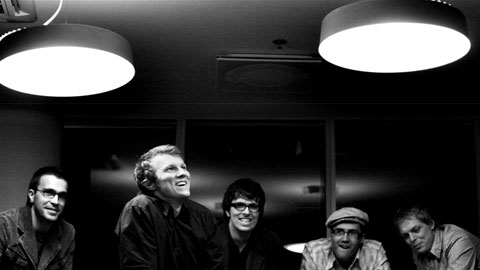
The five members who make up S.P.B. are Jānis Aišpurs (vocals, keyboards and guitars), Ingars Viļums (bass, guitars and keyboards), Andris Buiķis (drums), Normunds Lukša (guitar) and Artūrs Eglītis (keyboards and back-up vocals). In all honesty, the music itself is good, but the unique sound of S.P.B. rests mostly on its vocals.

The album’s first track, “Ikaros,” is a nice a capella bit. It makes you hold your breath as your senses strain to catch each note of the romantically tuned intro. And then you’re pitched the line “I think it’s beautiful day to spread my wings and die.” Take it in now: This is how S.P.B. works.

The majority of the album is ethereal vocals and catchy beats mixed with lyrics that are unnaturally and shockingly dark for the bright-eyed group of guys smiling up at you from the album’s disc jacket. I still don’t know what to think, how I feel or if I should be tapping my foot to songs about self-doubt and uncertainty.

The album continues with vocal and sound plays in a track aptly named “Poet,” wherein S.P.B. tests the waters with reverb, echoes and something that feels like you’re in a tunnel. “Poet” is one of the strong points of the album, a charming song that reminds me of one of Ben Folds Five’s less annoying songs. Other than that, Sound Poetry is a slow ride. Most of the time, it is the refrains alone that save each individual track from becoming mundane.

One more song that in no way falls into that rut is track five, “Another Day.” The song, my favorite on the album, has a very involving introduction and an overall catchiness. It seems to include everything you need to “get” S.P.B.: delightfully “bipolar” vocals, variations in the themes of the song, free application of synthesizers and a good beat.

One thing S.P.B. does well is tackle sounds—all kinds of them. Many tracks sound like they might have been recorded in a cement tunnel or in a tiled bathroom. Other tracks include such additions as stomping boots, restaurant clatter and traffic on a rainy day. While listening, you at times feel as if you’re in a traveling performance and as an audience member are tasked with keeping up with the band. All of these things are little hooks that could either keep you listening “for just a few seconds more” or that could make you hit the eject button on your stereo system.

The sixth track, “Body Selling,” takes the album from slightly off-beat relationship songs to a more serious and potentially uncomfortable subject matter. What sells this track for me is the aforementioned sound of stomping boots and clapping hands, elements that lend the song something both intoxicating and eerie. I personally get antsy after this track, a point at which I feel like I’ve gotten everything I can out of the album.

Still, S.P.B. manages to putter on through to the last track, where it teeters on the fence with a mini-ballad (“Feeling Behind”) I don’t remember enough about to really comment on. S.P.B. won’t be readily liked by everyone. However, there is also no doubt that this mixture of innocent, teen movie sounds and dull razor blade lyrics will catch your attention. This may make you feel uncomfortable or disjointed, but this is what poets do best—they test the boundaries of their audiences by purposely pushing previously unpushed buttons and touching on topics that might otherwise stay uncovered.

S.P.B.

The five-member Latvian band Sound Poets, or S.P.B., was formed in 2006. (Publicity photo)

Details

Sound Poetry

Sound Poets

SPB Records,  2008

PMP3133

Track listing:

Ikaros (intro)

Poet

Pearl Tears

The Moon

Another Day

Body Selling

It Takes Me

Spinning the Sun Around Fingers

Breaking Bounds

Pilgrim

The Doors

Feeling Behind