Better liner notes make for better dancing

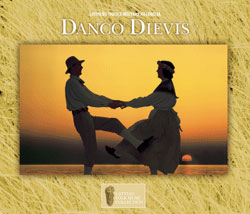
Danco Dievis

The newest addition to UPE Recording Co.‘s Latvian Folk Music Collection, Danco Dievis, can be seen as a continuation of last year’s Latviešu danči (Latvian Dances). Musically I found both albums to be just as enjoyable, but in terms of liner notes Danco Dievis is superior.

In this collection all of the pieces are not played by the same group as they were in Latviešu danči. Here they are performed by four different groups: Dziga, Laimas muzykanti, Dandari and Danču mūzikas grupa. Danču mūzikas grupa is composed of individuals who belong to other groups. They include several musicians and singers (Ilga Reizniece, Kristīne Karele, Mikus Čavarts, Gints Sola, Andris Alviķis, Ilmārs Mežs and Māris Muktupāvels) who performed on Latviešu danči.

The author of the dance instructions is Ernests Spičs, who calls himself an ethochoreologist. I found many of these dances (such as “Suseklis” and “Tymsa, tymsa”) to be somewhat simpler than those on Latviešu danči. Maybe therefore some of these dance instructions seem to be clearer.

The collection contains many pieces that are not well known in North America. One, “Trīnīte,” is even from the Latvian village Lejas Bulāna in Siberia! Several others I heard for the first time.

The first song in the collection is a wonderful version of “Pērkonītis,” a well-known and much-loved dance. In this recording the verses are sung a cappella with just a drum providing a beat. Between the verses the music was purely instrumental. If you hear this piece in the morning, you will be singing and humming it all day long. The name of the album comes from the words of this song: “Danco Dievis ar Pērkonu,” translated as “God dances with Thunder.”

Another piece that will be familiar to many is “Krustdeja,” which may be better known as “Rucavietis,” a dance often learned and performed by Latvian folk dance ensembles in North America. Although listeners may not know it as a dance, the song “Samniekdēli” also will probably be recognized.

Of the lesser-known pieces on the album, the ones I enjoyed most were the toe-tapper “Suseklis” and “Vēžu dancis,” which had me feeling like I really was at a Saturday night dance somewhere in the Latvian countryside.

In addition to the dance instructions, the liner notes contain a short essay (in Latvian and English) about dancing. Spičs writes, “Dance is hardly comprehensible to the rational mind—there is no adequate intellectual explanation for it. Dance can only be comprehended by the senses. Dance offers the opportunity to find harmony with all that is: to find connections and to come into attunement with everyone and everything.” Anyone who has let themselves be swept away by a good polka will agree. Spics also comments that, although the liner notes include dance instructions, “one really should participate in events with traditional dancing in order best to learn how to create dance variations and even to improvise.” Unfortunately, for those of us outside Latvia, this may prove difficult.

Another nice aspect about the liner notes are the one or two sentences that tell a little about what region of Latvia the dance is from and what it’s like. For example, regarding “Tymsa, tymsa tei egleite,” Spičs writes, “Senā latgaliešu precību rotaļa, kas piemērota arī kautrīgiem mūsdienu jauniešiem” (“Old wedding game from Latgale; also appropriate for today’s shy youth”).

Overall this is another worthy addition to the Latvian Folk Music Collection and to the collection of any individual who enjoys Latvian folk music.

(Editor’s note: This article originally appeared on SVEIKS.com.)

Details

Danco Dievis

Latviešu tautas mūzikas kolekcija

UPE Recording Co.,  2000

UPE CD 019

Mielavs frustrates, but holds out hope

Es nāku uz Taviem smiekliem

Every time listening to this album, I am reminded of a January afternoon in Old Rīga, sitting across a cafe table from Ainars Mielavs. He seemed uncomfortable in the role of interview subject, even though the interview was not about him but about his recording company. I left frustrated because Mielavs had not opened up more, but I was just as frustrated with myself, wishing I had posed my questions differently. Yet I also felt empathy. And so it goes with this album: frustration with Mielavs, frustration with myself, but with a sense that I know what he’s singing about.

Es nāku uz Taviem smiekliem (I Come in Response to Your Laughter) is Mielavs’ debut solo effort. This is Mielavs without the folk-rock influence of Jauns Mēness and without the masterful compositional hand of Imants Kalniņš, with whom he has released three albums. Es nāku is a showcase for Mielavs’ lyrical talent—it is a remarkable one—and for his musical skills, although he does get a hand from guitarist Gints Sola, who carries the brunt of the instrumental work on most of the tracks.

Almost all of these are love songs. They are presented in a variety of musical styles, from blues to jazz to pop. Several are painful yet optimistic love songs that dig into the relationship between two people. For example, the first track, "Labradors" (Labrador), tells of a volatile, crumbling relationship and a man’s hopeful search for his beloved’s conscience: "The walls collapsed in hatred / With dampened emotions / And all the ordinary days / Became the best of days."

These also are simple songs, with direct, strong imagery in the lyrics and—in most cases—a minimal musical underlayment.

It is this simplicity that in part leads to frustration. Mielavs in his lyrics relies often on lists of similes, of opposing thoughts, or just things. He’s done this in the past with Jauns Mēness songs, and does it here on at least five of the 12 tracks. For example, there’s "Dvēselu noliktava" (Warehouse of Souls), which has lines such as "Fame is a net which entangles / Fame is 100 proof rum / Fame is thin air on which to climb / Fame is an overthrow of values." And in "Visvairāk un vismazāk" (The Most and the Least), we have verses such as "There are books that I read the most / There are weaknesses I reveal the most / There are hopes I believe in the most / There are people I feel the most." It’s a simple and often effective songwriting technique, but when the technique begins to overpower the lyrics, perhaps it’s time to explore other forms. How about a ballad, Ainar?

Mielavs also often repeats verses, as if he were telling the audience, "Listen carefully to what I just said." In songs such as "Es izvēlos būt" (I Choose to Be), the technique at times left me thinking that additional lyrics could have been just as helpful, but at other times found me listening intently.

Musically this album has Mielavs’ voice supported on most tracks by unembellished, controlled guitar work, with an occasional banjo or mandolin. But again, too much simplicity can be frustrating. If Mielavs isn’t going to explode, at least the guitar could! Fortunately, the album is fairly well-paced. The first two melancholy tracks, "Labradors" and "Es nāku uz Taviem smiekliem" are followed by a slightly uptempo "Par un pret" (For and Against). And all the tracks seem to build toward the big finish that is the final song.

The final track, "On My Way to the Big Light," is the only song in English. Written by Mike Scott, the Scottish-born singer known for his work with The Waterboys, it is performed by Scott and Mielavs. It’s an uplifting tune, somewhat out of synch with the rest of the tracks, but nonetheless appropriate with its chorus of "All love to the Love / All flame to fire / All wings to the wind / All that lives, higher!"

The album as a whole is frustrating, but I find that it keeps digging into me—and that’s frustrating, too. My favorite tracks have become "Labradors," "Es nāku uz Taviem smiekliem," "Visvairāk un vismazāk," and "Tavu acu augstumā" (On the Level of Your Eyes), which is a gentle song, it seems, about a short woman.

This is a collection of songs that demands a careful ear, that requires listening again and again to understand fully. More so than other recent Latvian recordings, this album asks the listener to think about their own experiences in life. And the more I listen, the more I understand.

A final note: UPE has been doing a nice job with liner notes on all its recent releases, and this album is no exception. Lyrics are included in Latvian and English, with some of the translation done by Mielavs’ friend and Latvia’s former ambassador to the United States, Ojārs Kalniņš.

Details

Es nāku uz Taviem smiekliem

Ainars Mielavs

UPE Recording Co.,  2000

UPE CD 015

Andris Straumanis is a special correspondent for and a co-founder of Latvians Online. From 2000–2012 he was editor of the website.

Choir’s recording highlights Rīga venues

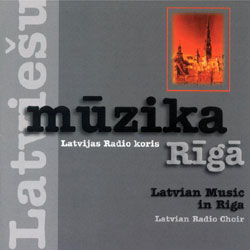
Latviešu mūzika Rīgā

Latvians call themselves a "singing people." Wherever Latvians gather, a choir is inevitably formed! While the musical ability of many amateur choirs is admirably high, elite and professional ensembles also have an important role in inspiring and performing more difficult and challenging music and presenting Latvian music internationally.

Prominent among these is the Latvian Radio Choir. Established in 1940, it was dubbed the "Teodors Kalniņš Choir" during the latter period of the Soviet occupation in honor of its founder, but since Latvia’s return to independence has again been known by its original name. A flexible ensemble ranging from five to 90 singers allows them to perform music of many styles and eras. The singers’ professional ability and the talented leadership of Sigvards Kļava have raised them to a remarkable level of virtuosity and skill. A prominent Latvian composer recently told me this is the only choir in Latvia currently capable of properly performing this composer’s very difficult vocal music.

The particular interest and value of this new recording, Latviešu mūzika Rīgā, is that it mostly features recent music the average listener wouldn’t usually seek out or encounter. Even "A Birch in Autumn," by the "old master" Jāzeps Vītols, is not among his most frequently performed works. An ethereal, subtle nature evocation, it’s beautifully rendered here with sensitive vocal blending by the Chamber Singers of the Latvian Radio Choir. Ably conducted by Kaspars Putniņš, this ensemble also performs two other works. Pēteris Plaķīdis’ brief setting of the traditional Latin text "Domine salvum fac populum" (Lord, Save Thy People) is propelled to its conclusion by an effective use of repeated figures. In Romualds Kalsons’ harmonically imaginative "In the Sounding Hill," the choir vividly portrays repeated echoes.

Artistic Director Sigvards Kļava leads the full choir in the rest of the program, most of which is also of a spiritual nature. For me, the most impressive discovery was Maija Einfelde’s "Psalm 15." This powerfully expressive setting subtly builds dense dissonances resolving in calmer, more peaceful passages. This is uncompromising, sincere music of harsh beauty. Juris Ābols offers an impassioned setting of "Ave Regina coelorum" (Hail, Queen of Heaven). The "Agnus Dei" from Artūrs Maskats’ "Mass" forms an emotional arch, from a peaceful beginning, building to a dramatic organ passage, then subsiding to a calm conclusion. Andris Dzenītis is the youngest composer represented here (born in 1978), in a lengthy, intense, often anguished setting of "Ave Maria."

St. Francis of Assisi’s writings inspired Pauls Dambis to compose his cycle, "Canti Francescani," from which two sections are heard. In "A Prayer," alternating soprano and baritone soloists’ chantlike passages elicit choral responses. Repeated cries of "psallite" are prominent in "A Song for Sister Death." Pēteris Vasks has come to be contemporary Latvian music’s best-known exponent internationally. The beauty and radiance of his "Dona nobis pacem" never fail to carry the listener along. Aivars Kalējs accompanies impeccably on the organ.

Two secular works fill out the program. Though Imants Kalniņš is known as "the people’s composer," his music never condescends. His special talent for making fresh and imaginative use of simple ideas is effectively heard in "Cinderella." Juris Karlsons’ brief "My Song" is a lovely, engaging piece, sounding "Latvian" (at least to another Latvian) without retreading old formulas.

Another interesting aspect of this release is that every composer’s music was recorded in a different venue in Rīga: churches, university and museum halls, and a recording studio. Not only do the locales sound acoustically splendid and well-suited to the music, but the engineering is remarkably consistent, so there is no jarring change from one acoustic environment to another. The artistically handsome accompanying booklet is filled with photographs of the various locales with interesting historical information. Notes are in Latvian and excellent English, though the latter is sometimes not idiomatic. One other minor caveat: Latin pronounciation is sometimes irritatingly "Latvianized."

This is a magnificent production worthy of the widest dissemination and exposure. Hats off to Kļava for his brilliant conducting and sensitive interpretations, and to the choir for their skill and artistry. Though much of this program is challenging and intense, requiring thoughtful listening with receptive ears and an open mind, it is definitely not a compilation of avant-garde gimmicks or polemics. Latvian composers are clearly aware of international musical trends and techniques in addition to local traditions and practices, and have transcended both to produce music of substance and variety, with both emotional and intellectual appeal.

(Editor’s note: This article originally appeared on SVEIKS.com.)

Details

Latviešu mūzika Rīgā

Latvijas Radio koris

Latvian Radio,  1999