A charming guide, but not enough dill!

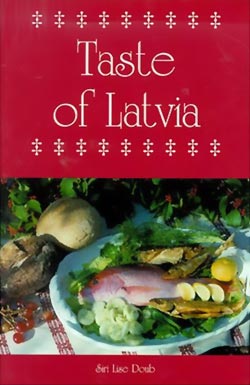
To see one’s culture through the eyes and experiences of someone outside that culture is fascinating. In her travel and cookbook, Taste of Latvia, author Siri Lise Doub takes us with her on a meandering exploration of the four corners of Latvia. She stops along the way to visit common tourist sites, and also invites us into the homes of families she visits. Photographs accompany the stories and show us the sites. The narratives are intertwined with translations of poetry and folk songs, mythology, traditions and even superstitions. Vignettes of Latvia’s history are included to round out the picture.

But Taste of Latvia is not only a collection of experiences of the author as a tourist. It is a cookbook as well.

A friend once asked me, “What is the basis of Latvian cuisine?” I answered: “Pork, onions and potatoes in infinite combinations with other things.” The recipes in this book seem to bear out my observation. Breads, fish, soups and dairy products round out the menu. Included are more than 100 recipes that are simple and useful for every day. The food is hearty and filling. A few of the recipes are for foods defined as holiday specialties.

I am glad that some of what might be considered “odd” about Latvian cuisine is explored and discussed. I refer to the sections on milk soups, on salads that contain no lettuce, homemade cheese and drinks that are boiled juices. We who have grown up with these foods understand how good they are, but sometimes find it hard to explain to folks trying them for the first time.

For someone looking for an introduction to a new culture, this guide would provide easy reading. However, for those of Latvian descent, there are a few jarring problems.

Some translations from Latvian to English really miss the mark. I had never heard the word “Dievs” (God) translated as “Bright Sky” or “Bright Sun.” In the wedding customs, “mice” is described as the ancient word for marriage, in translation “taking off the crown,” when in actuality, “mice” is from the German “muetze” meaning cap or hat.

Grammar in the Latvian texts is inconsistent, at times including diacritical marks, in other places ignoring them. Explanations of traditional holidays, costumes and superstitions are colorful and plentiful but some contain small factual errors. These might be due to variations in local customs or just relying on personal opinion instead of research.

Home-brewed beer was rarely mentioned, although beer is the traditional drink on various holidays. Some Latvian beers are now being exported, for those who want to try them.

A short note about the recipes: Not enough dill! Many salad, potato and fish recipes list chopped parsley, when more commonly dill would be used. Feel free to make this substitution. Add caraway to any cabbage or sauerkraut dish, or any rye bread.

Overall, Taste of Latvia takes the reader on a charming “armchair tour” of Latvia, and whets the appetite for travel and for cooking!

(Editor’s note: This article originally appeared on SVEIKS.com.)

Details

A Taste of Latvia

Siri Lise Doub

New York:  Hippocrene Books,  2000

ISBN 0-7818-0803-0

Where to buy

Purchase A Taste of Latvia from Amazon.com.

Note: Latvians Online receives a commission on purchases.
Patik dziedat un spelet; dancot vairs ne.

Liepāja Symphony updates a classic

Pūt, vējiņi

"Balancing on a razor’s edge between banality and beauty, the spiritual and rational" is how Liene Jakovļeva aptly characterizes the music of Imants Kalniņš, in her notes for this wonderful new recording of Kalnins’ music for the film Pūt, vējiņi!

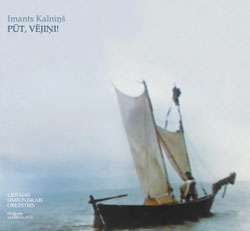
Jānis Rainis, the esteemed Latvian poet and playwright, wrote his classic play in folk verse, "Pūt, vējiņi!", in 1913. Sixty years later, Gunārs Piesis directed a film adaptation that has also become a classic, thanks greatly to Kalniņš’ brilliant musical contribution. While the film itself has not been widely seen outside Latvia, some of the music was available on a Melodiya record shortly after the film’s release. This is how I first came to know it 20 years ago, listening to a scratchy little second-hand vinyl disc and marveling at the composer’s vivid imagination and skill in blending popular, folk and classical elements.

"Pūt, vējiņi" (Blow, wind!) is also the first line of a folk tune that is indelibly etched in every Latvian’s psyche, as beloved and significant as the national anthem. Heard at the beginning and end of this score, the tune frames a tale of love and despair in music of a deeply cultural context. But Kalniņš’ handling of the tune takes Rainis’ allegory to yet another level: he embellishes it and presents it on an electric guitar, against a symphonic backdrop! At first hearing, this juxtaposition is jarring to say the least, but it works and ultimately is exquisitely memorable.

Many Latvian composers write in different styles and media, for varied audiences, equally comfortable writing symphonies, popular songs, or folk music arrangements. But Kalniņš doesn’t compartmentalize, keeping idioms or audiences apart. Unafraid of extremes, he positively revels in juxtaposing these different worlds, such as when he calls for a rock drummer in his Fourth Symphony. Expressing himself unflinchingly and eloquently, with honesty, directness and without rigid boundaries, Kalniņš’ skill in melding elements from seemingly antithetical traditions results in a uniquely personal expression that touches and satisfies a wide audience.

This is the second recording of Kalniņš’ music from his hometown Liepāja Symphony Orchestra, and the first orchestral recording I’ve heard from Māris Kupčs, the conductor here. So often, remakes of familiar film scores disappoint, especially when the nuances and flavor of the original are clearly etched in the listener’s mind. But Kupčs’ faithfulness to the letter and the spirit of the original, and vivid, compelling characterizations of the new sections, make this a terrific release. Equally commendable for their contributions are the fine ensemble of singers.

The compact disc is beautifully packaged in a tri-fold sleeve with images from the film. Notes are in English and Latvian, though they are more ruminative than informational. A brief plot outline would have been helpful in guiding listeners unfamiliar with Rainis’ play. Or do the record’s producers assume a limited audience of listeners already familiar with the plot? They shouldn’t. The fully professional presentation of this disc, the appeal of the music, and Imants Kalnins’ growing international reputation should assure a successful life for this disc, within and without the Latvian community.

Details

Pūt, vējiņi

Imants Kalniņš

UPE Recording Co.,  2000

UC002

Dependable rock from good, old Līvi

One of the very few rock groups that can be considered a Latvian institution would have to be Līvi. From their beginnings in Liepāja back in the mid 1970s, they have been playing their own unique and recognizable music for almost a quarter century now. Even though they have gone through many lineup changes, their commitment to great and uncompromising music has been unwavering.

Līvi were formed in 1976. Fronted by the late Ēriks Ķiģelis, they produced many great songs from their inception to the mid-1980s (see the Līvi album Bailes par zinģēm, and the Feliks Ķiģelis album Rudens vēju muzikants for the only versions of these songs available in compact disc format). After Ķiģelis’ death, they continued to make exceptional records, each one expanding their popularity not just in Latvia but other countries as well.

The group have had a long line of hit songs and albums. Hit songs include Zīlīte (from the Mikrofons 1981 collection), “Dzimtā valodā” (which won first place in a mid-1980s Mikrofons song competition), “Ozolam” (from the Mikrofons 1988 collection) and “Lai notiek viss” (from the 1994 Mikrofons collection). Recent hit albums include Bailes par zinģēm and Viva.

My first experience with Līvi was with their self-titled 1988 album. My dad had bought it for me, mainly because he thought I would enjoy the album because the cover pictured a bunch of long haired guys screaming. He was right, and I have been hooked ever since.

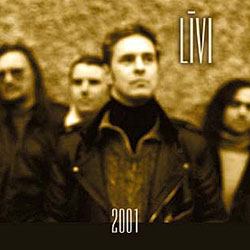
Their latest album is simply called 2001, and it continues the same course set by the 1998 album Viva. The lineup is the same as on the Viva album: Ainars Virga on guitar and voice, Dainis Virga on drums, Jānis Grodums on bass and vocals (according to MICREC, he’s the only original member still in the group), and Tomass Kleins on guitar and vocals. Stylistically, the 2001 album is not much different than the Viva album, with short, catchy songs, raspy vocals and distorted loud guitars. This album has noticeably more “testosterone influence” (never a bad thing), as the overall album is heavier than its predecessor, and contains fewer “ballads.” As with previous albums, most all of the songs feature lyrics written by Guntars Račs. The overall theme of the album seems to be to live for life and to not waste your time worrying about small details. Another theme is independance of the spirit—dictate your own life’s course.

The album starts off with an uncharacteristally mellow first song, simply called “Intro.” It is a minute and a half of muffled piano and vocals, sounding like something played over an ancient radio, perhaps to ease the listener into the album. Or perhaps it is to give the listener a false sense of security. Once the second track, “2001,” kicks in, the listener will be wide awake, as it is one of the fastest and heaviest songs on the album. (Interestingly enough, some of the lyrics of “Intro” reappear in the song “Tik un tā!” in a more up-tempo form.)

“Dieva dēls” was a Christmas song that originally appeared as a “guest” track on MICREC’s Dziesma 2000 collection. The vocals are sung softly and the song shows a great deal of restraint in that it keeps the loud guitar down. Līvi make good use of an understated keyboard part in the background as well. This song reminded me of their other holiday song “Eglīte,” which is found on the Karogi greatest hits collection.

Another favorite is “Mana vienīgā zinģe,’ which is probably the catchiest song on the album, with its chorus of “Tu, mana vienīgā, vien Tu, vien Tu.”

“Cigarete, rums, meitene un zāle zaļa” is also a memorable song, with its anthem-like chorus, “Neguli, nesapņo. Dzīvo un jūti!” (Don’t sleep, don’t dream. Live and feel!). The song also makes the point, “Cigarete, rums, meitene un zāle zaļa / Kas gan vēl man varētu būt vajadzīgs?” (A cigarette, rum, a girl and green grass / What else could I possibly need?).

Another anthem-like song is “Rudens”, with its chorus of “Uguni! Ūdeni! Zeme cietājā, Zilajās debesis” (Fire! Water! Hard land and blue skies).

The only oddity on the record is the closing track, simply called “Coda,” which is almost the exact same song as “Intro,” the only difference being the lyrics are sung in English. I’m not sure what purpose this served, other than leaving the album on the same mellow note as it started.

Līvi fans should not be disappointed at all by this latest offering. It provides all that Līvi fans have come to expect from their records. The production on this record sounds better than on Viva, as that album sounded muddy in various places. Līvi are not a highly experimental band, and they don’t need to be. They are as dependable a band as any in today’s world of rock and roll, be they Latvian or be they from any other country. The sound and songs are familiar without being tired or predictable. This is the kind of record that makes me want to pick up my guitar and start to play (I’ve already started to learn some of the songs on the record), and should be a welcome addition to the music library of anyone who has even the slightest appreciation for Latvian rock music.

(Editor’s note: This article originally appeared on SVEIKS.com.)

Details

2001

Līvi

MICREC,  2000

Egils Kaljo is an American-born Latvian from the New York area . Kaljo began listening to Latvian music as soon as he was able to put a record on a record player, and still has old Bellacord 78 rpm records lying around somewhere.