Unplugged, Līvi can rock just as hard

Live albums are an unusal entity in the rock world. They are intended mainly for longtime fans, who are looking to have the experience of seeing a band in concert contained in a recording. But Līvi’s latest, Spoku koks, is not just any live album. It is an acoustic live album by a veteran hard rock band.

The album is a re-release, but it is the first time this concert is available on CD. It is a recording of concert Līvi performed Dec. 16, 1994, in the Latvian Radio 1 studio in Rīga.

So can a veteran hard rock band still give a good concert, even if you replace their electric guitars with acoustic ones? If they are Līvi, the answer is a resounding yes.

As the liner notes indicate, this recording was meant to be a Christmas present for all the longtime Līvi fans, and what a unique present it is. Not only is the concert an intimate, acoustic show, but the song selection is interesting as well. Līvi chose to not play any of their big hits, but instead performed rarities and other songs that you would not normally hear them play.

In fact, of the 15 live tracks on this album, I had only heard six of these songs before—and to my knowledge, I have most every album Līvi have released, so there is quite a bit here that would be of interest to any Līvi fan.

The band members on this record are today’s members (Ainars Virga and Tomass Kleins on guitars, Jānis Grodums on bass guitar and Dainis Virga on drums) with the addition of since-departed vocalist Aivars Brīze.

One of the songs that I had heard before was not one orginally done by Līvi. They do a version of the old Pērkons song “Lakstugailis” (which can be found on Pērkons’ Dziesmu izlase #1 album) but with their own twists on the song. Līvi also have good interaction with the audience, as is heard here in the audience participation on the “Un tapēc rīt, vai aizparīt” part of the song.

Chronologically, I think this live album fits in right before their 1996 K.M.K.V.P. album, as Spoku koks contains live versions of two of the songs—“Meitene” and “Var jau būt…”—that would appear on this album. What is odd, though, is that one of the songs “Guntis ir muļķis patiešām” (which gets the award for funniest song title) is introduced as a new song, but is partly credited to Ēriks Ķiģelis (the former band leader who had passed away many years before) so I’m not sure how that is possible.

Also, being a Christmas concert, there are a couple Christmas songs as well. The only real “hit” on the record is “Eglīte.” That song is introduced with a bit of history: When the song was originally recorded in Soviet times, Līvi were not allowed to use the word “Ziemassvētki,” so they had to replace it with “Jaunais gads.” Now that that era has thankfully passed, they now sing “Ziemassvētki klāt.”

The other Christmas song here is simply called “Ziemassvētku dziesma.” It is a very mellow, yet catchy celebration of the season.

The album concludes with a great acoustic version of the song “Kad saule riet,” originally found on their self-titled 1988 album. Although this version is acoustic, it loses none of the power that the original “electric” version had.

There are two common problems that live albums in general have: either they sound too polished (due to post-concert studio fiddling with the songs, usually removing or re-recording of bad notes or vocals) or they don’t sound live at all (the live experience has two parts, the band playing and the audience reacting). I’m happy to say that this album has neither of these problems. Though there was inevitable studio tinkering with the show, it’s not much. According to the liner notes, the original release of this show was available the day after the concert, which is not enough time to redub vocals or guitar parts. In a few spots the vocals are a bit off or somebody plays a wrong note, but that is part of the live experience! Also, the audience is very much present on this recording. Though small, it is noisy and actively participates in many of the songs.

In addition to the live recording, two “bonus” tracks have been added to the CD: studio recordings of “Lakstugailis” and “Līviskā ziņģe.” Though it is nice to hear studio versions of these songs, they are not much different than the live versions. On some parts of “Lakstugailis,” Brīze sings as though he was in a great deal of pain—hope he’s feeling better!

On an unrelated note, this is one of the new releases from MICREC that has a reduced price tag. I purchased this record in Latvia for LVL 6 (a bargain compared to the price of other new CDs, often as much as LVL 10 or 11).

For longtime Līvi fans, this record will be a treat to listen to for all the rarities contained on it as well as for the acoustic performance. Casual or new Līvi fans will like this as well, as you don’t need to know much about Līvi to enjoy this release. The album also begins the celebration of Līvi’s 25th anniverary as a band. According to the MICREC Web site, 2001 will see the re-release of their older records as well. I think Spoku koks is a great way to kick off that celebration.

Details

Spoku koks

Līvi

MICREC,  2000
Egils Kaljo is an American-born Latvian from the New York area . Kaljo began listening to Latvian music as soon as he was able to put a record on a record player, and still has old Bellacord 78 rpm records lying around somewhere.

Folk group sings warrior songs with ‘oompf’

It surprised me a bit to see that Dzelzīm dzimu, the latest album in UPE Recording Co.‘s “Latvian Folk Music Collection,” features Vilki (The Wolves), a controversial folklore group that specializes in warrior songs.

Vilki seem to be a group more interested in “doing” rather than “recording”—that is, researching and actually acting out and living the ancient customs and rituals, rather than sitting in a modern recording studio. Vilki concentrate on the past, and not just musically. They’re interested in the whole warrior culture—from the very oldest times to modern times, too—but especially in the culture of about 1,000 years ago, before the forced conversion of Latvians to Christianity. This particular recording focuses on these oldest of Latvian warrior songs from the medieval times and before (no mention of guns and artillery—here it’s only about swords and war horses!)

Notwithstanding this, the result of Vilki’s foray into the studio is powerful. The quality of the songs is high and (it sounds to me) authentic. Every last one of the songs is about war. But even if war isn’t your thing, this is riveting and inspiring music. It’s stark, strong, even chilling. The music does a remarkable job of evoking the power, sadness and uncertainty of war, as well as the excitement of adventure and joyfullness of prancing horses. But luckily, most people who listen to Dzelzīm dzimu are not doing so to get into the mood for going off to war—they’re just listening to good music.

Considering that the subject matter and aura of most of this music are very similar, Vilki have come up with quite a variety of sounds: driving drums, small whistles, a war horn, an assortment of bangles. The listener is taken from the haunting sounds of the first song, “Ko domāji, tu kundziņi,” to the loud bagpipes of “Novītusi tā puķīte,” to the gentle strum of the kokle on “Div’ baloži”; from the intense “Šķiramies, brāleliņi” and mighty “Lustīt mana” to the almost dreamy “Uz tiem laukiem” and sorrowful “Kas tie tādi.”  Inbetween is the relatively bright and spirited “Kaŗavīra līgaviņa.”  One hears the persevering beat of “Zviegtin zviedza” and the subtle bass of the ģīga on the heavyhearted “Māte mani lolodama.” “Cīrulīti, mazputniņi” is a melancholy solo, while “Visi kauli noguruši” and “Sadziedami, mēs bāliņi” are forceful a capella pieces.

The arrangements are simple yet sophisticated. Vilki rely heavily on fifth intervals for vocal harmonies, giving the music an appropriate “primitive” feel, and only in two places did my ears perk up at hearing an unconventional harmony. About half of the songs on Dzelzīm dzimu are already on the 1997 cassette by Vilki, also called Dzelzīm dzimu. But at least it sounds like the old songs have been newly or freshly recorded. The compact disc sounds much more professional than the cassette.

It seems that the fad in folk music is to introduce modern elements and ingredients from other cultures. Vilki, though, have stayed true to the old music. They’ve stuck to traditional instruments, melodies and texts. And it’s well they have. It’s not even appropriate for warrior music to have much accompaniment besides drums, because you don’t take your fancy musical instruments along to war. But despite the bareness of this music, the effect is good. It’s dark and heavy, and in it one truly feels the somber nature of war. This is powerful music—it sent a few good shivers up my back!

Obviously, these songs have powerful lyrics. Powerful in the emotional sense, but also texts that are meant to bring and concentrate strength—magic spells and rituals, if you will. Unfortunately, the English translations in the Dzelzīm dzimu liner notes are poor. For the most part they can be forgiven, but I feel that the translation of “Uz kariņu aiziedams” is not just poor, but wrong (and in this case, not for a lack of knowledge of English). The child in the song is not the soldier’s fiancee’s child by another man, but rather the soldier’s own sister, who has grown into a young woman while he was away at war.

Despite a comment I heard that Dzelzīm dzimu sounds like a funeral dirge, this is a good, strong and powerful recording for those who like very traditional folk music with a primitive sound and natural “oompf.” Those who like to pore over every last word of liner notes, though, may find the English text on Dzelzīm dzimu to be less informative than notes on previous UPE recordings.

Details

Dzelzīm dzimu

Vilki

UPE Recording Co.,  2000

UPECD 020

New York choir highlights Baltic Christmas

After half a century of official disparagement and outright criminalization in the Baltic States, Christmas has returned, with its joyous and hopeful sights, sounds, and traditions. While we in the West continued to celebrate and enrich this heritage during those years, the people of Eastern Europe have only been able to do so again freely in the last decade, since the demise of Communism.

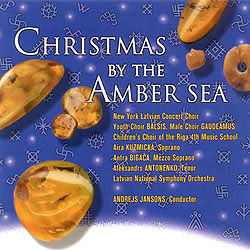
For many years, a major contributor to the choral repertoire for the Christmas season has been the New York Latvian Concert Choir. Since the early 1980s it has commissioned and premiered a new Christmas cantata from a different Latvian composer every year. In 1997 the choir released an album containing five of these works. Now Christmas By the Amber Sea has appeared with two more, by Jānis Lūsēns and Ilze Akerberga, as well as a work by 40-year-old Estonian composer Urmas Sisask.

Sisask’s “Christmas Oratorio” dates from 1992. Lasting just shy of 37 minutes, it is divided into 21 short, vividly contrasting movements setting traditional Latin texts recounting Christ’s birth. With skillful, imaginative writing, it grabs the listener’s attention from the outset. A large ensemble dominated by the sharp, bright colors of recorders, harpsichord, organ and piano is carefully and lucidly scored, with small groups of instruments often used to colorful effect. Choral and solo sections are punctuated by several purely instrumental interludes as the work progresses without any extraneous gestures, keeping the listener’s attention focused throughout. Rhythmic propulsiveness, clear textures and frequent contrasts occasionally bring the music of Carl Orff (of “Carmina Burana” fame) to mind.

An all-Estonian performance of the original version with male chorus was released several years ago on the Antes label. Though both recordings are excellent, the newer one sounds richer and fuller, with female soloists’ diction much clearer. However, sung Latin in neither performance entirely follows international standards, with irritatingly local pronounciation of some sounds.

Ilze Akerberga was born in New York City in 1953 and is a musician who conveys her ideas with great sensitivity and skill. Her “Winter Cantata” is half as long as Sisask’s oratorio, with spare, effective textures in a warm, simple style. Six contrasting movements set words by five Latvian poets, reflecting on the snowy northern winter landscape and the mood of the holiday season, often as seen through the eyes of a child (two movements are sung by a children’s choir). While not directly addressing the birth of Christ, “the overall concept [of the work] suggests the close interaction of God’s world with that of man,” in the words of Kathryn Livingston’s excellent progam notes, and the choice of texts underlines the inextricable associations for Balts between Christmas, the winter season, and the winter solstice. Composed in 1981, this is a loving work of great warmth and sincerity.

Born in 1959 in Liepāja, Latvia, Jānis Lūsēns is the composer of the final work on this album, a 1997 cantata titled “Child of the Stars.” Similar in conception to Akerberga’s cantata, it does not address Christmas directly, but rather reflects on the impressions the holiday evokes at different stages in life, with texts by four different Latvian poets.

While it is a lovely work that begins promisingly, I ultimately found it to be less compelling than the other works on the album. Perhaps those works’ more distinctive profiles invite unfair comparison? I found my attention repeatedly drifting in the middle of the work, though the appearance of the children’s choir in the final section provided welcome contrast and brought the work to a satisfying conclusion.

Performances on this album are vivid, sung and played with verve and enthusiasm. Soloists Antra Bigača, Aira Kuzmicka and Aleksandrs Antonenko are wonderful, and a children’s choir and recorder ensemble, both from Riga, sing and play with professionalism. The New York Latvian Concert Choir, together with two renowned Riga choirs, Gaudeamus and Balsis, produce a rich and clear sound. All these forces as well as the Latvian National Symphony Orchestra are led with passionate commitment by Andrejs Jansons in finely nuanced readings.

A beautifully packaged, well-filled recording with superb graphic design, fine notes and fully translated texts—what more could anyone ask for?

Details

Christmas By the Amber Sea

New York Latvian Concert Choir

New York Latvian Concert Choir,  2000

NYLCC 003