A fresh glimpse of folk songs a la Dārziņš

“In order to become universal, one must first become national…To study, to immerse oneself in the spirit of one’s own people until you feel a part of the whole—that is my goal.” So spoke Hungarian composer Bela Bartok, who redefined how the elements and character of a folk tradition could be internalized to inspire music universal in expression.

Volfgangs Dārziņš (1906-1962), son of beloved Latvian Romantic composer Emīls Dārziņš, shared that belief. His volume of 200 Latvian folk song arrangements stands as a testament to his conviction. Written as a vocal line with accompaniment, they can be performed either by solo voice with piano accompaniment or as piano solos. However, the brevity of these settings (generally a single stanza, often only a few measures) requires some imagination for a satisfactory presentation in performance.

On Volfgangs Dārziņš: 100 latviešu tautasdziesmas Latvian composer and pianist Imants Zemzaris has selected 100 of these arrangements. He has arrived at a very satisfying solution by grouping them into sets by subject to highlight their similarities and differences in a way that presents them as little suites—lullabies, burial songs, sun songs, everyday life, etc. In the past, many singers and pianists have performed and recorded them in strophic fashion, simply repeating each setting depending on the number of verses in the text, with variation achieved through dynamics, tempo and nuance.

So what are they like? Brief, even fleeting bits of mood, established through very personal, highly varied settings. Dārziņš did not elaborate or develop these melodies, nor did he set individual verses to reflect the textual character of each verse. He did make more than one arrangement of some tunes, but these are alternative views of the music, rather than unified variations. In all, they are his personal reaction to the character of each melody, the message of the text. Aphoristic as they may be, Dārziņš packs a world of emotion and power into each few seconds through allusion and suggestion, often in dense, highly chromatic visions. His view of each tune brings out unique colors and often unsuspected characteristics in these mini-suites, much like gazing at facets of a gem from different angles.

It’s often difficult to point to a specifically Latvian character here. Bartok, the Spaniard Federico Mompou, and the “Russian” period of Igor Stravinsky come to mind at times, with the postimpressionism of Maurice Ravel often close by. Some even hear the influence of Carl Orff. If you’re expecting the tonal beauty and tame dissonances of Jāzeps Vītols (who also set 200 Latvian folk songs in a similar format) or Emīlis Melngailis, this music will surprise you at times. But repeated listenings reinforce the feeling that Dārziņš’ more modern, laconic and individual approach is just as valid and rewarding. If not for his status as an exiled “nonperson” during Latvia’s Soviet occupation and premature death at the age of 56 he would certainly be more widely known on the world music scene.

Imants Zemzaris obviously loves and admires these miniatures and his fine technique allows him to effortlessly toss off technically demanding passages with a well-judged palette of tonal color, variety and fantasy. Compared to a private archival tape of the composer playing some of these same arrangements, Zemzaris’ approach is remarkably similar, but more technically assured and vastly better sonically. However, this recording is very close and emphasizes the brightness of the piano. A more mellow instrument might have taken the edge off the clanginess of some very percussive sections. But this is a personal preference and is in no way meant as a criticism of Zemzaris’ playing or musicianship.

An important release, providing a fresh glimpse into the music of a modern Latvian master. Now, how about Dārziņš’ other solo piano music, and the two piano concertos?

Details

Volfgangs Dārziņš: 100 latviešu tautasdziesmas

Volfgangs Dārziņš

BaltAsia Foundation,  2000

Notes: Performed by Imants Zemzaris.
Solstice album sounds too polished

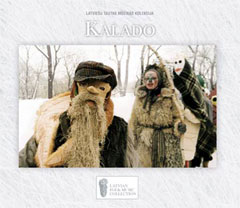
Kalado

The most common refrain to the winter’s seasonal music is “kalado,” hence the name of this album, Kalado, devoted to the music of the winter solstice, or Ziemassvētki. These are not Christian Christmas hymns or “Jingle Bells” translations. All of the songs on the album are from the ancient folk traditions, which are still familiar to Latvians but not widely practiced.

I got my copy of Kalado only after New Year’s, so the music on it already sounded out of season to me. But traditionally Latvians went ķekatās from the Mārtiņi celebration on Nov. 10 all the way to the Meteņi celebration on Feb. 10. One of the signatures of Latvian winter celebrations, ķekatas are people in costume going from house to house, barging in with loud dances and songs, demanding food, and basically making a lot of noise and a big ruckus, sometimes even causing trouble (think Halloween, Mardi Gras or English mummers).

Overall, I’ve been very pleased with UPE Recording Co.‘s “Latvian Folk Music Collection.” But the album Kalado, which features all previously recorded material by various folklore groups, kind of bugs me. And what bugs me most is that I just cannot put my finger on exactly what it is that bothers me.

It begins with a beautiful, gentle song by Iļģi, but the song really has nothing to do with the winter solstice. The second song jars you awake with an energetic rendition of “Nerejati, ciema suņi” by the group Auri. It’s fun at first, but the song just won’t stop, and quickly becomes annoying. The beginning of the third song, “Svātki gōja, svētki gōja,” sounds almost Middle Eastern. Then you hear good old Skandinieki singing “Ziemassvētki sabraukuši,” which is much more like what I’m used to hearing at winter solstice celebrations. “Es čigāna dēliņš biju” is a catchy tune about ķekatas. “Es bej vīns kuplys līps” is a dance game that unfortunately does not make me want to get up out of my chair, while “Vylks dora olu” and “Čigāniņi, bāleliņi” do just the opposite. I like the question-answer lyrics and “kalado” drone of “Ej peleite zerņu zogtu.”  The album ends with a complex arrangement of “Sidrabiņa lietiņš lija” (performed by Rasa) and a meditation on the “kalado” refrain.

I find it hard to get a consistent feel for the album. The beginning leads me to expect music as calm as a Christmas snowfall, but the bulk of it is impatient, nervous, restless and even frenzied. The end of the album is again calm and meditative. Maybe this is what bothers me. The beginning of the album throws me off, and I never quite seem to find my footing after that.

In a way, though, this is appropriate. Solstices and equinoxes in all cultures have been times of the year when everything is on edge. They are often socially acceptable times to “let loose.” The borders between worlds blur, and the earth stands still for a moment while the sun and earth figure out which direction to follow. One must be very careful for one’s self until things fall back into a normal cosmic rhythm. Kalado definitely evokes this skittish and jittery feeling of unrest (in Latvian, nemiers). After all, one never knows what the ķekatas will do. Will they eat up all the food and leave us to starve? Will they steal something? Will they scare the children? Or will they be friendly? Who are they, anyway?!

On Kalado you’ll notice repetition of the lyrics within a song and from song to song, and you’ll also notice that the melodies tend to be quite narrow in their range. If you’re in a large gathering (such as a solstice celebration) where everyone wants to sing along, lots of repetition is necessary. Simple melodies and repeated texts make for easy learning and participation. The repetition can even become intoxicating—like a trance—when you take part in it. But on a recording one can grow tired of it after a very short time.

Taken alone, there are some wonderful arrangements on Kalado. I know and appreciate the artistic exploration in these ensembles’ music, but in a recording like this—which I assume is devoted to introducing people to winter solstice songs and traditional Ziemassvētki celebrations—I’d like to hear simpler and less exotic arrangements. The music at the solstice celebration I attended several weeks ago sounded little like this album (except, of course, the selections by Skandinieki and Rasa, who stick to very traditional renditions of folk songs), and therefore I expected Kalado to sound less polished and complex.

Details

Kalado

Latviešu tautas mūzikas kolekcija

UPE Recording Co.,  2000

UPE CD 022

Comfort food for the singing soul

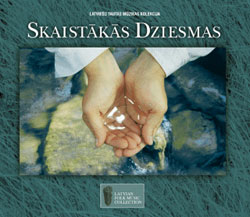
Skaistākās dziesmas

Modern interpretation of the most beautiful Latvian folk songs? Being that I like my folk music to be fairly traditional, I’ll admit that I was a bit skeptical when I first heard about UPE’s collection Skaistākās dziesmas (The Most Beautiful Songs). Curious, but skeptical.

But the album started off just right, with Ainars Mielavs’ (the founder of UPE and lead singer of the pop group Jauns Mēness) distinctive voice singing “Tumša nakte, zala zale”—a favorite in our family. The next song, “Sarkandaiļa roze auga,” was an old favorite of my mother’s (and therefore also often heard at our house), albeit with a variation in the lyrics. Should I have been surprised that those two songs were also somebody else’s favorites?

The songs on Skaistākās dziesmas stand on their own, which is probably why they’re considered favorites by so many people. In other words, the songs’ beauty does not rely on elaborate vocal arrangements and instrumentations, but rather only on the traditional melody and text. In fact, only “Tōli dzeivoj muna meilō” has a sung harmony.

There’s no question that Latvians like songs in minor keys and sad lyrics! There are plenty of examples on Skaistākās dziesmas. I guess the minor keys “speak to our souls.” It’s funny, though: in our folk music not all songs in minor keys are sad. It’s also kind of odd that a third of the songs on this album have to do with war. Maybe that’s because Latvia has experienced so much of it. In any case, Skaistākās dziesmas covers a large spectrum of songs.

“Jūrā gāju naudu sēti” and “Div dūjiņas” are sorrowful songs about drowning and war, while “Čuči, guli, līgaviņa” is a tender lullaby and love song. “Visu dienu bites dzinu” is one of hundreds of orphan songs. “Snieg sniedziņis, putināja” and “Tumša nakte, zaļa zāle” are about the horse, a Latvian’s favorite animal. “Saulīt vēlu vakarā” is possibly the all-time favorite Latvian folk song. “Caur sidraba birzi gāju” is definitely not one of my favorites (it reminds me of singing class at the obligatory Latvian school every Saturday morning of my childhood), but it is very widely known. “Es izjāju prūšu zemi” sounds conspicuously like Jauns Mēness, and although a very catchy tune, seems slightly out of place on this compilation. Maybe it was included for the sake of variety. The more I listen to the album, though, the more I’m beginning to like “Es izjāju.” Could be that Mielavs and Ilga Reizniece are on to something!

Mielavs and Reizniece (of the post-folk group Iļģi) collaborated on choosing the songs for this very personal project. Any more people and the songs probably would not have fit together as well as they do. But what a daunting job: to come up with a dozen or so marketable favorites out of literally thousands upon thousands of folk songs. How do you maintain objectivity and yet remain true to your own aesthetic sense? After all, my own list of the most beautiful Latvian folk songs would be quite different, and so would yours (which is why I call this such a personal project). In any case, Mielavs and Reizniece have done a good job. The more you listen to Skaistākās dziesmas the more it grows on you.

All of the selections on the album are “interpretations of Latvian folk songs in the year 2000.” But that does not mean rock or pop. It means that the guitar, which is definitely not a traditional Baltic folk instrument, provides the only accompaniment to the songs. (After many listenings, though, I think I heard a kokle in one isolated spot. The kokle is a very traditional instrument.) The acoustic guitar’s calming and peaceful strums, though, lend themselves well to these serene songs. “Modern interpretation” also means that the singers are not specialists in folklore; they’re normal, everyday people like you and me (except that they make a living singing and composing modern music). In fact, the liner notes hint that the singers—including such pop artists as Ingus Ulmanis and Rolands Ūdris—are new to singing these timeless folk songs.

But don’t expect much gusto. This is more of a nostalgic, easy-listening, background-music album, rather than a “catch-you-by-the-collar-and-demand-all-of-your-attention” album. Except for the two or three more lively men’s songs, the acoustic guitar and mild voices pretty much all blend into one another. Although I realize that it’s largely a matter of singing style, some of the singers could enunciate their words a bit better. In part, it is this weaker enunciation that makes some of the songs sound nonchalant.

The pleasant and subdued voices of Skaistākās dziesmas sing very nice, comforting folk songs. It almost sounds like a few friends getting together over a glass of wine and then pulling out the guitar and singing for themselves (in Latvian: savā nodabā) the quiet old favorites that bring back memories. These are favorites pretty much the way you and I sing them—no fancy accompaniments, no messing around with melodies or texts, no embellishments. You’ll be able to sing along to this album right off the bat, and there will hardly be any new texts to learn. If you happen to not recognize some of the songs, this is the perfect album for learning them, because the songs are sung very straight-forward, and all of the texts are written in the liner notes. The liner note translations, though, should have been proofread for spelling errors and awkward expressions, and I’d also like the liner notes to show who sings which song.

Details

Skaistākās dziesmas

Latviešu tautas mūzikas kolekcija

UPE Recording Co.,  2000

UPE CD 021