A lively, danceable album from Maskačka

I was quite excited by the prospect of hearing the first album by Maskačkas spēlmaņi, Zirnīšiem skaisti ziedi. Having heard some of their tunes previously on the Internet, I was ready to really enjoy this one in full length.

Maskačkas spēlmaņi, led by Ansis Ataols Bērziņš, hails from from the Maskavas district of Rīga, south of the Old City and east of the Central Market along the Daugava River.

The album begins with some very good songs that got me tapping my feet and humming along. “Meitas mani melli sauca,” the first song, had that really good beat and style that makes you want to bounce along. So did “Nadūd, Dīvs, nadūd, Dīvs.”

Other tracks that I really enjoyed were “Moza beju, gonūs goju,” “Trīs putan dižan dzied,” and “Teci rikšiem, kumeliņi.” Being a Latvian folk dancer, my feet are always looking for a good tune. Maskačkas spēlmaņi do deliver in that category, giving the listener many songs that could easily be made into folk dances or just enjoyed at a party.

I also really enjoyed listening to one track, “Pats precieju, pats atvežu,” that consisted of only kokle and voices. It was close to musical styling of Andris Kapusts of the folk group Grodi. The kokle playing is clean and precise, as are the voices.

One song that got my attention was “Tālu gāju sievas ņemt.” The refrain is in Russian and my wife, who is from Latvia, says it is part of a Russian soldier’s song. Historically, this song has value in that it clearly reflects the musical and linguistic influences of that era. But details on that in the liner notes might be helpful.

The musical and technical ability of Maskačkas spēlmaņi is very good and the recording is also of good quality. The majority of the tracks is very folksy and upbeat and makes me want to dance and sing along to the tunes.  The instrument mix makes for a very diverse sound and creates a good balance of high notes and low notes. The accordions (bayan and ieviņa) have a good driving sound and the drum really keeps the beat going. Being an accordion player myself, I really enjoyed the songs that utilized the Latvian-made ieviņa button accordion. The honking bass really adds to the folksy sound the band is attempting to achieve. The cītara rounds out the sound and the violin is able to create a good counter-position to the accordion. The trejdeksnis and other percussion also help to bring the sounds all together.

The liner notes are quite nice in that they provide the words to the songs, just in case you like to sing along—like I do. And given that Maskačkas spēlmaņi sing many tunes in the Latgalian dialect, non-speakers of that will find the words to be of great help. For non-Latvians, some brief liner notes in English would also have been good.

I would have liked to have more information about the group itself in the liner notes, but Maskačkas spēlmaņi provide a Web site with information so that listeners may “get the scoop.” I would encourage people to visit the site and see their pictures. I always like to see who is playing the music I’m listening to.

Members of the band, besides Bērziņš, are Jānis Barons, Zane Kriumane, Sandra Kuzmina, Ieva Medene and Paulis Paulins.

Overall, this first album by Maskačkas spēlmaņi is very nice. Listeners will like the catchy tunes, and dancers will enjoy the driving beat.

Details

Zirnīšiem skaisti ziedi

Maskačkas spēlmaņi

Maskačkas spēlmaņi,  2001
Unpredictable Kalniņš pens music for son’s group

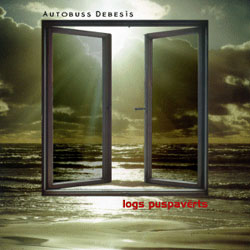
Logs puspavērts

Imants Kalniņš is one of the most adept composers in Latvia. Not confining himself to any one style, he can move between symphonic work (a great example being his “4th Symphony”) to film work (the music to “Pūt, vējiņi!”) as well as to popular music. He brings his style to every form of music that he composes, making it at once unique, but also recognizable. One never knows what to expect next from him.

One of his most recent projects is writing the music for the group Autobuss Debesīs, whose first album, Logs puspavērts, came out earlier this year.

Autobuss Debesīs is a new group, but one that I liked after hearing just one song. I had heard the song “Sitiet bungas, mani mīļie” on the MICREC release Superizlase and was anxiously waiting to hear more from the group. Though that song isn’t on this release, there are many other great songs that make this record a good listen.

Of course, it is not just Imants Kalniņš that made this record possible. The band is made up of Kalniņs’ son, Marts Kristiāns Kalniņš, on vocals; Kārlis Auzāns on lead guitar; Andrejs Grimms on acoustic guitar; Ervings Znotiņš on keyboards; Armands Treilihs on bass, and Emīls Zilberts on percussion. The lyrics are provided by Ieva Roze, Māra Čakla and Aigars Jirgens. Latvian actress Rēzija Kalniņa (now appearing in the new film Labas rokas) shows up to add vocals to two songs as well.

As with most music by Imants Kalniņš, it can be very hard to describe at times. Being an accomplished composer, most of the music is rather intricate and involved, taking a few listens to appreciate. The first few times I listened to the album, I didn’t think too much of it. The album seemed to be a bit too “artsy” for my tastes. But after repeated listenings, I began to enjoy it much more. The music is complex, so this record might not be for everyone, but I think even those people whose musical tastes are more toward the simpler style will find many things to enjoy.

The album opens up with “Alejas,” which is one of the more intricate songs (and, at more than six minutes, one of the longer ones). The singer describes himself as “apmulsis gaiss” (confused air) and wants to add green to the air in your alleys, or something like that.

Two of my favorite songs on the album are the second and third, “Es to tev teikšu” and “Kur slēpies tu,” which are more traditional in the sense that they are very catchy and have great melodies. “Kur slēpies tu” contains some great lead guitar work by Auzāns. These songs show that Autobuss debesīs are quite capable of playing great three-minute pop songs as well.

“Kad migla” recalls other Imants Kalniņš songs; it’s a subdued, keyboard heavy piece. It reminds me of the songs Kalniņš did with Ainars Mielavs, very relaxed and understated.

“Pie mežrozīša krūma” is another lengthy pice, clocking at the eight-minute mark. It starts off slowly, leading you to believe that this will be another relaxed song. Then suddenly, the song really kicks in and the tempo increases, allowing the musicians to shine in lengthy instrumental passages. But the song doesn’t seem to drag at all.

The song “Logs puspavērts” is a very pretty tune that features the vocals of Rēzija Kalniņa, as well as some beautiful cello work by Auzāns. It is another subdued piece, but also evokes a great sadness. Marts Kalniņš sings as well, but his vocals are mixed much lower than usual, so Kalniņa gets the chance to really shine in this song.

The lyrics on Logs puspavērts (which are included in the liner notes) also are on the artsy side, more poetic than the standard rock release. My knowledge of the Latvian language is fairly decent, but these lyrics had me reaching for the Latvian-to-English dictionary more often than usual.

Imants Kalniņš fans will like this record, as it features his trademark unpredictable style. The album can be enjoyed by all, from casual music fans to more serious listeners. It does take a few listens to get into, but it is worth it. Even if you’ve never heard of Imants Kalniņš before, this would be a good way to introduce yourself to his music, as there is plenty more good stuff where this came from.

Details

Logs puspavērts

Autobuss Debesīs

UPE Recording Co.,  2001

UPE CD 024

Egils Kaljo is an American-born Latvian from the New York area . Kaljo began listening to Latvian music as soon as he was able to put a record on a record player, and still has old Bellacord 78 rpm records lying around somewhere.

Just passing through? Then use these guides

I have always been a fan of Lonely Planet’s insightful and at times irreverent style. But their guides to Latvia miss its essence, and not just because they cover several or more countries in one book. (One is the guide to Estonia, Latvia & Lithuania, the other is the condensed guide to Scandinavian & Baltic Europe). Much focus is given to the regional and superpowers that have overrun the Baltics throughout history. That focus extends to monuments to the past, where the guides spend more time on Salaspils and the Nazi attrocities there than on Latvia’s rich achievements.

Indeed, it reminded me of their television series segment on Latvia, where you saw more of Salaspils than Rundale, Cēsis, and Bauska put together—and the final impression was of a country bearing the sins of past tragedies, not a country proud of its cultural riches, its creativity, or its energy. By comparison, the Maritime Museum in Rīga, a veritable treasure trove of maritime trade and life, is merely mentioned as an interesting place to visit.

What struck me next, reading both guides, was how quickly Latvia has been changing. The Baltics-only guide was published in 1997 (an updated second edition was released in July of this year, but is not reviewed here); the condensed Scandinavia and Baltics guide appeared in 1999. The more recent condensed guide had a new and fairly comprehensive list of Web sites focused on Latvia. For the neophyte, that is one of the most valuable resources mentioned in the guide. It also deleted some of the more dated and not particularly accurate observations in the detailed guide, for example, the admonishment to bring one’s own bag to the market, as you otherwise have to buy plastic bags at a lat each and suffer having to carry around the pictures of naked women printed on them. I’ve been visiting Latvia at least yearly since 1991 and have wandered around Rīga taking hundreds of pictures. I’ve seen everything from Hare Krishnas to a woman walking her goat, but no naked ladies on plastic bags.

In other terms of accuracy, particularly in dealing with the fallout of the Soviet occupation, the guides seemed more focused on an outsider’s uninformed optimism than actually delving into the Russian-Latvian relationship.

Indeed, the guides are stricken with an outsider’s shallow perception of Latvia and Latvians, who allegedly are not as reserved as Estonians but not as outgoing as Lithuanians. That observation, and its repetition verbatim several times, fills out page space, but does little to fill out the reader’s understanding of, or appreciation for, the Baltics—either the people or the sights.

The whole attitude is of passing through somewhere to get to another (more interesting) destination, not lingering to savor the experience. The best example is the guides’ suggestion that visitors need not allocate more than two days for Rīga, as that is all you need to see all that’s worthwhile. Even every non-Latvian I’ve talked to who has visited or lived for a while in Rīga will tell you that’s barely enough time to scratch the surface! The how of traveling to Latvia is addressed quite well, but, in the end, we are left wondering why.

(Editor’s note: This article originally appeared on the SVEIKS.com site.)

Details

Estonia, Latvia & Lithuania

John Noble, et al

Melbourne:  Lonely Planet Publications,  1997

Notes: Also reviewed is Glenda Bendure, et al., Scandinavian & Baltic Europe. Melbourne: Lonely Planet Publications, 1999.