Latest by Labvelīgais Tips lacks classic song

Eiropa mūs nesapratīs

One of the few things left to depend on in this world is the yearly arrival of a Labvelīgais Tips album every April 1. For the last seven years, each April Fool’s Day brings another release from this ensemble, making them probably the most prolific band in Latvia. This past April 1 came Eiropa mūs nesapratīs, a collection of 14 songs.

Labvelīgais Tips is a band that is hard to categorize. Humor is a major part of their arsenal, and many of their songs are in the schlager style (though a more "modern" interpretation of that form). Their songs are about simple topics, finding the humor in everyday occurences. The band itself is larger than your everyday rock band: besides the usual guitar, bass and drums, they add trumpet, flute and accordion, not to mention a string quartet.

I only became a fan of Tips upon the release of their "best of" collection in 1999. I had heard a few of their songs prior to that, but I suppose I wasn’t yet able to get the joke at that point, as Labvelīgais Tips have a very unique sense of humor that takes a certain mentality to appreciate. But after listening to the collection, and hearing tales of omnibuses in people’s backyards and brothers in Chicago, I was hooked. And though I didn’t get all the jokes (it seems most are geared towards people who have spent their lives in Latvia), I began to listen to them much more frequently. I also picked up their 2000 release Atkārtot!, which was another great collection of songs.

Surprisingly, I found Eiropa mūs nesapratīs a bit disappointing. Though the classic Tips "sound" was there, after listening to the album a number of times it seemed to me that something was missing: a truly classic Tips song. The "best of" collection was full of these classic songs, and Atkārtot! added a few more, but there aren’t really any songs on Eiropa that can stand alongside their earlier material. Not that the songs are bad: All the songs are solid, but there aren’t any songs that I would look forward to hearing if I were to see these guys in concert.

The songs continue to have an even more eclectic sound, with influences ranging from reggae to Latin. "Koka klucis Konstantīns" sounds like a combination of Latin and lounge music. The song "Pazudis ir miegs" also has a Latin sound, but also strikes me as that "Russian-Latin" sound that many Raimonds Pauls songs in the 1970s seemed to have.

The old Latvian standard, "Augstu laimi un prieku" (the "Lai dzīvo sveiks!" song), is redone a la Tips, this time in a Mexican mariachi style.

Many of the songs here defy description, which is part of the charm of Labvelīgais Tips, though some may be turned off by the constant changing of styles. There is always some new sound, some new surprise on each of their records. Even the lyrics defy description, as some of the songs left me scratching my head and thinking, "What was THAT about?" Songs such as "Smilšu krasas portfelīts", "Dubļi mani dubļi" and "Tu, mana ģeometriskā" either show off the creativity of the band or leave some thinking, "These guys will write a song about anything."

"Eiropa mūs nesapratīs" is a song in waltz style that tells the story of a Latvian guy and his great-great-great-great-great (and a few more greats) grandfather, both of whom have been to neither Germany nor Denmark and don’t have any Hungarian or Irish friends. This probably alludes to the fact that to truly appreciate and understand Labvelīgais Tips you have to be a Latvian living in Latvia.

The packaging of this album, though it looks nice, also is lacking in a few ways. Particularly annoying is the absence of lyrics. Having those would make a lot of their jokes easier to understand. Also, though the members of the band are listed, nowhere is it written what they do or what instruments they play.

Maybe the need to release an album every year has started to take its toll and isn’t giving them enough time to properly craft an album. Many of the songs wind up sounding a bit repetitive, often repeating verses and choruses a few more times than necessary. Perhaps the reason that Atkārtot! was such a good album was that it was two years after the last recording of new material.

Die-hard Tips fans will like this record. I don’t dislike it, but don’t think it will be making it into my CD player with any great frequency. If you don’t have any Tips recordings, this is probably not the one to start with. I’d recommend starting with the "best of" release. If you really like what you hear there, you might just like Eiropa mūs nesapratīs.

Details

Eiropa mūs nesapratīs

Labvēlīgais Tips

MICREC,  2001
Egils Kaljo is an American-born Latvian from the New York area . Kaljo began listening to Latvian music as soon as he was able to put a record on a record player, and still has old Bellacord 78 rpm records lying around somewhere.

Riše’s music uses memories to challenge

The Return

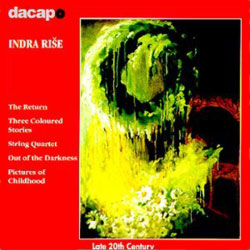
A couple of years ago while surfing the Web for stray recordings of Latvian music, I came upon an obscure Danish compact disc of music by a Latvian-born composer who was completely unknown to me at the time—Indra Riše. Born in Latvia in 1961, where she studied piano and composition, she left for Denmark in 1993 for advanced study on a state scholarship and has lived there since. This second release of her music, The Return, has afforded me a welcome opportunity to get to know her music, and I’ve recently seen an announcement for a third release from Sweden, so she is clearly a rising star.

The Return has tremendous variety and begins with "The Return," written for the piquant combination of mezzo-soprano, flute, cello and accordion. The work presents an interesting paradox: while I did not find it particularly compelling as I listened to it, the impression left by the music is oddly haunting and effective in retrospect. Certainly, one usually has to hear an unfamiliar work several times before having a clear sense of it, but somehow this music felt so fragmented every time I listened to it that I didn’t sense a logical progression of events.

However, repeated listenings have enhanced the effect of the music in my memory, so perhaps the logic of this music is less obvious. Sometimes vaguely Mahlerian, gently nostalgic and wistful, occasionally bittersweet, there is an overall feeling of disjointed and fractured memory. The text by Kārlis Skalbe, one of the most beloved of Latvian poets, is powerful enough to withstand such an unusual adaptation with no loss of impact, but this is a very different way of treating his poetry than I can recall any other composer having done.

Some of these characteristics of experience versus memory are shared by "Pictures of Childhood," but in a more unusual way. The work consists exclusively of electronically distorted or morphed vocalizations, sounds and words from a solo singer, resulting in an often bizarre variety of effects, evocations and reflections on childhood memories. The first movement, with clever and often amusing chugging and hissing, seems to recall a train ride. The second is filled with the sound of barking dogs, but I was hard put to detect the fear that the composer claimed to evoke. The third consists of a chittering, chirping background with an aimlessly meandering vocal line. Perhaps a very young child listening distractedly to an improvised lullaby amid everyday sounds?

The earliest work in this program is "Three Colored Stories," for solo piano. Brilliantly played by the composer herself, its three movements sound rather French at times, though by no means derivative.

A more spiky and abstract work, the "String Quartet" is somewhat Stravinskyish at times, and occasionally reminscent of Pēteris Vasks’ music, in a laconic way.

Finally, the very emotive and sometimes raucous "Out of Darkness" is for solo saxophone, using a variety of techniques and playing styles, and progressing through a series of moods. The subtlety of mood and timbre is probably quite challenging and interesting to the player, but this piece did not draw me in like the other works on this album and I didn’t find it very appealing, either as I listened to it or recalling it afterward. Perhaps it wasn’t meant to be, since it is about "unresolved conflict."

This is a splendidly produced, generously filled album with stellar performers and a superb recording, with program notes in four languages. Not aggressively avant-garde, much of this music still requires mental involvement and a readiness to approach it on the composer’s terms, not as mood music or mindless ambience. After an initial listening, I didn’t think I would come back to this disc very often, but some of it is so unexpectedly intriguing and haunting that I find myself being drawn to it more than I expected. Much of Riše’s music deals with memory, moving musicologist Ilze Liepiņa to write, "allusions to childhood and fairy tales are always important to the composer: being childish means for her being emotionally genuine and wise." Challenging as it may be at times, this is certainly sincere music. If you are moderately adventurous you should give it a try.

Details

The Return

Indra Riše

Dacapo Records,  2000

CD 8.224142

Verdict on latest Streičs film still a mystery

Vecās pagastmājas mistērijas

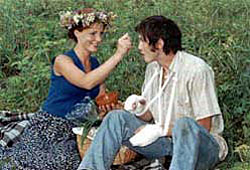
Magda (Aurēlija Anužīte) and Juziks (Renārs Kaupers) spend a quiet moment on Midsummer’s Eve, hours after an ex-KGB agent nails Juziks’ hands to a cross. (Photo by Atis Ieviņš)

It is not often that I feel I have to watch a film more than once. Not because I missed some important plot point, but because I am not sure I liked or disliked the film. In the case of Vecās pagastmājas mistērija, I am still not sure. The films of Jānis Streičs have that effect on me.

Vecās pagastmājas mistērija (The Mystery of the Old Parish House) is loosely based on real life events that took place in Krimulda, Latvia. It tells the story of an aging KGB agent (Eduards Pāvuls) who is forced to live the rest of his life in a house in whose basement he had tortured and murdered people during the summer of 1941. Yet, the film itself is really about much more than that. It is about filmmaking and contemporary life and the notions of guilt and responsibility.

The film is told in three parts. The first, "Mea Culpa," is a film within a film. It is about the screening of the KGB agent’s story. In the film within the film, the KGB agent hires two construction workers (Renārs Kaupers and Andris Bērziņš) to brick up the door to the basement to prevent the ghosts of all those he had killed from coming after him. As the two workers discover the true nature of the job they resolve to avenge all those who had died by killing the Chekist, but eventually end up saving him from killing himself. Unfortunately, no one, other than the director (Artūrs Skrastiņš), likes the finished film and it is decided that additional scenes need to be shot to improve it.

The second part, "Agnus Dei," is about the shooting of an additional horror scene in which the ghosts, accompanied by a spectre of Jesus nailed to a cross, chase the Chekist. Unbeknownst to anyone, one of the people hanging around the shoot—a filthy, drunken bum looking for a free drink—is the real-life KGB agent. During a break in the filming, while no one is watching, he nails the actor (Kaupers) playing Jesus to the cross.

The last part of the film, "Tuba Mirum," is about the relationship between the young actor Juziks (Kaupers), the film’s producer, Hugo (Ivars Kalniņš), and Magda, the woman they both love (Aurēlija Anužīte).

It all comes to a head as the sadistic producer tries to rape Magda, Juziks comes to her rescue and—with the help of the ghosts of the victims of the old parish house—they triumph over all.

The major flaw of Vecās pagastmājas mistērija is that so much of the story is dependent on the fact that the film within the film is supposed to be flawed and we spend too much time watching a bad movie being made. It’s not that this is a bad idea. Films about bad films are not a new genre. I can think of two examples, Ed Wood and Living in Oblivion, that worked. However, neither of those films tried to focus on anything other than the basic premise. Streičs tries to reach far beyond that by also making Vecās pagastmājas mistērija about the true-life events of what happened to Latvia under Soviet occupation and all of the real and imagined scars that they left on the Latvian psyche. If he had focused on either story the film would have been much stronger. By trying to combine the two he succeeds in telling neither.

This is not to say that Vecās pagastmājas mistērija is a bad film. Many parts of it work and others are downright profound. Streičs’ combination of mysticism with realistic themes and execution show a great deal of talent and depth. The three parts all complement each other. You have layers upon layers of symbolism here. The real-life events are often more absurd and surreal than their celluloid representation. Reality and fantasy blur and complement each other to the point where you can’t tell them apart. All in all, while some of the parts might not work, the sum is greater than the whole.

Details

Vecās pagastmājas mistērija

Jānis Štreics

Rīgas kinostudija,  2000

Notes: In Latvian with English subtitles. Drama, color, 110 minutes. Screenplay: Jānis Streičs; director of photography: Harijs Kukels; music: Mārtiņš Brauns; set design: Ieva Romānova; principal cast: Aurēlija Anužīte, Andris Bērziņš, Olga Dreģe, Ivars Kalniņš, Renārs Kaupers, Eduards Pāvuls, Inese Saulīte and Artūrs Skrastiņš.