Emotion gets the better of soldier’s tale

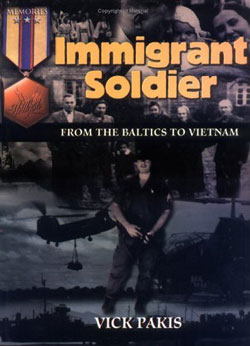
Immigrant Soldier

Immigrant Soldier: From the Baltics to Vietnam is a very personal story that is told with heartfelt conviction and sincerity. Unfortunately, it never develops beyond an oversimplified look at history through the prism of personal experience.

As the title suggests, the memoir attempts to span the historical era from Latvia’s independence through Vick Pakis’ own experiences fighting in the Vietnam War. That is a Herculean task. It includes the Soviet occupation of Latvia and the family’s flight to the West, their experiences in a Displaced Persons camp in Germany, and their arrival and adjustment to life in the United States, eventually culminating in Pakis’ own experiences in the Vietnam War.

Similar approaches were used by Agata Nesaule in A Woman in Amber and by Modris Eksteins in Walking Since Daybreak. The problem is that Pakis has neither the literary skill nor the historical backgrounding of Nesaule or Eksteins. His story seldom goes beyond simple narrative in which all the good guys wear white and all the bad guys, in this specific case, wear red. The writing often reads like ledger entries.

Small nagging errors are hard to ignore after a while. Pakis refers to his grandfather as Khrisjanis. The Latvian pronounciation of the name would most likely be Krishjanis (Krišjānis). Another character is referred to as Mr. Ozoles; in Latvian it would be Ozols. The family members are referred to by first name only, which can be confusing. The book’s jacket claims that the book "…reveals how his personal history would ultimately influence Vick Pakis’ own confrontation with Communism—as a soldier in the U.S. Army." However, the only character in the book who serves in the U.S. Army is named Karl. The only Vick in the book is Viktor, Karl’s father.

These are to be expected in a book from a small publishing company, Hellgate Press, specializing in books that claim to look "through the eyes of someone who has experienced war" and written by a novice writer who feels strongly about his subject matter. Ultimately, it’s the strength of feeling that is the downfall of Immigrant Soldier.

The story of the incredible hardships that the Pakis family had to endure works, even if one suspects that it might be a bit self-serving. It’s the recounting of history that exposes the book’s shortcomings. It’s not that Pakis’ family did not go through hell and that the Soviets were responsible. It’s not that the Vietnam War wasn’t as simple as the war protesters tried to make it out to be. It’s just that he tries to put it all into such a narrow historical perspective that even the staunchest conservatives might blink.

The Reds are to be blamed for everything. In the fight for Latvia’s independence all of the bad guys are Reds. During Latvia’s independence the Reds cause all of the problems. In German labor camps the bad guys are all Reds, or Russians. During the Vietnam War period it’s the Red media. And if they are not Reds, then they are obviously malcontents and idiots. The book is peppered with passages like “…experiences of the past created a hatred for hypocrites, liars, thieves, and most of all, the so-called experts…Viktor’s success was based on hard work, but it did create a few enemies for him. Envy and jealousy came his way from several older writers in the section…It’s not going to be tomorrow or the day after that, but eventually they will be able to say, ‘I told you so’ to all of these Commie lovers and Socialists."

Pakis’ life, the experiences of his family’s flight from the Soviet occupation of Latvia and—by extension—the lives and experience of countless other Latvians, those who left and those who stayed behind, deserve to be heard. Unfortunately, Vick Pakis was probably not the best person to tell them.

Details

Immigrant Soldier: From the Baltics to Vietnam

Vick Pakis

Central Point, Ore.:  Hellgate Press,  2000

ISBN 1-55571-512-5

Where to buy

Purchase Immigrant Soldier: From the Baltics to Vietnam from Amazon.com.

Note: Latvians Online receives a commission on purchases.

Image of drunkenness damages album’s effort

Alus dziesmas

Think of the cute farmer’s daughter in overalls, straw hat, freckles, pig-tails and a piece of straw between her teeth. Now think of the Latvian version of this scene. That’s what the first half or so of the album Alus dziesmas (Beer Songs) sounds like to me: a caricature.

According to the liner notes, Latvians enjoy beer, but their tradition doesn’t condone drunkenness. The liner notes correctly state that "beer was an integral part of the ritual meal at all ancient Latvian celebrations." Beer was a part of socializing, feasting and singing—a beverage to enjoy, instead of a means by which to get drunk. But you’d never know it by listening to some of the songs on this compact disc, nor by looking at the cover picture!

I admit it—the cover photo put me off from the very beginning: a museum-quality traditional Latvian house with four men partying, one of whom is passed out at the table. The first half of the CD sounds like the picture looks: more or less traditional music, but then there’s that one passed out guy that messes it up. The mood sounds exaggerated, like a parody.

If you’re drunk, then not only would your singing and judgment suffer, but also your playing of musical instruments. The playing on Alus dziesmas does not suffer. In fact, it is quite good, as one would expect from the musicians associated with the UPE Recording label. But to me it sounds like they started recording the vocal tracks at the height of their drinking. Thankfully, after about half a dozen songs the music seems to have mellowed them out some. After a somewhat bitter first taste, the CD ends with several really nice songs, leaving a good aftertaste in my mouth.

A few highlights of the CD:

"Es bej loba īmetēja" is very interesting, being a song from the woman’s point of view. This woman does not lament about her husband’s drinking, as one would expect, but rather jokes about her own fondness for imbibing: "Whoever plans to marry me should first build a brewery so that I can start each day by going there…"

The men’s a capella "Kur tu biji alutiņi" is a nice change from the previous songs and leads into "Redz kur nāca alus kanna," sung by three very confident women. "Redz kur" is the traditional drinking song where I come from, aside from the common ziņģes. It rarely has a set text, because people are expected to just add verse after verse. The melody line is almost too simple, but the elaborate ways people keep the strong beat going (for example, pounding anything made of wood) keep the song fun and exciting.

While all the songs on the CD (except the two instrumentals) are truly pretty much about beer and beer alone, "Pie alus galda sēdēja" is a love song of sorts that mentions beer only in the title. "Alus, alus, laid mani iekšā" is a great waltz-polka combination.

Actually, there are quite a few good, merry, lustīgas songs on Alus dziesmas. But like I said, I don’t care for the treatment they receive on this recording. I also got a bit tired of the constant accordion (as well as the Cajun-inspired playing of it, for example, on "Aiz kalniņa dūmi kūp"), but I guess the instrument does seem to fit well with beer.

A warning to connoisseurs of ultra-traditional music: This CD contains a whole lot of whoops, yips, grunts, squeals, calls and shouts. For some reason these have become quite popular in Latvian traditional music lately. They’re not really at all out of place at a wild party or even just a fun evening of dancing and singing. But some people do not like to hear them on recordings.

Alus dziesmas contains just a few of the many, many songs on the topic of beer and drinking (a great number of which are, need I say, heart-rending laments about drunk husbands, but we hear none of those on this CD). Despite the treatment they receive, the collection of songs is pretty good, and the goal of the CD is noble: to once again intertwine the drinking of beer with the singing of traditional beer songs.

Details

Alus dziesmas

Latviešu tautas mūzikas kolekcija

UPE Recording Co.,  2001

UPE CD 026

A small, gentle film about Christmas

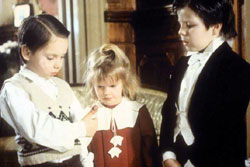
The Cīrulītis children in a scene with the child prodigy.

Great films don’t always need to be “great” films. They don’t have to be perfect or about important topics. Sometimes they can just simply be small, gentle films that tell their story with heartfelt sincerity, humor and warmth. Ziemassvētku jampadracis is such a film.

Jampadracis tells the story of the Cīrulīši, a tight-knit family down on their luck, and their trials and tribulations during the Christmas season.

Father Cīrulītis has just been turned down for a job as a music teacher. He can barely support the family as a piano teacher with far too few students. They can’t even afford a Christmas tree. The landlord is threatening to kick them out. The kids have just received their report cards and some of the marks are not, well, they are not the kind that you would want your parents to see. The eldest son has been summoned to the police station falsely accused of hitting a policeman with a snowball. And, to top it all off the child prodigy—whom the two youngest kids have been entrusted with entertaining—has just been injured on the eve of his concert. The pair is sure to be blamed.

What ensues is a story that is as genuine as it is warm, a wonderful tale that transcends whatever weaknesses it might have simply because it is told from the heart. The Cīrulīši might be poor and going through hard times, but the love that they have for each other can triumph over anything that comes their way.

In contrast, the family of the child prodigy, which has all the wealth and status that anyone could possibly need, seems lost and sad because they lack precisely the one thing that the Cīrulīši have been blessed with.

The winner of several awards,  among them Chicago’s and Frankfurt’s children’s film festivals, Jampadracis might be characterized as a children’s film, but it is a film for the child in all of us. It transcends the genre. The performances do not contain a single false note and Varis Brasla’s direction and the script by Alvis Lapiņš are exemplary.

Details

Ziemassvētku jampadracis

Varis Brasla, director

AL KO,  1993

Notes: In Latvian. Comedy, color, 72 minutes. Screenplay by Alvis Lapiņš, based on a story by A. Zapere; camera: Dāvis Šīmanis; music: Mārtiņš Brauns; principal cast: Dace Everšs, Jānis Paukštello, Ināra Kalnaraja, Uldis Dumpis, Līga Zostiņa, Lāsma Zostiņa, Liene Zostiņa, Almārs Zostiņš, Edgars Eglītis and Kaspars Ādamsons.