Love him or hate him, but Pauls is still a legend

Tev, mana labā

Raimonds Pauls. The name alone has a great meaning to just about every Latvian, whether they are living in Latvia or elsewhere. Ask a Latvian what their opinion of the man is and you are bound to get a full spectrum of responses. Beloved by many, detested by just as many, Pauls has been by far the most famous figure in Latvian music in the past 50 years.

Pauls is also probably the most prolific composer of the time as well, having released albums by the boatload throughout the years. And in all styles as well: film music, jazz music, music for theatre, Christmas music and just about everything else you could think of. Of course, with that kind of output, there was bound to be some material of lower quality. (The Sapņu pīpe record, anyone? I get bad memories just thinking of that one.) One of the main reasons Pauls was able to release so much material was his good standing with the government at the time, something that few other artists had.

Tev, mana labā was released in 1969, and was Pauls’ very first record. The album had long been out of print, but MICREC—recognizing Pauls’ very large fan base and the historical significance of this record—re-released it on compact disc at the beginning of 2001. And, as a bonus, this CD includes four additional tracks that weren’t on the original album, but had been separately released on a 7-inch vinyl record.

The first time I sat down to listen to this CD I didn’t know what to expect. I knew many of these songs, but didn’t know what they would sound like, as I hadn’t heard them in years. However, as soon as the first track, the song "Tev, mana labā," started playing, a wave of memories started flowing back. My parents had this record when I was much younger and I listened to it constantly. Although I have since aged (but maybe not matured) and my musical tastes have changed, there are still many great songs on this album.

Pauls’ music can be hard to classify at times. "Lounge music" seems to be the most common description, and it fits many of the songs here. Most of the songs are backed up by the REO (Rīgas estrādes orķestris), and feature Pauls’ usual suspects on vocals, including Ojārs Grīnbergs, Nora Bumbiere and Margarita Vilcāne. Pauls had a great interest in jazz as well, a rather different sound in Latvian music of that day.

This release contains many of Pauls’ best-known songs. Among fans, "Mežrozīte" remains his most beloved song. MICREC’s Web site ran a poll on the public’s favorite Pauls song and "Mežrozīte" won hands down. And it is a really beautiful song, with lyrics by A. Krūklis, about a forest rose that continues to grow and bloom throughout the years.

Another favorite of mine and of the general public is the song “Papu, saki mammai pats." It is a song about a conversation between a father and his daughter, who wants to get married to some guy. Of course, both father and daughter are deathly afraid of Mom, so neither wants to talk to her about this (sounds like a typical Latvian mother!). But there are wedding bells at the end of the song, so presumably Mom was okay with the whole thing. The song is infuriatingly catchy, and you will find yourself singing it for a week after hearing it.

Other famous songs include "Kur tu esi" and "Dziesma nenosalst." The latter is a song about wishing to hear the old cradle songs that had been sung in distant childhood, and features some very pretty harpsichord work and backing vocals by a women’s ensemble.

The sound quality of the CD is exceptional. MICREC has done a great job restoring the audio to the highest CD quality. The packaging is also very well done, with very interesting commentary and history about the recording of this album, as well as pictures. The only disappointment is the fact that the lyrics were not included.

Some songs are too “lounge” for me and make me reach for the CD remote so I can skip those tracks. A good example is "Cik labi, ja Tu blakus man." Even as a 7-year-old kid, I couldn’t listen to it the whole way through. It’s a song best left for hotel bars.

One thing struck me as particularly odd. With Pauls having the clout that he does, you would figure he would have had at least a better picture of himself on the front cover! The picture is truly dreadful, with Pauls adopting his best "I am a very serious socialist" pose.

If you’re going to have one Raimonds Pauls album in your collection, this would be the one. It has some of his best work on it, as well as some of his most famous songs. At times the record does show its age, but there are many timeless classics here that will undoubtedly remain popular in the Latvian world for years to come. Love him or hate him, you have to respect the man for his musical ability, and Tev, mana labā is one of the best examples of Raimonds Pauls’ ability to make music.

Details

Tev, mana labā

Raimonds Pauls

MICREC,  2001

Egils Kaljo is an American-born Latvian from the New York area . Kaljo began listening to Latvian music as soon as he was able to put a record on a record player, and still has old Bellacord 78 rpm records lying around somewhere.

Berzins hits her stride with latest mystery

A Tear in God's Eye

It takes a while before Doreen Bell, the main character of Ilze Berzins’ latest crime thriller, is introduced to the reader. And it takes an even longer time before someone is found dead. Combined, they are among the elements that make A Tear in God’s Eye the author’s best work so far.

Readers familiar with her earlier mysteries—1999’s Death in the Glebe and 2000’s Revenge on the Rideau—will recognize certain Berzins trademarks. Bell, the middle-aged Ottawa artist who becomes amateur sleuth, of course figures prominently, as does her cop boyfriend, Barry Mullins. And Berzins soon had better provide a map to Canada’s capital city; she’s using more of the geography of Ottawa now.

Men, as they did in the earlier novels, are mostly cast as disagreeable characters, although their rough edges are softening. "Men need to feel powerful and in control," Bell tells her neighbor, Constable Julie Barnes. “And when they feel they’re losing it, they lash out—attack, even kill.”

But there the similarity ends. A Tear in God’s Eye is more layered and complex than the earlier crime novels. I kept expecting Doreen Bell to jump out at ever turn of the page, but it wasn’t until about a quarter of the way through that the story finally got to her. Along the way, the author had already introduced and developed several characters, among them the two-bit criminal Ivan Pavnick and his wheelchair-bound sister, Val Pavnick, the owner of a women’s shelter.

Berzins also has developed a much more intricate plot, one that she slowly unwinds before getting to the key element in a murder mystery: a body.

When death finally comes—to Linda Pedersen, wife of policeman Carl Pedersen—we are just past the halfway point in the book’s 315 pages.

The novel offers the reader a view of a grittier Ottawa, complete with corrupt cops and the drug underworld, not just the artsy Glebe or the fashionable Rideau districts that were featured in Berzins’ previous works. A Tear in God’s Eye also has a sexual tension that was lacking earlier.

Berzins also is funnier here. Sometimes the turn of a phrase seems a bit overplayed, but at other times the irony and weird humor work well. Linda Petersen, for example, is killed in a parking lot. "The killer had left a signature," Berzins writes. "The V from a Pontiac Aztek was found lodged in the dead woman’s torso." I had to laugh, because Pontiac Azteks really are disagreeable-looking vehicles.

Without the benefits of a large publishing house that might advise against going to press before an author is ready, Berzins in a few short years has churned out three crime mysteries, plus her recently re-released memoir of trying to start a new life in Latvia, Happy Girl. She’s received both accolades and criticism, of course, but has also matured as a writer. With A Tear in God’s Eye, Berzins has hit her stride.

Details

A Tear in God’s Eye

Ilze Berzins

Halifax, Nova Scotia:  Albert Street Press,  2001

Andris Straumanis is a special correspondent for and a co-founder of Latvians Online. From 2000–2012 he was editor of the website.

Album offers peek at a dark metal future

These days, admitting that you are a heavy metal fan is not an easy thing to do. Unfortunately, heavy metal has gotten a bad reputation, associated with cheesy bands in the 1980s sporting absurd hair and bad makeup, or for supposedly “influencing” people to either commit suicide or worship Satan.

When I was younger, I listened to quite a bit of metal myself. I would frighten friends and family with the music I listened to: band with names like Metallica, Megadeth and Iron Maiden and songs with titles like “Harvester of Sorrow,” “Wake Up Dead” and “The Number of the Beast.” The album covers would reflect the titles, with pictures of skeletons, demons, graveyards and similar imagery.

Most people figure that it is just a teenage thing and it passes, but I enjoy listening to heavy metal whenever possible. And I am glad to say that I have neither committed suicide, nor do I worship Satan. I like the aggressive music, the bleak lyrics and the blunt attitude of many of the bands. This kind of music helps get out your own aggression, or close off the rest of the world when you want.

Heavy metal is quite popular in Latvia. Most every time I walk around Vecrīga, I see many posters advertising heavy metal bands that are playing in the area. Their shows are well attended, too. Most of their recognition comes through word of mouth. Though heavy metal is popular, many of these bands don’t have the resources to put together a complete album. Thankfully, Gailītis G (of all labels!) has provided an outlet for many of these bands to reach a wider audience.

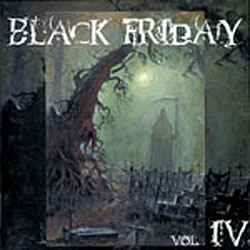
The fourth volume of the Black Friday metal compilation album collects 15 tracks (totaling about 70 minutes of music) by a wide variety of bands from Latvia. Most of the songs are in English, some are in Latvian and some I can’t tell what language they are in!

The quality of the songs is quite varied. Some are still in the demo phase, but some are release-quality recordings. Regardless, it is still an interesting journey through the rugged landscape of Latvian heavy metal.

The album begins with “Angel’s Tears” by the band Heresy from their EP Heresy. The song begins with a disembodied female voice chanting some Latin words in the style of the “industrial metal” sound of groups like White Zombie. The only words I can make out are the chorus of “God is dead, and no one cares!” It’s a good song.

Also in the industrial metal vein is Huskvarn’s “Save Your Soul,” but the song reminds me a bit too much of Marilyn Manson, although the vocals are hard to hear.

Next is Skyforger with “Sešas ārprāta dienas” from the album Latvian Riflemen. Skyforger’s claim to fame is that they sing songs about Latvian warriors and even dress the part, judging by their picture in the liner notes. Their Web site lists them as being “deeply inspired by their native folklore and pagan heritage” and their lyrics being “poetry based upon the stories from times of the World War I.” Very good guitar work in this one, especially aggressive music, but the lyrics are too far down in the mix for me and I can make out few words.

“Autumn” by Sanctimony, from the album Eternal Suffering, is up next. This is a rather generic “death metal” song. Death metal is characterized by bludgeoning, extremely distorted guitars and drums, along with growled, incoherent vocals (sort of like an angry Cookie Monster). Fans of the genre (bands like Cannibal Corpse and Carcass) will probably like this, but it’s a bit dull for my tastes. The same applies to the group Preternatural with their song “Presence” from a demo tape of the same name. I like the guitar work, but the high-pitched guttural growling makes this song sound like any other death metal song.

Plenty of death metal is found on this album. Songs include Brute Chant’s “Olympiad” from their album Killer Each of You, The track sounds like the production was intentionally made muddy, as the vocals are routinely drowned out by the noisy guitars.

Moving further back to the mainstream is Fatum’s song “We Are Dreaming of Peace.” The hard driving bass line and the harmonies in the guitars remind me of Iron Maiden. Once again the vocals are mixed too far back, making it hard to understand the words. I liked this song, though. Hopefully, Fatum will be releasing more some day.

One of my favorites on the album is Rainmaker’s “Lietus dziesma.” From the great opening bass line, to the rythmic assault of the guitar, to the menacing (and understandable!) vocals, this is one of the standouts of the album.

Heresiarh’s “Higher Than Hills,” from the album Mythical Beasts and Mediaeval Warfare, is what the band on its Web site calls “Latvian dragon metal.” This is due to the fantasy themes that are throughout its songs. One of the latest trends in the metal world is to add female vocalists, perhaps to counterbalance the roughness of the male vocal. However the female vocals in this one are indecipherable as well.

Another favorite on the record is the Dzelzs Vilks song “Ledus,” which balances an extremely rough guitar part with a lighter keyboard part (sounding like raindrops!), as well as a techno beat and howling vocals. This is the most professional sounding song on the record, but that is no surprise, as Dzelzs Vilks’ lineup is just about the same as Deus (S)ex Machina (who released the soundtrack of the rock opera “Fausts”). They have just released an album, Lai arī tu būtu ar mani, that I will assuredly be purchasing next time I am in Latvia.

“Tu jūti” by Apēdājs is another good, straight-forward metal song, with some great guitar effect work. The Quarks’ song “Dziesma par reklāmu” starts off with an extremely deep bass sound, then brings in some crunching guitars as well. Sounds a bit like the grunge-metal style (a la Stone Temple Pilots). Moral Free’s “Bangin’ on the Radiators” is another straightforward song.

Sliede’s “Vēl prasīts” starts off with a very Van Halen-ish guitar intro but then becomes a Black Sabbath-ish (slow and deliberate guitar riff) song.

The most bizarre track on the collection has to be the last one, “Māt, es gribu būt nevainīgs” by the hardcore band Inokentijs Mārpls. Flying along at 100 miles per hour, the song features a rather unearthly falsetto shriek by the lead vocalist. I presume that they are not trying to be serious in this song, but I’m not entirely sure. Unique, for sure, but an assault on the nerves of the listener.

Liner notes are pretty sparse: a picture of the bands but not much else. For these kinds of compilations, information about who is in the band or a Web site address would be useful. Having the lyrics would have helped, too, especially for the unintelligble death metal songs.

Quite a few tracks here are very good. However, many of the tracks are highly derivative and sound very similar to other, more popular bands from the United States and Europe. And a number of the tracks would benefit from a bit more polishing of the sound and music. However, the album does provide a thorough snapshot of the world of Latvian heavy metal. From listening to this record, the future of this style is very bright (though I’m sure most of the groups would prefer to say that the future looks very dark!).

Details

Black Friday, Vol. IV

Various artists

Gailītis-G,  2001

Egils Kaljo is an American-born Latvian from the New York area . Kaljo began listening to Latvian music as soon as he was able to put a record on a record player, and still has old Bellacord 78 rpm records lying around somewhere.