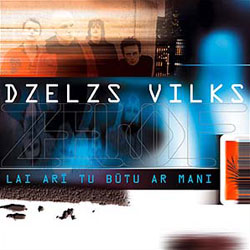
Industrial metal album is a rather dull affair

During the Rīga 800 celebration last year, one of the highlights for me was the all-day music performances on the big stage by the Daugava River. The entire day was devoted to all kinds of Latvian bands, of all different styles and sounds. Two bands caught my interest. The first was Deus sex machina (formerly named Deus ex machina), followed by Dzelzs vilks. It was a very hot day, and perhaps I was suffering from heat exhaustion, but it appeared that the groups were one and the same—no personnel changes happened between their sets. This is not a surprise as the guitarist, Juris Kaukulis, plays in both groups (as well as sings in Dzelzs vilks). I enjoyed their performance, as the group had a heavy, aggressive industrial sound, balanced by intricate keyboard parts.

After the performance, I picked up the Deus sex machina recording of the Fausts rock opera. Unfortunately, it was not to my liking, though the performances on the album were all good. On that recording, Kaukulis was joined by Andris Vilcāns (the composer of the music) on keyboards. Perhaps I would have appreciated the record more if I had actually seen the rock opera, but this compact disc rarely gets into my CD player.

After hearing and liking the song “Ledus” on the Black Friday Vol. IV compilation, I decided to pick up the latest Dzelzs vilks CD. The UPE Recording Co.‘s Web site explained that it is the band’s third album, but only the first to be released on CD. Even though I didn’t like the Fausts recording, my expectations were still high, since this was a different group on the CD, and the songs were the band’s own compositions. However, I found Lai arī Tu būtu ar mani a rather dull affair.

Kaukulis is joined by Armands Butkevičs on bass, Mārcis Judzis on drums and Kaspars Tobis on programming.  Kaukulis also wrote all the music and lyrics for the record.

The music is all in the industrial metal style. That on its own is not why I dislike the album, but it becomes clear from listening to the record that the participants spent a lot of time listening to bands like Nine Inch Nails and other industrial bands. This results the album sounding like a diluted Nine Inch Nails record, on which Dzelzs vilks tries to recreate the sound of a better-known band, but without great success.

It also seems at times that the guitar sound does not change much throughout the album. It remains in the “crunchy” style from beginning to end. This gives the album a repetitive sound and even after multiple listenings I have difficulty distinguishing between many of the songs.

The album starts out well enough with the title track “Lai arī Tu būtu ar mani.” It is a good introduction to the band, with heavy guitars, prominent synthesizers and Kaukulis singing like a soul in torment. The lyrics of this song also present many themes that reoccur throughout the album,  such as the pain of love and how generally miserable existence can be from time to time.

The recording of “Ledus” is slightly different than on the Black Friday compilation, sounding a bit more polished. This remains my favorite song on the album, becaues I think it has a good melody and is not too repetitive.

I also like “Vienas nakts meitene.” The song is quite different than the others on the album, starting off with a very pretty piano and guitar introduction. The track is less aggressive than the others on the album, and it is a good way for the listener to relax (if briefly) before the sonic assault of the rest of the album.

“Saplēstie stikli” has a very eerie piano introduction that is repeated within the song, though the “Whoa-oh” vocals start getting repetitive after a while.

The album ends with a remix of “Ledus” done by Alis P. Though not much different from the original, this remix brings the beat out more with a louder drum track.

Most of the other songs follow the same pattern—starting with a quiet introduction, then the guitars crash in—which is likely why I cant distinguish many of the tracks.

Though many of the songs show promise, this album was not to my taste at all. This is ideally meant for seriously devoted industrial fans (of which I am not one). The production on the album can also be quite muddy, as the crunchy guitars tend to drown everything else out. These guys have talent and have some interesting synthesizer loops,  but there is not too much of interest on this record for me. You could classify the music as hard rock, but its industrial influences make Dzelzs vilks a far different group than, for example, Līvi, so it would not be fair to compare them. Fans of industrial will likely find everything they are looking for here (synthesizer loops, crunchy guitars, angst-filled lyrics), but I must pass on this one.

Details

Lai arī Tu būtu ar mani

Dzelzs vilks

UPE Recording Co.,  2001
Egils Kaljo is an American-born Latvian from the New York area . Kaljo began listening to Latvian music as soon as he was able to put a record on a record player, and still has old Bellacord 78 rpm records lying around somewhere.

Forward into 1980s with latest Piecīši re-release

Last year saw the release of the latest compact disc of Čikāgas Piecīši re-releases, which takes us into the 1980s. The album Par mani, draudziņ, nebēdā was originally issued in 1982, while Made in Latvia was released in 1988. Both are collected now on CD.

Already in the 1980s the Piecīši were in their third decade of performing and recording, and as they are getting older, their songs have begun to develop a more sentimental (not to mention patriotic) bent to them. The distinctive tounge-in-cheek humor is still there, but it is enhanced with songs that show a group that has become older and wiser through the years.

It is not clear from the liner notes what the lineup is on the Par mani record, though I can be fairly certain that at least Alberts Legzdiņš, Armands Birkens and Janīna Ankipāne are there. “Made in Latvia” lists Legzdiņš, Birkens, Uldis Streips and Lorija Vuda as singers; musicians are Birkens on guitar and R. Daughtry on guitar and bass guitar.

Patriotism is a strong theme in these two recordings. One of the highlights is the song “Par mani, draudziņ, nebēdā,” the Piecīši tribute to the Freedom Monument in Rīga. The song is sung from the monument’s perspective, telling everyone “not to worry about me”—a song of optimism where no matter how bad things go, they will turn out fine in the end. And they did, so it was a prophetic song in a way.

Also in patriotic style is the song “Made in Latvia.” It is about how, even though everything in his house is imported in some way (Japanese shaver, South Korean alarm clock, Danish table), at the very least, his beloved is 100 percent Latvian. She is so Latvian that even when the neighbors ask her to play bridge, she can’t, as she is making pīrāgi.

Though the leader of the Piecīši will always be Legzdiņš, who provides almost all of the words and music, the real star of this release is the achingly sincere tenor voice of Armands Birkens. Just hearing his voice will make the listener weepy. Even if he sang the phone book, most listeners would break into tears! This is best displayed on the song “Lai visa pasaule to redz” (a duet with Lorija Vuda), a song about two lovers, one in Rīga, one in Chicago, who want the whole world to see how great their love is, regardless of the distance between them. This song is one of my favorites on this release.

Sentiment is also heavy on the song “Mūsu mīlestība,” a song about someday meeting again, because their love will never end. This song again features the voice of Birkens.

Now that the Piecīši have grown older, and have had had children, it was inevitable that there would be songs about the trials and tribulations of getting these children to Latvian school on Saturday mornings. The similarly titled “Piektdienas vakars, sestdienas rīts” and “Sestdienas rītā” are about the occasional panic attacks on Friday nights, and the massive process of getting everyone ready Saturday morning. Reminds me of the many occasions in my family when on Friday evening I realized that I had a domraksts to get done by the next morning!

On certain songs, the Piecīši display their growing country music influence, complete with twangy guitars, baying vocals and songs where a pickup truck is a major plot device—see “Šoferdziesma”. This song is actually a bit too country for me, featuring Birkens howling in the background. I usually skip over it.

Though heavy on sentiment, the distinctive Piecīši humor is still present. The opening track is “Kurpniekzeļļi,” a song about shoemaker apprentices who spend more time staring at women’s legs than doing their job. This song’s “sequel” is “Skroderzeļļi,” this time about the great life a tailor’s apprentice enjoys, which is apparently much better than a shoemaker’s apprentice’s life.

Also in the humorous vein is “Trīs vecenītes,” which is about three old ladies sitting around and bragging about what they have managed to keep “real,” even in their old age. Legzdiņš encourages the audience to spit along with the chorus.

My main complaint about this release is the same complaint I have had about the other Piecīši re-releases: the packaging. I think I have already whined about this enough in my previous reviews, so go read those, because I don’t think I have anything different or more insightful to say this time.

Though they may have gotten older, and their songs have gotten (perhaps a bit too) heavy on the sentiment and patriotism, these Piecīši re-releases still occupy a very important space in the Latvian music world. They give voice to the many Latvians in the United States (and elsewhere outside of Latvia) who were also growing older, and at the same time facing similar problems such as raising Latvian kids and trying to keep their Latvian identity. Though they have gotten advanced in age, these records still sound fresh and relevant today. They reinforce once again the importance of the songs of the Čikāgas Piecīši, both in the 1980s as well as today.

Details

Par mani, draudziņ, nebēdā & Made in Latvia

Čikāgas Piecīši

Balss,  2001

Egils Kaljo is an American-born Latvian from the New York area . Kaljo began listening to Latvian music as soon as he was able to put a record on a record player, and still has old Bellacord 78 rpm records lying around somewhere.

Song festival tribute mixes the old with novelties

Latvians are more likely to ask each other “Did you go to the last Song Festival?” rather than “Have you ever been to one?” Almost every year for decades, a song festival has been held somewhere in the world, and Latvians have flocked in droves to this most ubiquitous celebration of their culture and heritage. Non-Latvians may have difficulty understanding the excitement and emotion surrounding these events. Lasting several days to a week or more, the larger festivals feature numerous concerts, dance presentations, crafts exhibitions, nightly balls, and mass demonstrations of Latvian patriotism and nationalism—in short, total immersion in the Latvian ethos.

During the period of Soviet occupation of Latvia, festivals were held periodically in Latvia, but the repertoire and events were carefully manipulated. While the trappings of Latvian culture were present (at least those reasonably acceptable to Soviet authorities), many foreign influences were also felt and much was strictly proscribed. During those years, festivals in Latvian communities abroad helped keep the spirit alive, and when Latvians were finally allowed to hold a truly national festival in their own country in 1990, for the first time in 50 years, the excitement, pageantry, emotion, and sense of occasion were overwhelming.

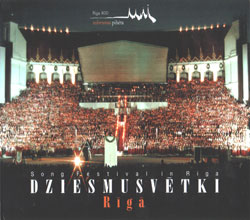
The album Dziesmusvētki Rīgā features some highlights from that milestone event, as well as more recent selections. Issued as part of the national commemoration of the 800th anniversary of the founding of Latvia’s capital, Rīga, this compact disc mixes old favorites with some novelties.

The disc opens with choral arrangements, by Jānis Cimze, Emīlis Melngailis and Pāvuls Jurjāns, of beloved Latvian folksongs. Original compositions by Jāzeps Vītols (“Gaismas pils”) and Raimonds Pauls (“Manai dzimtenei”) follow, works that have come to be as well known to most Latvians as their national anthem.

The Festival Choir has numbered up to 24,000 singers in Rīga, and the ability to cohesively and musically conduct such a huge mass of singers with subtlety and nuance is clearly an art form. Effectively recording such a widely dispersed field of humanity, where balance problems are already inevitable when one end of the choir is hundreds of feet away from the other, is also a highly specialized skill, with happier results in some selections than others.

All the conductors represented here are experienced in directing such large forces, though some are more satisfying than others. Haralds Mednis’ performance of “Gaismas pils” is a model of clarity, unity, and musicality. On the other hand, Jānis Zirnis succumbs to the temptation to stretch phrases to their limits and overemphasize dramatic effects in Melngailis’ “Jāņu vakars.” Subtlety is not really the point of these events, though: for the singer, it’s the joy of lending one’s voice under such momentous circumstances; for the listener, it’s the thrill of hearing a huge, stirring sound.

Two purely instrumental works follow: an old waltz tune, “Brūklenājs,” zips along merrily but the ensemble often verges on chaos. A potpourri of popular Latvian beer-drinking songs, arranged for brass band as “Alutiņš,” chugs along in marching-band style of a century ago. A 1998 choral composition by Juris Vaivods titled “Rīgas dziesmas” concludes the more traditional fare on this disc, and features a number of familiar tunes with connections to Rīga’s past. Effectively done, and enthusiastically sung.

Finally, something completely different—excerpts from Zigmārs Liepiņš’ rock musical “Teika,” presented at a Latvian youth song festival held in 2000. Despite generally not being fond of rock music, I found parts of the work very enjoyable and arresting. This is not a work with a strong, personal profile, though—much of the material is firmly rooted in the sound of groups and composers popular in the 1970s in the West, such as Supertramp and Electric Light Orchestra, and Imants Kalniņš’ influence is also felt. I suspect this work would have been much more interesting on video—the excitement of the audience and photos in the booklet suggest a strong visual element.

The album has attractive packaging, with thorough annotations in Latvian and English. Proofreading by a native English speaker would have been useful, though. In short, if you’d like a souvenir of “Rīga 800” and a melange of different musical genres doesn’t discourage you, then by all means try this unique, generally enjoyable compilation.

Details

Dziesmusvētki Rīgā

Various artists

MICREC and Latvijas Radio,  2001

MRCD 158