Scholars offer dispassionate, rich look at Latvia

It’s a lot like the mood of many Latvians today, facing rapid change in all spheres of life. Artis Pabriks and Aldis Pūrs’ book shows us that the “challenges of change” have been many, and difficult, over the past century. One is left quite aghast at the range of shocks that have faced Latvia over this time, and the difficulties yet to face.

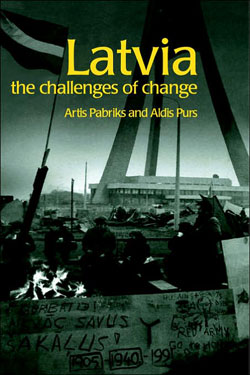
The tone for the text is quite adequately set by the cover. This is a serious work of scholarship, part of a series of academic “snapshots” of postcommunist countries. It is one of the few in the series actually written by citizens of the country under study. What makes this book interesting for Latvian readers is that it is a collaboration between a scholar originating from Latvia and another from the diaspora.

The characterisation of the authors in the preface was curious. Pūrs is offered to the reader as “cynical and irreverent,” scion of the Latvian emigre community, characterised as an environment of “intense conservatism and nationalism.” Postmodern titbits on Latvian identity scattered in the text would have to be pure Pūrs. Pabriks is proferred to the reader as a “liberal republican,” words to me very evocative of American politics.

It was pleasantly refreshing to read a dispassionate perspective, yet written by “insiders” to the Latvian scene. Too much written by Latvians about themselves and Latvia is highly charged with bias and emotion. Although one could never purport to be entirely objective, the authors are well-effaced in the writing, leaving readers to breathe a sigh of relief, weigh up the evidence presented and make their own conclusions. Bravo to the authors for raising discussion of “alternative concepts of Latvianness” and those strained state-citizen relationships in contemporary Latvia.

Historical transformations in Latvia are surveyed since the time of first national awakening in the 1850s, with a focus on the period commencing with the second awakening, beginning in the mid-1980s. The reader is informed of developments up until the close of the 20th century.

The end product is a well-woven mesh of history, politics, economics and foreign policy analysis. Overall, here is a sweeping panorama that importantly places changes in Latvia in a wider context, avoiding the nationalistic provincialism of many an emigre history.

The main problem with panoramas is that some portions of the text can become over-packed with information. The introductory chapter was a heady brew in this respect. The rapid march of social and political movements over a century was conveyed in a measured, clear but rather sterile prose style, which did go some way to alienating a general reader like me, although the narrative came alive for me where it painted a picture of people’s lives and social conditions, such as the section on Latvia between the wars. Generally, however, the book is a mine of facts, not a field of flowery phrases or a sea of emotion.

Intriguing were summaries on contemporary issues, such as foreign policy, giving some indication of the motives behind attitudes of some foreign states toward Latvia, and discussing how Latvians can envision their future (for instance, former Latvian ambassador the United States Ojars Kalniņš’ “Amber Gateway” conception of Latvia’s place in its region). The work remaining to be done by Latvians themselves is highlighted. Criticism of recent governments is tempered by muted concluding calls for further development of civil society; for the public, not the state or international organisations, to be more loudly heard in debates over Latvia’s future.

Latvia: The Challenges of Change is a handy general introduction to contemporary Latvia, though primarily for foreign scholars of the region and its particularities. Nevertheless it is a useful reference work and appraisal of the immediate postcommunist period for other readers. And it is a bridge to much more besides. The book is very positive is its copious list of references and impressive bibliography (including Internet sites), as well as a handy chronology for those who want it short and sweet.

Much as its cover attests, Latvia: The Challenges of Change is not a sparkling, rollicking narrative, not a light read by any means. Latvians might say that “not all is gold that shimmers,” but then not all that doesn’t is to be avoided.

Details

Latvia: The Challenges of Change

Artis Pabriks and Aldis Pūrs

London:  Routledge,  2001

ISBN 0415267307

Where to buy

Purchase Latvia: The Challenges of Change from Amazon.com.

Note: Latvians Online receives a commission on purchases.
It’s Jumprava, so never mind the synthesizers

Trajektorija

I find it extremely difficult to leave a record store without buying anything. Sometimes I feel like I have to justify the time spent in the store browsing and listening by having something to show. It’s a problem that’s especially severe in Latvia, so I have many šlāgermūzikas tapes to show for my troubles.

Sometimes I will pick up something that I really had no interest in buying, and it turns out I will really like it. This happened in 1998, when I was in a record store in Rīga, had no idea what to buy, but knew I couldn’t leave empty-handed. I spotted a compact disc by Jumprava, Laika atšķirību romance, and picked it up on a whim.

I had heard a few of their songs before then, like the quirky “Peldētājs” and the keyboard-heavy “Ziemeļmeita,” but had no idea what to expect of the album. Much to my surprise, it became one of my all-time favorites. From the opening track, “Pastorāle,” to the Indian-influenced “Jaganatha,” the album rarely left my CD player.

The late 1990s saw many Jumprava-related releases. After Laika atšķirību romance, Platforma Records in 1999 released a Jumprava best-of CD, Labāko dziesmu izlasem, which also became one of my favorites because it gathered into one place the earlier Jumprava songs that I had scattered over multiple tapes and records. The year before, Jumprava founder, guitarist and vocalist Aigars Grāvers released his collection Pret vēju pēc 90-ta, which gathered together a number of songs from the various bands he played with. In 2000, Grāvers and Latvian poet Nataradža collaborated on the Rama Dance project, Sāga. Both Grāvers and Nataradža were influenced by Indian culture and folklore and the album bore the fruits of their efforts, combining Sanskrit, Latvian and plenty of keyboards to produce another excellent and unique album.

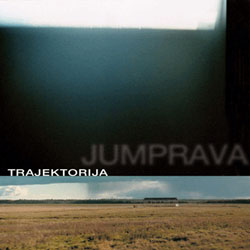
After all that, Jumprava returned late last year to deliver an entirely new album called Trajektorija. I was very curious what it was going to sound like. Was it going to be more like Rama Dance or Laika atšķirību romance, or was it going to sound completely different?

I must say I wasn’t expecting what I heard. However, after a few listens this album really grew on me and I believe it has become a very worthy addition to the Jumprava catalogue. This release will find its way into my CD player quite often, even in the distant future, which is a testament to its staying power.

Though the participants on the album are not listed anywhere in the liner notes, Jumprava’s lineup has not changed: Aigars Grāvers, Aigars Grauba, Aigars Krēsla and Ainārs Ašmanis make up the band. Nataradža also returns to provide lyrics to a number of the songs.

Many of the tracks on the album strike me as classic Jumprava, and some were a bit unsettling to hear at first. I wondered, “Does anyone actually play bass or guitars or drums on this album, or is it all synthesized?” However, because Jumprava have always been a synthesizer-intensive group, the less-organic feeling of the album can be forgiven.

A reoccurring theme over the course of the album is flight. This is first made clear in the opening song, “Lidosta mehāniskiem putniem.” Heavy on electronics, the opening beats of this song sound like an airplane getting ready to take off. The song makes for a great start to the album.

Next up is “Dzinējsuns,” the most techno-sounding song on the album. This one is a bit too techno for me. It reminds me of the frantic music in those Mortal Kombat video games. It also features practically “rapped” verses, presumably by Grāvers.

A favorite on the album is “Divi putni.” Cheesy 1980s-sounding keyboard intro aside, this up-tempo and hard-driving track features some great vocals and lyrics by Nataradža.

Another favorite on the album is the more somber “Anastasijas vārdi.” The track features a number of effects adding to the rather “mysterious” sound of the song.

The song “Baiga vasara” is from Grauba’s film of the same name set in Latvia during World War II. It features lyrics like “Ja lūdzam ar noliektu galvu, vai eņģeļi sadzirdēs mūs?” (If we pray with bowed heads, will the angels hear us?). Though the song is bleak, some hope remains.

The song I liked the most is the last one, “Nedaudz par viņu,” written by Grauba. Out of all the songs on the album, it best displays the Jumprava sound. Painted in both broad and fine musical strokes, the song has a rather simple keyboard part that is very involving. Grauba’s practically pleading vocals are also memorable, as he sings “Mīļā, kāpēc es neredzu savadāk?” (My love, why do I not see differently?). It’s definitely a classic Jumprava song.

Combining elements of Rama Dance, their most recent recordings, as well as their classics, Trajektorija is another great album from Jumprava. Don’t let the heavy synthesizers and downright techno sounds discourage you. Jumprava are still at the peak of their creativity and songwriting skills.

Details

Trajektorija

Jumprava

Platforma Records,  2001

Egils Kaljo is an American-born Latvian from the New York area . Kaljo began listening to Latvian music as soon as he was able to put a record on a record player, and still has old Bellacord 78 rpm records lying around somewhere.

Angry? Have a dose of Latvian ‘Nu metal’

The Inevitable

As music evolves through the years, listeners often get to hear strange and unexpected hybrids of different genres. One of the most unusual combinations to have become popular in recent years is the combination of rap and metal, sometimes given the goofy “Nu-metal” label. One would have thought that the two styles of music, what with their devout fans and uncomprising musicians, would never have come together. However, because both styles are often outlets for anger and aggression, perhaps it is not too much of a surprise that this style has become very popular in recent years.  The best known group in this style is Rage Against the Machine, but groups like Limp Bizkit and Korn also have incorporated it into their music.

This trend has also taken hold in Latvia, evidenced by the release of The Inevitable by the group F[ei]K. The album is entirely in English and contains all the loud guitars and anger you could possibly need in a rap-metal album.

F[ei]K are made up of Ansis “Rooc” Auders on guitars, Gusts Leimanis on bass, Verners Biters on vocals, Martins Opmanis on drums and Kristaps “Krii” Krievs on “effects” (and who, according to the band’s Web site, has already left the group). Auders founded the group in 1998. The Inevitable is their debut album.

I would have to admit that this style of music never particularly appealed to me. I’m not really sure why, as I have been a devout heavy metal fan for most of my years. Maybe it is because it is simply too much anger and angst to digest. This music is like a sledgehammer to the mind, relentless and unyielding.

This record reminds me a bit of the latest Dzelzs vilks album, as many of the songs seem to follow the same formula: Start off quiet, with some soft vocals and clean guitars, then suddenly burst into screaming vocals and super-distorted and heavy guitar power chords. This does get tiresome after a while.

The opening song, “Egoism” sets the stage for what is to follow. The heavy guitar and bass form a very formidable combo, and with lyrics like “I can’t tolerate you anymore, my misinterpretations ruin my life,” the group is not willing to take any prisoners.

The band’s Web site has this to say about the lyrics: “The lyrics are about the problems and experiences in life, about how other people make you feel.” This is made clear in the song “Sigh,” which contains the lyrics, “You let me down. The teardrop fades on me.”

“Flying” starts off with some interesting guitar effects, while drummer Opmanis gets to shine in the solo opening to the track “The Same.” There is also an instrumental “hidden” track, which is quite different than the rest of the album. Actually, it is mostly just effects strung together, and makes for a rather strange coda to the album.

Liner notes are meager, mainly filled by each bandmember’s thanks. I recommended that the listener visit the Web site to find the lyrics, since most of the singing is either unintelligible or buried under thundering guitars.

The Inevitable unfortunately winds up being a rather ordinary rap metal album. If you are already a huge fan of this type of stuff, you’ll probably like it. However, this album will not make believers of the doubtful, as there is not much to distinguish itself from the tidal wave of bands that play in the same style. There is of course the novelty that they are from Latvia, a place which, not surprisingly, breeds a lot of angst in its youth. Because the album is released by MICREC, it is a professional effort thanks to the production of Tālis Timrots and the band F[ei]K themselves. But the album is best consumed by the very angry and those who could never imagine listening to mellow music.

Details

The Inevitable

F[ei]k

MICREC,  2002

Egils Kaljo is an American-born Latvian from the New York area . Kaljo began listening to Latvian music as soon as he was able to put a record on a record player, and still has old Bellacord 78 rpm records lying around somewhere.