Gregorian chants bring on electroshock

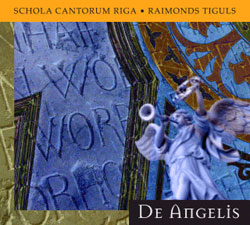
When the editor asked if I would be interested in reviewing a new compact disc of Gregorian chant from the Schola Cantorum Riga, my curiosity was piqued and I agreed. I couldn’t recall having come across a recording of medieval religious chant from a Latvian source before.

When the disc arrived, I took a quick look at it, admired the handsome packaging, then put it aside until I could spend some time with it. Eventually, I settled down with the disc, hoping for some pleasant listening. As sounds emerged from my headphones, I sat up in amazement. What’s this? A synthesizer?! I thought this was a disc of vocal music! Taking a more careful look at the back of the CD folder I examined at the fine print and saw that, in addition to the four vocalists, the group’s leader was listed as playing “keyboards.” Eventually I did hear voices, singing the traditional chant I had been expecting to hear, but the electronics continued in the background throughout the entire disc.

So, what did I make of this unexpected accompaniment? My first reaction was shock. Why would anyone want to “enhance” these beautiful, unaccompanied tunes that had survived over the centuries and are still being sung plain and unadorned to the glory of God? My second reaction was anger. The disc was credited as having been “arranged and produced” by Raimonds Tiguls, the group’s leader. However, nowhere on the packaging does it clearly state that all the tracks feature a synthesized backdrop of sound. Inside the trifold jacket, the skimpy notes (three sentences!) open with the statement “This album is based on traditional Gregorian chant…” but provides no rationale for the arrangements.

Well, in all fairness, plainchant did undergo an evolution over the centuries, serving as a basis for much of the glorious polyphony that presaged choral music as we know it. However, this was organic development that grew directly from the chant itself and the resulting polyphony successfully stood on its own, with the original chant often submerged and only subtly apparent. Instrumentally, many of Johann Sebastian Bach’s organ preludes based on Lutheran chorales were created in much the same fashion, with composers before and after him applying the same compositional principles, with varying degrees of subtlety and complexity.

So, there is precedent for using chant as a basis for new musical works. But that’s not what’s happening here. These newly composed electronic backgrounds are mostly an annoying, unnecessary distraction rather than an outgrowth or development of the original melodies, and often seem to be a rather blunt attempt to “strengthen” the sense of implied harmonic progression in the melodic outline of the original chant. While sometimes imitating familiar instrumental timbres, they are all too often just a variety of generated and sampled sounds clearly emanating from an electronic source, their gentle swooping a sort of aural equivalent of a lava lamp.

Nonetheless, there are some positive aspects. First, the singers are terrific! Not quite the seamless blend of Anonymous 4, but a very skilled and musically attractive male counterpart at the very least. I would love to hear them sing this repertoire without the superfluous backgrounds. Second, their Latin pronounciation is impeccable! After the many discs I’ve heard and reviews I’ve written complaining about the localized pronounciation of Latin, this comes as a breath of fresh air. Bravo! Third, the final track, an original, purely instrumental composition by Raimonds Tiguls, is intriguing.

I will admit, after additional hearings, that the accompaniments are varied, generally artfully and musically done, and become less offensive (except when a “pop” beat threatened to break out in the background a couple of times!). But they’re superfluous! Are contemporary listeners truly afflicted with such limited attention spans that they need additional aural stimulation to make this beautiful music more palatable?

If you think this may be your cup of tea, or if you’re desperate to hear this wonderful group despite the electronic baggage, then go for it. Otherwise, buyer beware!

Details

De Angelis

Schola Cantorum Riga and Raimonds Tiguls

UPE Recording Co.,  2001

UC004
New disc brings alive Rainis’ phantasmagoria

Mythological songs, atmospheric arrangements for traditional instruments and postfolkloric freedom of interpretation are qualities usually associated with Iļģi, the best-known Latvian folk music group. Therefore it was a surprise last year to see the group in the capacity of theatre music authors—and for nothing less than “Spēlēju, dancoju” (I Play and Dance), the classic Latvian phantasmagoria by Jānis Rainis.

The play was a part of the programme of the International Festival of Contemporary Theatre Homo Novus 2001 during September 2001 in Rīga. The soundtrack has now been released on compact disc by UPE Recording Co.

“Spēlēju, dancoju” was staged by the Lithuanian puppet theatre Miraklis, well-known for its phantastic stagings of mysteries. The Rainis version of the orphic myth suited it well. Iļģi were chosen to create the music, and the result is more than an hour of a fresh, vivid and inspiring material that could be labelled as an ethno-rock musical. (Imants Kalniņš in 1977 composed the play as an opera.) It is amazing that even without seeing the play, the music can reveal all the phantastic and intricate visuality of the play.

The melodies are composed basically by Ilga Reizniece and Gatis Gaujenieks. Some motifs are traditional, such as the wedding dance “Tūdaliņ, tagadiņ,” “Apaļdancis,” the funeral tune and, partly, “Spēlēju, dancoju.”

The arrangements and instrumentation not only take on the character of the episode, but add some unexpected, almost mythical, dimensions. For example, on “Ko tu ‚rdies? Vai tev pr‚ts?,” a slow and deep-pitched reggae takes us to the strange abode of the Mole-cricket, its character skillfully transmitted by the unbelievable vocalisation of the “r” sound. The heavily distorted sounds of kokles and guitar evoke the depressing feeling of the realm of Kungs, the lord of the Netherworld (“Ha, ha! Kungs, vesels dzēris!”). The appearance of the dead Lelde to the satanic society is hardly possible without unusual powers, and the electrifying sound of tanpura, providing allusion to Oriental mysticism, does the job (“Vedat Leldi! Taisat kāzas!”). Similarly, on “Acis veras—aizveras,” the tabla-like sounds accompany Lelde’s fight for life.

Both the public and professionals have given high praise to the music and to the performances. Particularly lauded have been the leading roles of Tots (played by Gatis Gaujenieks), and Lelde and the Mole-cricket (both played by Rūta Muktupāvela). Also, Kaspars Putniņš’ vocal group is excellent. My youngest daughter listened to this recording five times a day for three months, and not just because her mother (Rūta Muktupāvela) and uncle (Māris Muktupāvels) sing on it. Can you make a 9-year-old listen to any music they dislike?

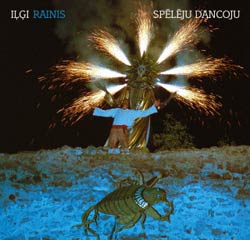
All the recording, mixing and mastering was done in the GEM studio by Iļģi member Gatis Gaujenieks, who also made most of instrumentations and programming. The CD has the high-standard cover design characteristic of other UPE albums, especially those in the Latvian Folk Music Collection. Ieviņa Liepiņa wrote the liner notes about the music while Janīna Kursīte wrote about the contents and symbolism of Rainis play. Full text of the Iļģi version of “Spēlēju, dancoju” is included, thus permitting the listener to follow the play in detail and to catch all the nuances otherwise lost because of the old-fashioned language style.

(Editor’s note: In the interest of full disclosure, it should be noted that Spēlēju, dancoju performer Rūta Muktupāvela is the author’s wife and that his brother, Māris, is a principal performer in Iļģi.)

Details

Spēlēju, dancoju

Iļģi

UPE Recording Co.,  2002

UPE CD 038

‘Labās rokas’ reveals itself as a good choice

Labās rokas

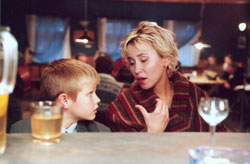
Small-time Latvian thief Margita (Rēzija Kalniņa) and young Pavo (Atis Tenbergs) first meet in a small-town Estonian pub. (Photo from Allfilm)

Labās Rokas (Good Hands), the Estonian and Latvian co-production directed by Peeter Simm, is filled with characters and character, sadness and humor. There’s Margita (Rēzija Kalniņa), a two-bit thief who along with her sister will steal anything that isn’t nailed down. There’s Adolf (Lembit Ulfsak), an engineer in a dying industrial town that no longer needs his skills, and his best friend, Dr. Lepik (Tonu Kark), who performs dental surgery on himself with the help of a mirror but without the benefit of anesthetic. There’s Arnold (Tiit Sukk), Adolf’s son, the town’s policeman whose primary job seems to be to ticket his father each time he catches him speeding. And then there’s Pavo (Atis Tenbergs), a caustic and jaded 8-year-old who seems to be going on 80.

All of their lives become entwined when Margita, after stealing a car with her sister in Jūrmala, gets into an accident and has to flee across the border into Estonia. She reaches the outskirts of the town of Vineeri (Plywood), named after a now non-functioning and shuttered plywood factory, and attempts to steal Adolf’s car while he is taking a swim in a river. As she is trying to get away she notices that Adolf still hasn’t come up for air. Thinking that he is drowning she jumps out of the car and tries to save his life, much to Adolf’s disappointment and surprise. Eventually they end up back in Adolf’s house. When Margita finds out about Arnold the cop, who shares his father’s house, she realizes that hiding in the house of a policeman might be the best way to wait for the heat to blow over.

What ensues is an exploration of character and relationships. Simm weaves a simple story that is brought to life by wonderful performances from his cast. Rēzija Kalniņa is almost perfect as a seemingly amoral thief with no loyalty to anyone or anything, but who once literally walked on glass to prove her love. Lembit Ulfsak and Tonu Kark are perfect as a the quarrelsome and quirky odd couple who have long ago learned to accept each other despite their differences. Tiit Sukk, like Kalniņa, is good as the lonely and morose cop, but at times seems a bit too wooden in his performance.

The true standout of the cast, however, is young Atis Tenbergs. When his real mother (Maija Apīne) is admitted to the hospital, he adopts Margita as his surrogate mother and mentor. Its not a novel cinematic device, but Tenbergs pulls it off perfectly as a child in a world of mixed-up and often childish adults who has to be both a child an and adult.

Labās rokas is also an interesting exploration of the two different national characters of Estonians and Latvians and how they perceive each other. Too often the Baltics are seen as a single entity where the people are indistinguishable from each other outside of their languages and borders. The rest of the world might perceive them as “the Baltics,” but they can be as different from each other as night and day. As Pavo’s mother explains to Margita, she loves the town of Vineeri and its people but she is desperate for a conversation with a fellow Latvian. The locals never seem to go beyond “tere” (hello) and xx (goodbye).  On the other hand, the locals perceive the Latvians as “chatty” and “aggressive” and while in public seem remote and cold, on an individual level speak to each other about topics and in an intimacy that most of us are incapable of.

At the heart of it Labās rokas is about individual choices—and living with those choices—as well as loyalty. It is a wonderfully quirky film about wonderfully quirky people who have learned to accept and live with each other. The film has won a few awards on the European film circuit and the Latvian “Lielais Kristaps” for best film. It deserves a broader audience.

Details

Labās rokas

Peeter Simm

Allfilm,  2001

Notes: In Latvian, Estonian and Russian (with English subtitles). Drama and comedy, color, 90 minutes. Screenplay: Toomas Raudam and Peeter Simm; director of photography: Uldis Jancis; producers: Artur Talvik and Gatis Upmalis; art director: Ronald Kolman; sound: Ivo Felt; costumes: Ieva Kundziņa; principal cast: Maija Apīne, Rēzija Kalniņa, Tonu Kark, Leonarda Kļaviņa, Tiit Suuk, Atis Tenbergs and Lembit Ulfsak