In Dimiters’ Latvia, not every day is Jāņi

Ai, Latviya

Among the many things that Kaspars Dimiters can list on his resume—besides singer, songwriter, guitarist, drummer, arranger and producer—is “social commentator.”

Ten years after, now that the euphoria of independance has given way to the reality of life, Latvia has its share of problems and difficulties. Of course, many of us who live outside of Latvia, and who at best spend only a few weeks a year there, still have the perception that Latvia can be a bit of a fantasy place: full of people singing folk songs, drinking Latvian beer, dancing folk dances, and generally having a pretty good time.

Much of the new music in Latvia adds to that impression, especially the abundance of schlager, simple songs that almost always are about love, but sometimes about beer.

Taking his cue from this, Dimiters in October 2001 released his 11th album, Ai, Latviya (note that the “ja” in Latvija is replaced by the Russian “ya” letter—the backwards “R”). Although the album’s melodies do seem to have a sound schlager foundation, the lyrics are full of biting commentatry about the state of affairs in Latvia today.

Probably the only trait that this album shares with the satirical pop group Labvēlīgais tips is the fact that these lyrics were written for and likely only understood by Latvians living in Latvia. They refer specifically to certain people and events, and the lyrics themselves are loaded with Latvian jargon that few outside of Latvia will understand. However it is not all impenetrable, as the album, though not painting a particularly flattering picture of Latvia, provides for some good listening. Dimiters pulls no punches, and it is clear that he is speaking his mind and not caring if the listener likes it or not. Such honesty is refreshing.

It is more than likely that I have misinterpreted some of the lyrics along the way. Even with the help of Latvian-born friends, some of these songs are still a mystery to me! Due to my own foreign-born Latvian status, I am likely not the best person to review, or even appreciate this album, but I find myself listening to this record quite often, if only because of its simple melodies, honest lryics and matter-of-fact delivery.

The album opens up with “Latvju mežcirša dziesma jeb Zelma,” a song about a Latvian lumberjack whose beloved Zelma has gone off to Amsterdam. The woodcutter calls Zelma, only for her to tell him, “Mīļais esmu prostitūta, ne vairs jasmīns koši balts” (My love, I am a prostitute, And no longer a bright, white jasmine). The melody makes the song almost dancable, though its subject matter is less encouraging.

A major problem in Latvia is alcohol abuse, and alcohol makes an appearance in many of the songs on the album. The song “Kosmonauts” in particular, is about use and overuse of alcohol, describing how many people drink to become a “cosmonaut,” sailing among the stars in their drunkenness. “Iedzēris varu kā kosmonauts ar zvaigznēm un Venēru parunat” (When drunk I can talk with the stars and Venus like a cosmonaut). This song strangely reminds me of the Čikāgas Piecīši song “Man garšo alus,” a song about the same subject matter. But Dimiters takes a far more critical view of it.

The title track, “Ai Latviya,” comes across as Dimiters’ ode to the Latvia of today, how so much has been experienced, so much has been suffered, and there still is a long way to go before things get better. It is clear from this song that Dimiters does care very much about Latvia, even though it appears hopeless at times. He even compares Latvian progress to a bat’s progress: “Kā akli sikspārņi mēs tumsā redzam ceļu” (Like blind bats we see our road in the dark). Hopefully some progress will be made, even if slowly.

Dimiters has no love for the government of Latvia, and he unleashes some of his most scathing lyrics in the song “Intervija ar ministru” (Interview With a Minister). Taking the government to task for lies and corruption, Dimiters frequently and cynically uses the words “godīgi sakot” (speaking honestly), when it is clear the minister is doing anything but. Even more sarcastically Dimiters sings, “Cik labi mūsu ministram būt neaizskaramam” (How nice it is that our minister is untouchable).

The closes with a “country” version of “Ai, Latvija.” This is likely a dig at American country music, and general foreign influences (of which Dimiters is not particularly fond of). Not just limiting his criticisms to his lyrics, the art (created by his sister, Kristiāna Dimitere) on the compact disc itself has the word “Latviya” in the same typeface as used by the Laima chocolate company—perhaps a slight jab at the commercialization of much of Latvia.

Again, there’s a good chance I have missed the point of much of what he is saying. But that is one of the things that is great about Dimiters—the lyrics are extremely important, befitting his position as social commentator. It does make the listener stop and think. Though sometimes the blunt speaking takes you aback, the honesty of the lyrics is refreshing, in that someone is not afraid to speak their minds about the problems today.

Not every day is Jāņi in Latvia, and life is not as cheery and simple as schlager music sometimes suggests. Ai, Latviya is an honest, warts-and-all picture of Latvia. The situation is not completely hopeless, but there is a lot of work that needs to be done. Such a record would not have been possible 20 years ago, but now that the Iron Curtain has fallen, and Dimiters has been freed of any kind of restrictions, he is able to record and say anything he wants. Music listeners are better off for it.

Details

Ai, Latviya

Kaspars Dimiters

Baltic Records Group,  2001

BRG CD 110
Egils Kaljo is an American-born Latvian from the New York area . Kaljo began listening to Latvian music as soon as he was able to put a record on a record player, and still has old Bellacord 78 rpm records lying around somewhere.

Komersanti play professional country music

Komersanti

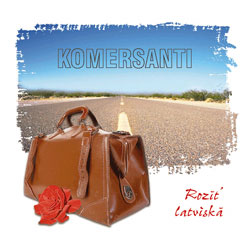
Komersanti (The Merchants) play music in a folksy, country style. I wouldn’t necessarily call it schlager, though I think this album would appeal to schlager fans. Actually, they remind me a bit more of Bet Bet than anyone else. In any case, their 2002 album, Rozīt’ latviskā, is a collection of 12 songs in a number of different kind of folk styles.

The group is made up of Juris Pavītols on vocals and guitar (he’s also the main songwriter), Norlands Millers on guitar and vocals, Aldis Žīmants on bass guitar and vocals, and Edijs Cionelis on drums.

Komersanti prove themselves excellent musicians. However, the songs do not stay in memory very long, and I probably will not listen to this album much in the future.

One of my criticisms of this album is technical: the production makes some of the songs sound like they were recorded in an echo chamber. This is particularly evident on the lead track, “Roze,” which is a nice little song about a Latvian rose that is blooming somewhere very far away. Though this was probably my favorite song on the album, the echo effect on this song is a bit annoying.

Komersanti also must have listened to a few American country records, because there is a country feel to many of the songs. A good example is “Oda lidojums” (The Mosquito’s Flight), where the guitar work gives this song a particularly country feel. To further illustrate the country influence, they even have a song with a horse motif, “Zirga smaids” (The Horse’s Smile). No songs about pickup trucks, though!

Another song I like is “Aizlūgums.” Although once again in a country style, it is a very catchy, inoffensive song. “Velna dziesma” (The Devil’s Song), performed in more of a “boogie” style, is another a song I like. “Tu tik man netraucē” (Don’t You Disturb Me) is also a catchy song. I’m not sure who sings on the track, though it sounds strangely like Ainars Virga from the guitar rock group Līvi, as the vocal is rather deep and gruff. Like Līvi, Komersanti are from Liepāja, while Pavītols (who is a bit of rock legend in Latvia) has ties to Līvi.

Liner notes are very sparse, with no lyrics and just a few pictures of the band. Not knowing much about this group, it would have been nice to have a bit more information about the group in the notes.

Overall, Rozīt’ latviskā is not a bad album, but there are no songs that leap out and demand you listen to them over and over again. It is clear that these guys got together to play music, mainly because they enjoy it—and that is a good thing. They aren’t trying to change the world with their songs, and it is nice to listen to some music that isn’t overly earnest or overly serious.This is much better than much of the schlager in Latvia, as it isn’t bogged down by cheesy synthesizer tracks and drum machines. And because the members of the group are capable musicians, the album itself is very professionally done.

If you have an aversion to schlager or country music, best to avoid this release. This album is for those who prefer their music very mellow and with few surprises.

Details

Rozīt’ latviskā

Komersanti

Baltic Records Group,  2002

BRG CD 120

Egils Kaljo is an American-born Latvian from the New York area . Kaljo began listening to Latvian music as soon as he was able to put a record on a record player, and still has old Bellacord 78 rpm records lying around somewhere.

Sure, they’re cute, but is that enough?

4.elements

The debut recording by the all-girl group 4.elements proves several things at once: They can sing in Latvian. They can sing in English. They can take a Latvian folk song and put it to a Eurodance techno beat. And they can overdo it.

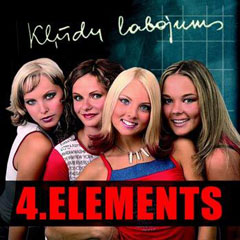
Staring at the cover of the compact disc, you really want to like these girls, named Erita Karlsone, Līga Ozola, Zane Ozola and Rūta Reinika. They’re cute, after all. And they’re not without talent and musical pedigree, as their thank-yous in the liner notes—as well as their voices—make clear. Unfortunately, this recording does little to really show what they can do.

The group was formed in 2001. Although the girls have been active in various musical productions for several years, they perhaps became best known in Latvia as finalists in the national Eurovision competition with the Arnis Mednis and Lauris Reiniks song, “Remember.” Mednis is a well-known pop and blues artist; Reiniks is a relative newcomer whose popularity has grown quickly and whose sister is among 4.elements members. Although they didn’t advance to the international contest won by Latvia’s Marija Naumova, 4.elements were in good company and certainly made their mark.

But I doubt we’ll ever see another album by them, at least not as 4.elements. Maybe it’s wishful thinking, but the era of boy bands and girl bands can’t last much longer.

Kļudu labojums is in a way two different CDs. The first four tracks, two in English and two in Latvian, are pop songs. And the first two, “Remember” and “Kļudu labojums,” are catchy.

The second part of the album, seven of the 11 tracks, is a series of well-known Latvian folk songs put to a techno beat by Mednis. They’re referred to on the album cover as “digitālas dainas” (digital dainas). I’m glad to see that folk songs live on in different genres, but this is really nothing new. The first song, “Laivinieka meita biju,” is actually rather fun. I could imagine this being played as a workout song. It’s got repetition and movement in it, with a number of “Hei!” yelps for those high kicks.

But tracks six through 11, including a “digital” version of the beautiful “Kas tie tādi, kas dziedāja,” wear on the listener. There’s only so much techno-folk one can take. Of course, this kind of music is meant to be moved to, not listened to intently.

If nothing else, Kļūdu labojums has given the four singers some exposure. Now let’s see what they can really do.

Details

Kļūdu labojums

4.elements

Platforma Records,  2002

PRCD 075

Andris Straumanis is a special correspondent for and a co-founder of Latvians Online. From 2000–2012 he was editor of the website.