
Album offers a taste of Latvian post-folklore

Sviests

Sviests (Butter) is a compact disc sampler of Latvian folklore-inspired music, also known as “post-folklore.” The CD does not have an overriding theme or style or time frame. Its only goal is to show the diversity of music that has been inspired by folk music, and therefore there’s a little bit of everything on it.

The CD begins with the groups Laiksne and Auri, both of which sing and play in a fairly traditional style. Next is Lidojošais paklājs with its mild, contemporary sound and elaborate arrangements, followed by Vilkači, the members of which focus on ancient Latvian culture and history.

Then the CD takes us to the world of ethno-jazz and the group Patina. Delve comes after that: a newer group from the Limbaži area with somewhat hypnotizing, ritual-like songs. Kristīne Kārkle and friends sing and play a first-rate rendition of “Ai, zaļā birztaliņa.” Kokle is a youth group, followed on the CD by the drums-and-bagpipes specialists, Auļi. Next is the most public face of Latvian traditional music—Skandinieki—followed by its antithesis, the pagan metal group Skyforger. If Latvian folk has made it this far, then there’s no fear that it will be lost any time soon, is there?

The next two groups on the CD are Trejasmens, a group that focuses on ancient warrior culture, and Dūdinieks, a project that creates modern musical arrangements for folk dance clubs. Kārkle then sings again, but this time with her original group, Ceiruleits. Next is the group Lāns and its delicate, ephemeral sound, followed by the Liv group Kala Jeng headed by Julgī Stalte. We hear Laiksne once more towards the end of the CD, and then Zane Šmite’s folk-avant-garde group Rīsa zvejnieki. The CD concludes with Visi vēji, a short-lived but popular and influential post-folklore group.

All in all, the variety included on Sviests shows an honest cross-section of the constantly changing post-folklore scene in Latvia. Some well-known groups have been left out, but some lesser-known groups have been brought to light. The liner notes offer a short description (in Latvian) of each group and a list of its participants. 

But why is the CD named “butter,” of all things? Especially when you take into account that in Latvian slang sviests means something that hasn’t turned out.

Maybe that’s what the CD sounds like to some: just a mess of unrelated music. But the name Sviests was chosen for other reasons. First of all, butter is a quintessentially Latvian product. Secondly, butter isn’t really a pure product, because in order to make butter, you need to take cream and churn and beat it until you finally get butter. But the result tastes just as good as the original product. The same goes for post-folklore: it’s highly processed folk music, but the result sounds just as good as the original. Thirdly, Latvians nowadays buy more margarine than butter—an analogy to the small part of the population who actually listen to and work with folk music.

In any case, this CD has definitely turned out and offers something for everybody who appreciates musical innovation.

Details

Sviests

Various artists

Lauska,  2005

LAUSKA CD05
Disregard snobby friends and get this Pauls album

Priekšnojauta

Raimonds Pauls, much like comedian Rodney Dangerfield, at times doesn’t get much respect. He is far and away the best known Latvian popular music composer of the second half of the 20th century, with fans not just in Latvia, but in other such countries as Russia and Japan as well. He has performed all over the world, including New York’s Madison Square Garden. He will mark his 70th birthday in 2006. After all that, why is he still given such a hard time, especially when many, many of his songs are beloved by Latvians? Mega-hits of his include “Dāvāja Māriņai,” “Mežrozīte,” “Kā senā dziesmā” and others too innumerable to mention.

From this usually humble reviewer’s perspective, there is quite a lot of Pauls’ repertoire that I quite like. I guess one might compare him to an artist like Prince (a very talented artist, but who probably releases more material than he should) or perhaps like Bruce Springsteen (his best songs are in a class of their own, but his lesser work all starts to sound the same after a while). Pauls certainly could have been more selective about some of the songs that he released. During the 1970s, when he was releasing albums nearly one a year, some lesser songs that otherwise would have been left unreleased got a space on a record. His jazzy style might unnerve some listeners, while some more snooty listeners comment that there might be some active borrowing from jazz pianists like Dave Brubeck in Pauls’ work.

Due to his prolific release schedule, his albums are a hit-and-miss affair. However, one album that bears further attention is 1977’s Priekšnojauta (Premonition). Re-released on compact disc in 2004 by MICREC as part of its “Latviešu populārās mūzikas klasika” series, this is one of Pauls’ records that stands the test of time and reconfirms Pauls’ place as one of the great Latvian popular music composers.

From the opening swell of strings in the song “Par pēdejo lapu” (About the Last Leaf), the listener can immediately recognize this as a Raimonds Pauls work. Perhaps a bit overly dramatic, this song, with lyrics by frequent Pauls collaborator Jānis Peters, is yet another mega-hit, as popular today as it was when it was first released almost 30 years ago. The song features one of the great Latvian female singers, Nora Bumbiere. Prāta Vētra fans will notice the strong resemblance between their song “Lidmašīnas” and this song—so notable that Prata Vētra credits “Par pēdejo lapu” as the basis for its song on CDs that contain “Lidmašīnas.”

Pauls also has a reputation of working with only the best Latvian singers, and this CD includes a number of them. Besides Bumbiere, there is also Mirdza Zīvere, Viktors Lapčenoks and Vladislavs Juhņevičs.

Another beloved song on this disc is the Lapčenoks-sung “Zied ievas Siguldā” (The Cherry Trees are Blooming in Sigulda), with text by A. Smagars. One might consider Lapčenoks one of the first “rock superstars” in Latvian music, because his style was perhaps more appropriate to rock songs rather than the more mid-tempo estrādes style of most of Pauls’ songs. A personal favorite on this CD is “Nīca” (text by V. Brutāne), a duet between Lapčenoks and Bumbiere, a song where Lapčenoks gets the chance to let loose and sing like a rock star—something rather unusual in 1970s Latvian music!

Lapčenoks and Bumbiere join up again to duet on the final song on the album “Tā diena” (That Day), with text by Jānis Peters, a song with a downright Carribean feel to it. Certainly this song and other songs on this album were experiments for Pauls, and I think they worked out quite well. This is probably one of the reasons I enjoy this album so much, as it is much fresher and sharper than a lot of the stagnant, lounge music style albums that came before it.

Of course, there are some clunkers here that I really could have done without, notably “Rudensogle” (Autumn Ember), performed by Zīvere. The song is far too overwrought for my tastes, especially with the overbearing string section.

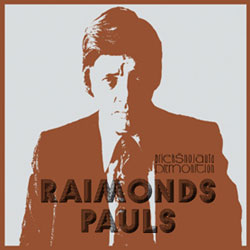
One refreshingly consistent aspect of Pauls’ releases (especially those from the 1970s and 1980s) are the dreadful album covers. Priekšnojauta, with its photo of the composer in brown and gray hues, is no exception.

In a rarity for these CDs in the “Mūzikas klasika” series, all lyrics are included, plus a whole two photographs. Though having the lyrics is a bonus, I still think MICREC could be doing more with these releases, even something as simple as getting Pauls and the other artists to write a few sentences about their thoughts on this album, or any memories of recording it, or anything simply to add value to these re-releases.

When faced with the choice of purchasing one of dozens of Raimonds Pauls releases, it can be difficult to determine what the correct choice might be. Priekšnojauta is one of the best of the bunch. Don’t let your snobby friends tell you that all of Raimonds Pauls’ songs sound the same. This album breaks that stereotype, rather convincingly I say. A bestseller in 1977, it still remains one of his most popular albums.

Details

Priekšnojauta

Raimonds Pauls

MICREC,  2004

MRCD 253

Egils Kaljo is an American-born Latvian from the New York area . Kaljo began listening to Latvian music as soon as he was able to put a record on a record player, and still has old Bellacord 78 rpm records lying around somewhere.

Crowd’s style of hardcore is an acquired taste

Jūtu evolūcija

Although the booklet accompanying Crowd’s debut compact disc, Jūtu evolūcija, may indicate a playful and colorful time, it’s anything but. “Jūtu evolūcija,” which literally means an evolution of emotions, here sounds more like a plateau of feelings so depressing and frustrating, that at times listening to the album became numbing.

The band includes Jana Čakste on vocals, Kaspars Čakste on guitar, Edgars Bindulis on guitar, Māris Vaivods on bass and Zigmārs Kics on drums. Its beginning can be traced to 1998 as the band Ugly Son, but it wasn’t until the end of 1999 that the band name was officially changed to Crowd. With the addition of Jana in 2000, Crowd, as it stood at the time the recording was released early this year, was completed.

The first time I heard the album I was reminded of the group Iedomu spārni, which seemed to pave the Latvian pathway to Evanescence-like music. But whereas the Iedomu spārni album Dienasgrāmata had songs with positive outlooks, Jūtu evolūcija brings the “hardcore” genre to a new level.

The album’s first track, and one of my favorites, “Rīts,” starts off right away with a nice, fast-paced guitar and drum combination. Even though I couldn’t hear the lyrics clearly at first, I have to agree with Radio NABA listeners who earlier this year helped place “Rīts” in the station’s Top 25. The track is colorful and has a full sound to it, and it’s made to be liked. (The lyrics can be found at www.dziesmas.com, but unfortunately not on the group’s official Web site.)

The second track, “Atdošanās,” is noticeable because of its funk undertone. At first it feels laid back with the funk-jazz feel, but the guitar pushes forward and suddenly the music breaks out. The track has a nice guitar line and is very rough.

Unfortunately, the third track, “Burned Hearts,” shoves the album back several steps. The track shows to me a classic example of Latvian-band-trying-to-go-English syndrome: a song by a band with interesting, haunting melodies and vocals, but with lyrics that, once sung in a language other than the group’s own, doesn’t cut it. Fortunately, the next track, “Dziesma,” picks the album back up. However, the album also moves into the realm of more depression, depression, depression!

The rest of the album’s English tracks move well and generally make more sense, especially the 10th track, “Today,” which blew me away with its grammatical goodness.

But “Freak,” the ninth track, is my least favorite. The song has the harshest guitar bits in the entire album. The song is apparently about a depressing nubbin of a person who hates themself as much as they hate the people who brought them into the world.

The final track, the cover title “Jūtu evolūcija,” is another of the band’s more popular radio singles, and also my second of two favorites from the album. The vocals are mild a present a simple message: “I’ll forgive you if you apologize, because I love you, idiot.” Subtlety is the song’s best aspect.

Would I sway to Crowd’s sounds? Yes. Would I head bang to it? No. Crowd is definitely an acquired taste, and may take listeners some getting used to, especially if they haven’t been exposed to much Latvian hardcore. Eventually, for me, after setting the disc on loop, the music becomes more of a backgroundish, mellow sound, depression and all.

Details

Jūtu evolūcija

Crowd

Raibā taureņa ieraksti,  2005

RTCD003

On the Web

Crowd

The band’s official Web site has news about the group, a biography and samples of its music. LV