
Instrumenal cello rock may not be for all

Melo-M

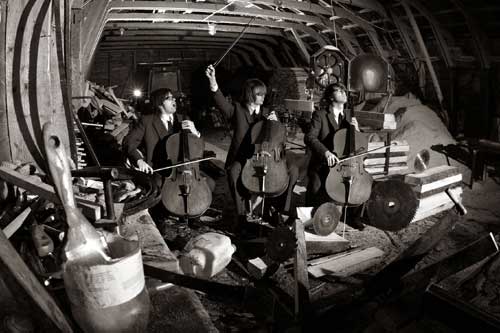
Orchestral string instruments are cool. They are cool whether they are being used to play the music of Mozart, Beethoven, Vasks or any other composer dead or living. And they’re also cool when used in nontraditional ways, such as when playing cover versions of Latvian pop and rock hits. That’s what the Rīga-based cello trio called Melo-M does on its debut album, the self-titled Melo-M.

The group released the compact disc last June on the Platforma label. The 10-track album may not be what listeners initially expect. Rather than rock music stripped down to mellow cellos, Melo-M sounds like almost full-on rock, but without the vocals. These guys get some amazing sounds out of their instruments. When I first listened to the album, I could have sworn keyboards and a guitar also could be heard, but I have been assured by the group’s manager that only cellos and drums are used.

Formed in late 2004, Melo-M plays what is described as “instrumental cello rock.” It’s part of the “classical crossover” genre popularized by groups such as Finland’s Apocalyptica, a cello-playing trio perhaps best known for its interpretations of the music of heavy metal band Metallica. On the day Melo-M released its album last year, the Latvian trio warmed up the audience for a concert by Apocalyptica in Rīga’s Skonto Hall.

Melo-M’s members include three cellists with classical training: founder Kārlis Auzāns, who also plays guitar with the pop group Autobuss debesīs; Valters Pūce, whose father Valts leads the Marana vocal group, and Antons Trocjuks, who, like Auzāns and Pūce, has done well in international cello competitions. Trocjuks has replaced Kristaps Bergs, the original third member of the band who appears on the album. Vilnis Krieviņš plays drums on the album. Melo-M is short for melomanija (melomania), the excessive passion for music.

For listeners unfamiliar with the history of Latvian rock music, some of the tracks on the CD may not immediately register. That’s the case with the opening song, “Rock on the Ice,” a composition by Jānis Lūsēns. Today Lūsēns is known in part for his work for theatre and rock opera, but in 1980 he was a founder of Zodiaks, an electronica and disco group that gained wide popularity throughout the Soviet Union and Eastern Europe. “Rock on the Ice” is off the group’s landmark album, Disco Alliance.

I will admit that I didn’t immediately take to “instrumental cello rock,” especially when cover versions are involved. Invariably I tried to imagine what the original recording sounded like, and in a couple of instances was not happy with Melo-M’s version. Pagan metal band Skyforger’s “Kad Ūsiņš jāj” (“When Ūsiņš Rides”, from the band’s Pērkoņkalve album) needs the guitars, the heavy bass and the growling vocals. And Linga’s “Atdodies man” just isn’t the same without Gvido Linga’s voice.

But the third track, “Dzimtā valoda” (“In the Native Language”) by Ainars Virga of the Liepāja guitar rock group Līvi, comes off sounding like a true anthem, the cellos pulling on the patriotic heart strings. The song, released in 1985, gained popularity as Latvia’s push for renewed independence gathered steam. It’s followed by “Dzejnieks,” another Līvi tune, in which Krieviņš and his drums nicely set the pace for what the cellos do.

I could have done without “Kvazimodo dziedājums” (“Quasimodo’s Song”), composed by Zigmārs Liepiņš for the rock opera “Parīzes Dievmātes Katedrāle.” I enjoy the song, but would have liked Melo-M to take on another more traditional rock tune instead. Raimonds Pauls’ “Undīne” also seems out of place on this album, but does show the range of material Melo-M is willing to cover.

The eighth track is the only one featuring a vocal, and that’s just in the introduction to “Sapumpurots zars” (The Budding Branch), also known as “Dziesma par sapumpuroto zaru,” a song by the rock group Pērkons composed by Juris Kulakovs. Melo-M’s version is a good take on the classic.

Also covered are “Trubadūrs” by Imants Kalniņš and “Zem diviem karogiem” by Jumprava.

Melo-M tours the United States during February, with concerts scheduled in Rockville, Md.; Cleveland, Ohio; Kalamazoo, Mich.; Minneapolis; Chicago; Seattle, Wash., and in Los Angeles. The tour also was to include Autobuss debesīs singer Marts Kristiāns Kalniņš, son of composer Imants Kalniņš, but he was forced to pull out on a doctor’s advice.

If you get a chance, take in a concert and decide whether “instrumental cello rock” is for you. If it is, Melo-M is worth adding to your collection.
Melo-M

Melo-M includes three classically trained musicians who play “instrumental cello rock.” (Photo courtesy of Melo-M)

Details

Melo-M

Melo-M

Platforma Records,  2005

PRCD 150
Andris Straumanis is a special correspondent for and a co-founder of Latvians Online. From 2000–2012 he was editor of the website.

Slow at first, Berzins’ new thriller still entertains

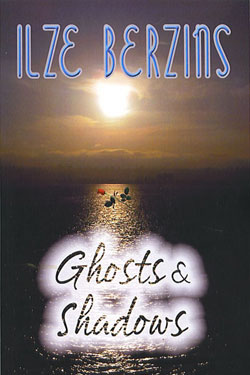
Ghosts & Shadows

Uldis Lapins, the seemingly shifty pastor of the Latvian church in the Canadian capital of Ottawa, may be trying to bilk the members of his congregation out of their life savings. But then, halfway through Ilze Berzins’ latest thriller, Ghosts & Shadows, he is reported to have died, apparently a victim of his peanut allergy.

The novel is one of Berzins’ better efforts. Rich characters combine with an eventually captivating plot for a story that should be of interest to anyone looking for a Latvian krimiķis in the English language. However, readers familiar with Berzins’ earlier stories will find that Ghosts & Shadows owes some of its success to the characters and efforts at plot development in those works.

It is courageous of Berzins to tackle this story, set as it is in Ottawa’s Latvian community. Writing about the place you know best, and for Berzins that is Ottawa, can lead to compelling prose, but also can raise the hackles of the locals. No doubt some readers will try to draw parallels with people they might know in real life.

Ghosts & Shadows, released in November, is the seventh mystery novel and the eighth book overall by Berzins. A second-generation Latvian-Canadian, Berzins also is an artist.

Berzins takes a long time to build up the drama in Ghosts & Shadows, a characteristic of her previous novel, Kolka (2004). It takes 47 pages—seven admittedly short chapters—for Berzins just to paint her protagonist.

Ghosts & Shadows is told from the first-person viewpoint of Anastasia Karsubova, Stasia or Stacy for short, the daughter of a Russian father and a Latvian mother. She’s a 40-something loner who hangs out with Ottawa’s older Latvian generation. Her one-time lover, a Latvian-American journalist named Andris Ripa, supposedly was killed years ago while covering a story in Rīga. Her dog, Bear the Rottweiler, has gone missing. Geez, this almost makes Stasia sound like the subject of a bad Latvian country song.

But there is more to Stasia than that. Like in Kolka, Berzins delves into the psyche of her protagonist. Stasia floats in and out of the past, fantasizing about returning to the Rīga she remembers from her time there from 1994-1998 (at this point readers familiar with Berzins’ work may be tempted to pull out their copy of her autobiographical Happy Girl): “When I was there ten years ago, Riga was a brawling bully of a town, an endless unstoppable crime spree, a chaotic feast of cheap booze, fattening food and eye-popping urban decay. I loved every moment of it. But now I hear all that’s gone and I wonder if I’d ever want to go back.”

However, Stasia may remind some of Birdie Finch, the protagonist in Kolka. Like Stasia, Birdie lived alone in Ottawa. Like Stasia, Birdie’s closest relationship was with a person much older than she. Like Stasia, Birdie spent a lot of time caught up in memories and dreams, although Birdie’s were darker than those of Stasia’s.

Also figuring strongly in Ghosts & Shadows is Alex Stromanis, who is tormented in his old age by memories of the night the Wilhelm Gustloff, a German cruise ship, was torpedoed in January 1945 by a Soviet submarine. He lost his wife and baby. The ship, extremely overloaded with refugees fleeing the advancing Soviet forces, had sailed from Gdynia, a port near Gdansk, Poland. Estimates of the number of dead range from 7,000 to more than 9,000 men, women and children, making it—as several sources note—the worst maritime disaster on record.

In a suitcase in his home, Stromanis keeps a satchel he rescued from that horrific night. In the satchel are thousands of Imperial Russian gold coins.

And then there’s Tamara Nemerova, a voluptuous Russian from Rīga who has come to Ottawa ostensibly to lure local Latvians to spend their money on a tour of the homeland. She knows Stasia from when she lived in Latvia, and before Stasia knows it, Tamara has managed to move into the spare room in her house.

A variety of other characters populate the novel, many of whom are carefully colored by Berzins. The reader might be frustrated that it takes so long for something to happen, but the last 100 of the 244-page Ghosts & Shadows have plenty of twists to make up for the slow start. The result is an entertaining tale of corruption and swindle set in Canada and Latvia.

More information about Berzins and her books is available from her Web site, ilzeberzins.com.

Details

Ghosts & Shadows

Ilze Berzins

Ottawa:  Albert Street Press,  2005

ISBN 0-9686502-7-9

Andris Straumanis is a special correspondent for and a co-founder of Latvians Online. From 2000–2012 he was editor of the website.

Remix retrospective reveals effects of aging

Remix

Although the group has been on extended hiatus for many years, Remix celebrated its 20th anniversary in 2005. In acknowledgement of the anniversary and of the group’s contribution to Latvian popular music, the recording label MICREC reissued three noteworthy Remix albums. The first two are instrumental albums released on one compact disc—Uz veselību and Naktsmājas. The third, Gold, is a compilation of the group’s most popular songs.

Gold was first released on CD in 1995, though it has been out of print for many years now. It is a testament to the popularity of these songs that the CD has been released again.

The group’s name is a bit of a misnomer. The group doesn’t actually “remix” anything. Perhaps the name comes from the fact that the members of the group came from already established groups and were “mixed” together, creating the first Latvian supergroup. Some of the biggest names in Latvian music were members of Remix, most notably keyboardist and composer Uldis Marhilēvičs, guitarist Aivars Hermanis, legendary Latvian rock singer Igo (vocalist Rodrigo Fomins) and drummer Vilnis Krieviņš. The group was also joined on bass at first by Eduards Glotovs and then later, after the departure of Glotovs, by Jevgēņijs Ščapovs.

The music is very obviously from the 1980s. It is very, very slick and polished, with particular emphasis on keyboards and synthesizers, as well as the grandiose vocal stylings of Igo. However, there is a notable difference in styles between the instrumental works and the popular songs with vocals. Two of Remix’s instrumental works are contained on this CD, Cīņa” (Battle) and “Uz veselību” (To Your Health). The brief liner notes (no lyrics, but there is a short history of the group) call the instrumental work “jazz rock,” but I’m not so sure I would agree, because neither of these two instrumentals sounds particularly jazzy. However, I can’t think of a better term, so I’ll just say that they would fit in well on an 1980s movie soundtrack. For those interested in hearing more of this style, listen to the Uz veselību and Naktsmājas re-release, or the Aivars Hermanis solo album Mans laiks.

One timeless song on this album is “Kā senā dziesmā” (Like in the Ancient Song), with music by Raimonds Pauls. Even today, the song remains a popular Latvian anthem. It was performed at the youth choir concert, part of the song festival in Rīga in the summer of 2003. Its unmistakable guitar introduction and chorus of “noskūpstītas lapas no rīta… šai rudenī!” (leaves kissed in the morning…this autumn!) is part of what keeps the song in the hearts of many listeners. It is also a song that shows of the vocal talent of Igo, singing the chorus with more than a little bombast.

Another big hit was “Meitene kafejnīcā” (Girl in a Café), which again has a distinctive guitar intro. Rarely is a drummer also a composer, but Krieviņš is the music’s author. This features yet another beloved refrain, “(S)kumjas acis Jums šovakar…” (You have sad eyes tonight).

Gold isn’t all polished pop songs. “Komunālais blūzs” (Communal Blues) is a blues number, as the title indicates. Hermanis uses his best dirty guitar sound for maximum effect, but I could do without the track’s vocal echo.

The 1980s are in full force on “Dzeltenās kurpes” (Yellow Shoes), which reminds me of some of Prince’s poppy ‘80s output—especially the keyboard, which is the central instrument in practically all of Remix’s songs.

Perhaps Remix’s biggest hit was “…pie laika” (At the Time). The song reached first place in the Mikrofons 88 song competition—with its unabashedly pro-independence lyrics by Igo: “Brīvību tēvzemei – pieprasām!” (Freedom for the fatherland—we demand it!). However, this is not the same version that was on the Mikrofons 88 record (as well as the Tas ir Igo two-disc “best of” compilation.) That is unfortunate, as I think the version on Mikrofons 88 is superior, but it is still interesting to have this slightly different version. The Mikrofons 88 version has a bit more punch to it.

Finishing off the album is yet another hit, “Vienīgai” (Matchless). It’s yet another polished bit of pop, but at more than six minutes, the song starts to drag near the end.

I tend to skip over about half the songs on this CD, because some of them are just a bit too dated, and perhaps a bit too polished, especially with the unmistakable ‘80s keyboard that Marhilēvičs uses at times.

As a group whose active life was only about five years, Remix accomplished much in a very short period of time. Though most of the group’s material has not aged well and is clearly rooted in the 1980s, some of the songs now are classics. Any student of Latvian rock should be familiar with Remix’s work, especially songs like “Kā senā dziesmā,” “Meitene kafejnīcā” and “Dzeltenās kurpes.” To be honest, I’d probably recommend the Tas ir Igo collection over this one, as that contains all the best songs on this CD, as well as a number of others from Igo’s long career. However, that does not mean Gold is not worth picking up. It would certainly appeal to any fan of ‘80s music. Remix was the first Latvian supergroup, and this CD clearly explains why.

Details

Gold

Remix

MICREC,  2005

MRCD 270

Egils Kaljo is an American-born Latvian from the New York area . Kaljo began listening to Latvian music as soon as he was able to put a record on a record player, and still has old Bellacord 78 rpm records lying around somewhere.