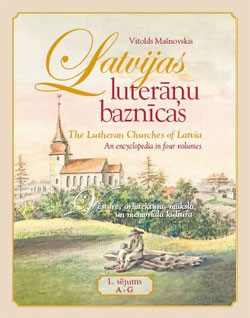
Encyclopedia catalogs Lutheran churches

Just before Christmas a new publication was unveiled in Rīga: the 472-page first volume of the encyclopedia The Lutheran Churches of Latvia (Latvijas luterāņu baznīcas).

One can only agree with Jānis Vanags, the archbishop of the Latvian Evangelical Lutheran Church, who at the book’s opening celebration joked that an inventory of Latvia’s churches will now no longer be necessary. That’s because the cultural historian Vitolds Mašnovskis, who often drove 1,000 kilometers a day from church to church, has just completed a full inventory. Mašnovskis has visited, photographed and compiled information on all of the Lutheran churches in Latvia, including those that have been destroyed. He has spent countless hours in archives searching for layouts, historical photographs, coats of arms, sketches and descriptions.

This first volume of the encyclopedia covers the letters A to G—in other words, 92 churches. Have you ever heard of the Borne church? It is located in the far Kaplava parish in Krāslava district of eastern Latvia. In 1937 Kārlis Ulmanis, the president of Latvia, channeled LVL 15,000 of the national budget for the construction of this church. The Chamber of Commerce and Industry donated the church bell, which was transported all the way from the Tosmare factory in Liepāja on the western coast of Latvia. The Borne church has been renovated and is well-cared for.

The churches in Grieze (Saldus district, Ezere parish) and Glūda (Dobele district, Krimūnas parish) present a much different story. The Grieze church was devastated during the Soviet era, while occupying forces sawed off the tower of the Glūda church in 1978 and afterwards used the building as a warehouse for chemical fertilizers. Today both churches are abandoned.

But, as the author states, it is surprising how many congregations have been able to renovate their churches despite minimal resources. A perfect example is the small Augstroze church, which was also used as a warehouse during Soviet times. It is a pleasure to enter the church today, for it is furnished with new wooden pews and a beautiful altar.

In an interview with the newspaper Svētdienas rīts, Mašnovskis, who has visited many churches in Estonia as well, explained that churches in Latvia are more accessible; they are open longer and it is easier to arrange visits to those that are closed. On the other hand, the Estonians have published a guidebook including the addresses of all of their churches and a book titled The 100 Most Beautiful Churches in Estonia.

The Lutheran Churches of Latvia is the first book of such size to be published in the Baltic states. It covers the history, architecture, and artwork of all 337 of the current and former Lutheran churches in Latvia. The first volume alone contains 1,254 pictures and images. The encyclopedia also contains a glossary of foreign terms, a list of the 677 sources consulted for research, and a map with all of the churches marked, so that readers may visit the churches themselves, if they so wish. The book’s main text is in Latvian, but there is a summary of each church in English.

The encyclopedia, published by DUE in Rīga, is printed on specially selected paper and is overall a very high-quality publication. But quality demands a large financial investment, and the publication date of the second volume will depend on the sales of the first volume. The publishers hope that they will be able to publish the second volume this year.

Inta Bērente-Strenga, the director of DUE, explained, “We became involved in this project three years ago, and we view it as an honor to take part in the creation of a reference book of such scale, which required 12 years of arduous work by the author. This encyclopedia really is a unique publication. I’m convinced that there will not be another work of this scale about the churches of Latvia anytime soon. I cannot underestimate the importance of this contribution to the preservation of the cultural heritage of Latvia for coming generations.”

Ainārs Baštiks (minister for children and family affairs), Imants Lancmanis (director of the Rundāle Palace Museum), Ojārs Spārītis (art historian and director of the Blackheads House) and many others expressed their appreciation at the book’s opening celebration. A total of 2,000 copies of the encyclopedia’s first volume were printed. But how many will find their way into the churches themselves? Knowing the small means of most congregations, the publisher hopes that individuals in Latvia and elsewhere will donate the encyclopedia to their local churches, schools and museums.

The Lutheran Churches of Latvia is on sale in Latvia at all Jāņa Rozes bookstores and at the offices of the newspaper Laiks at Doma laukums 1 in Rīga.

(Editor’s note: This article originally appeared in Latvian in the Jan. 14 issue of Laiks and is republished with the permission of the author. It was translated by Amanda Jātniece.)

Details

Latvijas luterāņu baznīcas

Vitolds Mašnovskis

Rīga:  DUE,  2005

ISBN 9984198294

Where to buy

Purchase Latvijas luterāņu baznīcas from BalticShop.

Note: Latvians Online receives a commission on purchases.

Igo returns on strong rock album

Igo

One cannot write about Latvian rock music history and not mention Rodrigo Fomins, or, as he is popularly known, Igo. He has one of the most recognizable voices in Latvian music. Igo’s 25-plus-year career has seen him perform with many different Latvian groups as well as in stage musicals.

His latest compact disc, Mirkļa liecinieks (Witness to the Moment), was released in March 2005 on the MICREC label. Considering his near-fatal accident five years ago and the resulting rehabilitation, Igo still sounds as strong as ever and has rebounded from that low point to release a very strong, solid rock album.

Igo was born in 1962 in Liepāja, home to many other famous Latvian musicians. By 1978, he had joined the rock group Corpus, but by 1980 was a member of the popular rock group Līvi. He can be heard singing on many of the band’s early hits, including “Zīlīte,” “Vēju muzikants” and “Zušu dziesma.” His career continued in 1985 when he joined Remix, recording hits such as “…pie laika,” “Meitene kafejnīcā” and “Kā senā dziesmā.”

His singing was not limited to just recordings, as he found success on stage as well. Igo took the role of Lāčplēsis in the Zigmārs Liepiņš rock opera of the same name, as well as Kvazimodo in another Liepiņš rock opera, “Parīzes Dievmātes katedrāle” (Notre Dame Cathedral of Paris). In recent years, he has focused on his solo work, which continued his extraordinary success, including hits like “Bet dzīvē viss ir savādāk.” In 1997, he released a two-disc retrospective called Tas ir Igo, a very thorough overview of his illustrious career.

Though he has accomplished a great amount in the field of music, his life has not been without tragedy. On May 16, 2000, Igo was involved in an extremely serious car crash, which left him with many broken bones and a concussion. It was unknown at that time whether he would even live, much less perform again. Miraculously, his health returned, and he has continued to record albums and perform in concert.

Joining Igo on Mirkļa liecinieks are Ivars Jercums on guitars, Edijs Dukurs on bass guitar, Juris Kristons on keyboards and Ilvars Manfelds on percussion. Igo handles almost all of the lyric writing on the record as well.

A number guest artists appear on the album. A Remix bandmate, guitarist Aivars Hermanis, performs acoustic guitar on “Kas gaida mūs” (Who Waits for Us). Hermanis also co-wrote “Manā istabā” (In My Room) with Igo. Brother Ivo Fomins, from the group Fomins & Kleins, performs a duet with Igo on the song “Krustojumā” (In the Crossing). Former Līvi bandmate Ainars Virga also performs guitar and shares songwriting credit on “Krustojumā” and on the album’s title track.

Probably my favorite song on the album is the first track, “Būsim kā 1” (Let’s Be 1), a straight-ahead rock number that shows Igo still has the ability to belt out a proper rock tune.

“Krustojumā” also is a favorite. Ivo and Igo also both sang in the group Liepājas brāļi, and this song has a small reference to their biggest hit—“Tikai tā.”

Somewhat out of place on the album, due to the song’s completely different style, is the new version of the Remix song “Dzeltenās kurpes” (Yellow Shoes) arranged by the rapper Gustavo. It is very strange to hear rapping in this quintessential 1980s pop tune. I prefer the original, though it is interesting to hear a completely different take on this song.

Packaging for the CD is minimalistic, containing just lyrics for the song “Mirkļa liecinieks” and some photos by Igo himself.

Mirkļa liecinieks is a very strong album and a welcome addition to the large number of Igo’s recordings.

Details

Mirkļa liecinieks

Igo

MICREC,  2005

MRCD 268

Egils Kaljo is an American-born Latvian from the New York area . Kaljo began listening to Latvian music as soon as he was able to put a record on a record player, and still has old Bellacord 78 rpm records lying around somewhere.

Double Faced Eels emerge from alternative scene

Double Faced Eels

When Latvian rock group BrainStorm was preparing for its 2005 summer concert tour of Latvia, I was interested to see who would be the opening acts. One of the groups named caught my eye: Double Faced Eels. “Double Faced who?” I had never heard of this group, even though it was formed in 2000 and was already known in Latvia’s alternative music circles.

Smoked eel is a traditional delicacy on the Latvian Christmas dinner table. Likewise Double Faced Eels’ debut album,  Zilais valis (The Blue Whale), is a Latvian music delicacy. Having listened to this album nonstop for the past few days, it’s clear to me the sound created by the band is something new and exciting. A brand of guitar-based power rock combined with solid drumming, along with some crazy lyrics, make this album a strong buy. The Eels’ music is sometimes heavy, yet at other times poppy, almost ska-like. With nearly 50 minutes of music, Zilais valis should go down well at parties and on the road in the car stereo.

The album actually has 15 tracks (if you count track No. 3 with no name, just 11 seconds of storytelling by an elderly lady speaking to a bunch of kids about kaņepu sviests, or hempseed butter).

The album starts off with the band’s big hit, “Zilais valis” (The Blue Whale). It has been nominated for best rock song of 2005 at the annual Latvian Music Awards scheduled March 10 in Rīga.

In the trail of the whale follows “100g,” a reference to the size of a shot of liquor in Latvia (100 grams is about 3.5 U.S. fluid ounces, or about a triple shot in the United States). It’s a quick ska-tempo drinking song.

The fourth track, “Cemme” (Anger), is a witty, angry power guitar Green Day-type song. Then comes a song sung in English, “To Take Breathe.” It probably should be called, “To Take My Breath Away,” as per its lyrics. The song is fairly musically mundane. The lyrics are unfortunately uncomprehensible and the pronounciation poor.

“16,” on the other hand is an uptempo modern remake of Olga Rajecka’s repetoire song, “Kad man vairs nebūs 16.” Rajecka even sings solo in the last part of the track.

“Ja esi stulbs” (If You’re Stupid) features a moving bass line and some weird chord modulations towards the end of the track, making for a good dancing song.

Next is “Krokodils” (The Crocodile). This is my favorite on the album, offering a compact rythmic barrage, with good lead vocals and harmonies, great drumming and nice counterpoint work between the guitars and bass guitar. All members of the band are in the zone on this song.

“Bikses” (Pants) is a light-hearted song with rather foolish four-line lyrics. The track includes a little kid who tries to sing one of the verses and an elderly woman who complains about her state pension.

“Sha la la” goes the chorus of the next track, just an average party song.

“Prasīt aizmirsto” (Ask for the Forgotten) has been one of the singles from the album. It’s of the few songs on the album with serious content.

Track 12, “SEX,” returns to the lighter side of things. The song starts out with acoustic guitars and vocals, then has some whistling combined with appropriate sound effects and a nice melodic chorus complete with harmonies and handclaps. The rest of the band joins in later on in the song, which fits in quite well.

“No Lies” is the other song sung in English. It’s another average heavy song with some pretty awful-sounding lyrics.

“Pa jokam” (Just for a Joke) is the current radio single. But there’s nothing funny about the song, which features power chords and a strong, rocking chorus. It’s one of the best songs on the album, without any doubt. The song ends with a bridge part that is quite unusual.

The final and longest song on the album is “LPDZ” (perhaps a reference to “The Proud Family” characters LaCienega, Penny, Dijonay and Zoey). It starts off with the now familiar ska rhythm and has verses sung in Latvian and the Livonian language. There’s an abrupt turn to heaviness about one minute into the song, almost as if a completely different song is beginning. During the final 90 seconds the track gradually speeds up, as does the guitar solo, and the band goes into a little ego trip, showing off what it can do, rounding off with a big ending.

I hear Double Faced Eels does a great live show, going all out. The members of the group are all young, between the ages of 18 and 23. They include Mārtiņš Gailītis (Marka) on guitar and lead vocals, Reinis Briģis (Reinis) on lead guitar and vocals, Eduards Zagainovs (Chikis) on bass and Pauls Ķesteris (Pauls) on drums. The band’s main musical influences are Green Day, Limp Bizkit, Linkin Park, Foo Fighters and The Beatles.

The past year proved to be somewhat of a breakthrough for Double Faced Eels. Having played on the BrainStorm concert tour and, in January, releasing its first album, Double Faced Eels is now considered one of the top bands in Latvia. There has been discussion in Latvia about the band’s lyrics being offensive to some people, but I wouldn’t try to read too much into them and just accept the lyrics for what they are. It’s just music and these guys are singing and playing about the pillars of youth: sex, drugs and rock ‘n roll.

It will be worth watching how Double Faced Eels follows up on the success its debut album.

Details

Zilais valis

Double Faced Eels

Platforma Records,  2006

PRCD 171

On the Web

Double Faced Eels

The band’s official Web site includes some background on the group, news of upcoming concerts, a bulletin board and other features. EN ES LV

Raitis Freimanis lives in Stockholm, Sweden, and is a founding member of the Latvian-Canadian band Skandāls.