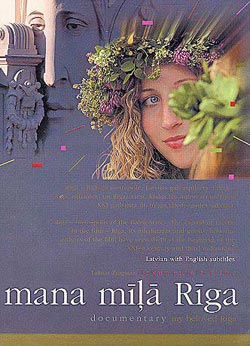
Documentary tells stories of love for Rīga

The standard tourist film about a country or city often seems to inform but at the same time lull the viewer into a gentle slumber. It’s often hard to remember the main points—and main attractions—the film has tried to bring to our attention. The problem is usually too much information in too short a time span. The documentary Mana mīļa Rīga (My Beloved Rīga) certainly does not fall into this category.

Director Laima Žurgina’s film was first released in 2004 and now is available on DVD.

The film is two hours long, so it has plenty of time to elaborate on specific themes. These give the viewer a good insight into various aspects of Rīga. There’s “Art Nouveau Rīga” and “Historical Rīga”, both with commentaries by experts; “Rīga’s Beautiful Cemeteries,” with commentary provided by a gravedigger; and the nation’s symbol , the Freedom Monument. The unhurried flow and sincerity of these commentaries, coupled with background music that blends in perfectly with each theme, make the title of the DVD seem fitting. One more added bonus is good-quality English subtitles, a detail that can often make or break a product.

Other clips show Rīga’s unique and memorable celebrations such as the seasonal Zāļu tirgus (herb and grass market) in the Dome Square the day before Midsummer Night and the annual arts and crafts fair at the Open-air Ethnographic Museum just outside Rīga during the first weekend in June. These two occasions show the nation’s love for tradition, both in terms of celebrating specific festivities as well as the continuation of centuries’ old traditions of embroidery, knitting, weaving, ceramics and other local handicrafts.The hope is that these folkloric legacies will remain with the Latvians for decades to come and cosmopolitanism will not take over.

Interviews with the architects of the new Hansabanka building, Saules akmens, as well as the architect responsible for the total revamp of Rīga Airport show Rīga’s contemporary new face and the direction that Rīga is heading in the 21st century. A fairly lengthy section devoted to a street festival may seem to drag, but it does show Rīgans relaxing and is a welcome break from the more serious parts of this documentary.

Scenes depict famous Rīga-born celebrities such as Gidon Kremer and the Kremerata Baltica, Olympic javelin-thrower Jānis Lūsis and his son Voldemārs, and artist Kristaps Zariņš—all in some way expressing their pride in their hometown and the emotional ties that bind them to the place. A Russian Orthodox Easter Mass, the opening ceremony of the Jewish Ghettos Memorial in Rumbula, the Latvian Song Festival and enthusiastic hockey fans celebrating Latvia’s win in a game all effectively depict the multicultural microcosm that is Rīga.

You catch the feeling that Rīga is in a state of flux. The film has no pompous attempt to exaggerate Rīga’s attractions nor an undertone of apologising for its shabbiness and neglect as a result of Latvia’s Soviet legacy. Emphasis is on the future, on Rīga’s dynamic changing nature and the possibilities that lie ahead.

After seeing this documentary you feel intrigued by Rīga and its diversity. The fim provides just enough information to raise a potential tourist’s interest level. For those who have just been to Rīga the film will give a bit more of an insight into what makes this city tick. The cinematography also helps shape the film. Subtle changes to the standard format—architecture, history, nature shots—couple with unusual angles, the use of narrative by local experts and a general feeling that the film has not been merely commissioned but created by professionals with a strong sense of pride in their city, make Mana mīļa Rīga stand out from other films of this genre. Rīga, and Latvia in general, would benefit if more people would use their creative skills with this positive aim in mind.

Details

Mana mīļā Rīga

Laima Žurgina

VISIO Ltd.,  2004

Notes: In Latvian with English subtitles. Documentary, 116 minutes. Script: Laima Žurgina; camer: Edgars Bite, Gvīdo Skulte and Uģis Egle; sound director: Aivars Znotiņš; producers: Laima Žurgina and Dzintars Belogrudovs.

Where to buy

Purchase Mana mīļā Rīga from BalticShop.

Note: Latvians Online receives a commission on purchases.
Daina Gross is editor of Latvians Online. An Australian-Latvian she is also a migration researcher at the University of Latvia, PhD from the University of Sussex, formerly a member of the board of the World Federation of Free Latvians, author and translator/ editor/ proofreader from Latvian into English of an eclectic mix of publications of different genres.

From Art Nouveau to contemporary architecture

While visiting or living in Rīga, you’re bound to lift your head skywards to admire the architectural masterpieces that dot the central skyline: the Old Town church spires, the Freedom Monument, the television tower or maybe the Soviet-style Academy of Sciences.

But the architecture that usually makes tourists’ jaws drop is Jugendstils or Art Nouveau, a style from the turn of the previous century (1880-1910) characterised by free-flowing forms and use of organic shapes in facades, such as human figures and animals. Art Nouveau is not only visible in whole buildings and their sculpted reliefs but also in stained glass windows, wrought iron gates and doorknobs, interior stencils and other ornamental design features.

Rīga is said to have the largest concentration of Art Nouveau buildings in the world. Forty percent of the buildings in central Rīga are Art Nouveau structures, with Alberta iela being the grand dame of this particular style.

Where on the Web can you glean more information about this historical architectural style? A good place to start is Photo Collection Art Nouveau Lettonie, a great gallery showing the various ways this style has been incorporated into the facades of Rīga’s buildings.

For guides to the must-see streets for Art Nouveau architecture have a look at Riga municipality portal. Another brief description is available at the Latvian Culture Vortal. It’s also worth reading a Wikipedia entry about the leading architect of this era in Latvia, Mikhail Eisenstein, and a Rīgas Balss article about the leading street, Alberta iela, republished on the Web site of the Rīga Graduate School of Law.

After 50 years of neglect under Soviet occupation, the restoration of Rīga’s architecture from the previous centuries is well underway. Simultaneously a new Riga is being shaped. Many old buildings are simply torn down and replaced by new mirrored glass structures.

In the planning stages are three new controversial projects estimated to cost in the millions of lats to build. These will change the skyline of downtown Rīga forever. The responsibility for the planning and construction of these new structures lies with a state agency, Jaunie trīs brāļi (The New Three Brothers), led by construction engineer Zigurds Magone. Gaismas pils (Castle of Light), the new home of the Latvian National Library is to be located on the left bank of the River Daugava based on a project designed by U.S.-based Latvian architect Gunārs Birkerts. The Museum of Contemporary Art, designed by Dutch architect Rem Koolhaas, is envisaged to be built by literally encapsulating the existing TEC (thermoelectric central) building on Andrejsala, located to the north of central Rīga on the right bank of the River Daugava. The third project, the new acoustic Concert Hall, is to be constructed on AB dam, directly opposite the Old Town.

If all of these new mega-projects come to fruition, then Rīga will be able to take pride in not only the architectural achievements of the previous centuries but of this century as well.

Details

Daina Gross is editor of Latvians Online. An Australian-Latvian she is also a migration researcher at the University of Latvia, PhD from the University of Sussex, formerly a member of the board of the World Federation of Free Latvians, author and translator/ editor/ proofreader from Latvian into English of an eclectic mix of publications of different genres.

Latvian past, American present collide in novel

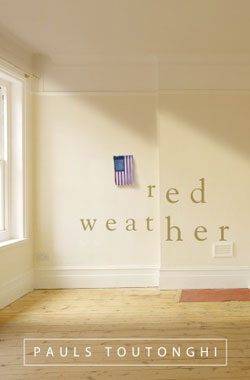
Yuri Balodis, the protagonist of Pauls Toutonghi’s engaging novel Red Weather, has a problem. He, the teenaged son of escapees from Soviet Latvia, has fallen in love with Hannah Graham, a committed socialist. His infatuation leads him to join the blue-eyed Hannah in her early-morning attempts to sell the Socialist Worker to uninterested workers in Milwaukee’s downtrodden Third Ward.

Yuri’s father Rudolfs is not impressed. He drags Yuri off the street, embarrassing him in front of his new left-leaning friends.

“Communists,” he tells Yuri, “are like goats. They come into your house. They eat everything. They sleep everywhere. They make an awful noise. Then, just before they leave, they shit on the furniture.”

Though a steadfast fan of capitalism, Yuri’s father is not one of its prime beneficiaries. Rudolfs Balodis is a part-time night janitor at Jack Baldwin Chevrolet, a position he endures by remaining “continually and slightly intoxicated.” He is a dedicated consumer of bourbon and Pabst, whose watery alcoholic eyes speak of multiple disappointments. All he wants now is for his son to grow up as a real American, free from the tortured past of his immigrant parents—a past Rudolfs has put so thoroughly behind him that it could have been lived by another person.

Yuri’s parents revel in things like electricity. They love their adopted city, redolent of sauerkraut and beer, in the way only collapsed cities can be loved. (A former industrial giant, it can now come up with no better slogan than “Milwaukee, a Great Place on a Great Lake.”) Yuri’s mother Mara has decorated their apartment with advertisements for consumer goods cut from magazines and covered with plastic. She adores Yuri and calls him bučina, or little kiss. She and Yuri’s father speak a frequently hilarious English filtered through Latvian speech patterns. Rudolfs Balodis is in the habit of calling everyone “my darling,” and has an aversion to contractions, while Mara can close an argument with: “Simply shut up, Yuri. I am telling you this as your mother.”

The inevitable collisions between the Latvian past and the American present are both funny and poignant. Yuri’s parents are Latvian with a Soviet inflection, and Yuri’s quietness and lack of communality (as evidenced by his preference for reading in his room) are perceived by them as gratuitous, and slightly suspect. They come from Soviet housing developments surrounding Rīga where the walls were, according to Yuri’s mother, “thin as flour,” and where “everyone was quiet, all the time, because if you said anything, made any noise at all, someone would make a note and call the secret police and you would disappear. So be happy for reading in here with me and being together with all this nice electricity.” He is not permitted even to learn Latvian; his parents want him to be as purely American as a soap bubble, or one of the endless sitcoms on television.

But the Latvian past muscles its way into their lives. After a cryptic telephone call, Yuri’s parents inform him that they will be receiving visitors from Latvia: Rudolf’s old friend Ivan and his wife. Ivan, his father informs Yuri, was his closest friend until Rudolfs stabbed him in the leg just before leaving Latvia. How Ivan feels about this event now is anyone’s guess.

Red Weather is an ode to the painful trajectory of Rudolfs Balodis’s life. Drunk, swaying under the stars on their little apartment balcony, he still embodies a doomed gallantry that can express itself only in humorous asides, a bravery only slightly compromised by its possessor’s complete inebriation.

Sometimes the sheer magnitude of Rudolfs makes Yuri seem small, almost fetal. It’s as though any normal adolescent anger towards his father has been smothered in retrospective filial guilt. Yuri seems oddly muted, like an updated prodigal son from an Anna Brigadere story, or an endlessly observant and self-effacing narrator in a Charles Dickens novel.

In Red Weather, the story goes off in all directions, a road movie that never quite leaves town—but isn’t that the story of adolescence? Part of the chaos, and the delight, is in the meeting of two worlds that are completely unknown to each other, yet strangely familiar. The Latvian past informs the American present, and in the end brings certain essential facts to light. The disorder is not entirely resolved, but this too seems natural and satisfying. According to Toutonghi, an old Latvian proverb states that every good story has at least one bad joke. Red Weather provides both.

Details

Red Weather

Pauls Toutonghi

2006:  Random House,  2006

ISBN 0307336751

On the Web

Pauls Toutonghi

Pauls Toutonghi, whose debut novel is Red Weather, is half Latvian, half Egyptian, as visitors to his official Web site may learn. EN

Where to buy

Purchase Red Weather from Amazon.com.

Note: Latvians Online receives a commission on purchases.