Web sites provide guides to Christmas and solstice

Zvani skan, zvani skan, Ziemassvētki brauc… (Jingle bells, jingle bells, Christmas is coming…). Christmas is just around the corner, so it’s time for a quick look at Latvian Christmas-related Web sites. Every year we hope to find at least one new place on the Web that will inform about the uniquely Latvian way of marking this season. We’re yet to find one site that has everything, from the winter solstice to recipes for gingerbread to the Latvian take on the origins of the Christmas tree.

Let’s start with events associated with Christmas in Rīga. If you’re planning to spend the festive season in Latvia, the Rīgas Domes Kultūras Pārvalde (Department of Culture of the Rīga City Council) or Notikumi.lv can help with information on concerts and other events in the capital.

To save time and send your Christmas greetings to Latvian friends via e-mail why not try E-cards.lv, which has a wide range of seasonal cards to choose from.

To find out more about the traditional Latvian way of celebrating Ziemassvētki read the following articles on Latvians Online:

If you’re intrigued and want to find out more about Christmas, Latvian-style, the Latvian Institute site has a concise and informative write-up on Latvian seasonal holidays. Latvian folk songs, or four-liner pantiņi, about Christmas can be gleaned from the Krišjāņa Barona Dainu skapis, while more information about traditions is found in the folkore section of the Latvijas Izglītības informatizācijas sistēma (Latvian Education Informatization System). You’ll need to have a basic knowledge of Latvian to read these.

According to an article that appeared on the Apollo portal, Christmas is the season that is the dearest to most Latvians’ hearts, followed by Jāņi (summer solstice) and Mārtiņi.

We can’t forget that Latvia has a Christian tradition and the celebration of the birth of Jesus Christ is primary during this season. The nondenominational Zvans portal has a thought-provoking compilation of Advent- and Christmas-related articles by journalists and clergy, as well as opinions of the average Latvian “person on the street.”

Christmas for many is a time of reflection on the year and on spiritual topics that often get neglected during our hectic day-to-day routine. It is a time of generosity of spirit, expressed in part by the desire to help those in the homeland. Relatives often come first, but if you’re looking for Latvian charities to donate money to, a good starting point is Ziedot.lv. The site, set up in conjunction with Hansabanka, has a team of professionals thoroughly check the projects before they are added to the site, so you can be sure your money won’t end up in a middleman’s pocket.

Last but not least important is Latvian festive fare. What would Christmas be without piparkūkas, pīrāgi and the traditional roast? For discussions on these essential ingredients for a truly Latvian-scented Christmas, look at the Latvians Online Forum for piparkūkas recipes and hints for baking Receptes.lv and Cāļa virtuve. Happy baking!

Details

On the Web

Apollo

One of the leading news and information portals in Latvia, Apollo is a product of the telecommunications company Lattelekom. LV

Cāļa virtuve

Part of the family-oriented portal Cālis.lv, the kitchen site has plenty of recipes. LV

E-cards.lv

Looking for an electronic greeting card to send to someone? E-cards.lv has plenty. EN LV RU

Krišjāņa Barona Dainu skapis

The digitized version of folklorist Krišjānis Barons important work of gathering thousands of Latvian folk songs, or dainas, is searchable on a computer or on a mobile device thanks to WAP. LV

Latvian Institute

Charged with projecting Latvia’s image to the world, the government-run Latvian Institute has various articles about Latvian traditions and history, including holidays. EN FR LV

Latvijas Izglītības informatizācijas sistēma

Created by the University of Latvia and the Ministry of Education and Science, LIIS provides access to digital resources for education. EN LV

Notikumi.lv

Latvia’s most comprehensive events calendar offers a searchable list of events. DE EN LV

Receptes.lv

The recipe portal, created by Ideju parks, holds hundreds of instructions for preparing various foods, including traditional Latvian fare. LV

Rīgas Domes Kultūras Pārvalde

The Department of Culture of the Rīga City Council offers a rundown of events around the capital city. EN LV

Ziedot.lv

Looking for a way to support a Latvian charity? Ziedot.lv reviews organizations and causes, while making the process of giving online easy. EN LV RU

Zvans

The nondenominational portal Zvans focuses on Christianity and is organized by the Sv.Anna congregation of Jelgava. LV
Daina Gross is editor of Latvians Online. An Australian-Latvian she is also a migration researcher at the University of Latvia, PhD from the University of Sussex, formerly a member of the board of the World Federation of Free Latvians, author and translator/ editor/ proofreader from Latvian into English of an eclectic mix of publications of different genres.

Songs from children’s musical are now on CD

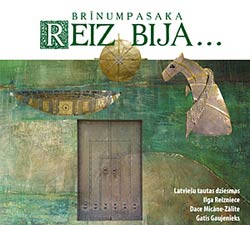
Reiz bija… (A long, long time ago…), a new compact disc on the market in Latvia, is the soundtrack to a recent children’s musical in Rīga. The play itself is a typical folk tale, where the heroes go on a journey to find a special object or knowledge that will solve a problem. Along the way they meet both good and bad people and animals, who either help or hinder them in fulfilling their goal. In the end, the heroes return home with the required object or knowledge, solve the problem, and everyone lives happily ever after.

The heroes in Reiz bija… are a young brother and sister on a mission to find out how the world was formed. Their journey is based on motifs from Latvian folk songs and folk tales—for example, two yellow horses emerging from the sea, a sunken castle, Jumis, and the mythic river Daugava—and intertwined with folk tales about stars, birds, mountains and hedgehogs. The goal of the producers was to show present-day Latvians that even today we can tap into the knowledge and traditions of past generations and gather strength from them, and that we do not need to give up our traditions in order to “make it” in the modern world. Whether the project achieved its patriotic goal or not, reviews were for the most part good. My elementary school-aged children sat on the edges of their seats for the whole show and liked it very much.

As would be expected, most of the songs in Reiz bija… are traditional folk melodies and use traditional dainas texts. The rest are compositions by Ilga Reizniece, Gatis Gaujinieks and Dace Micāne-Zālīte. The accompaniments are clearly contemporary, as opposed to folk, but the style is not forced. Thankfully, the children’s singing is also natural. Adults sing only two of the songs: a warrior’s song of protection and a song by the “complainers,” annoying caricatures who humorously plead to God for justice and didn’t really seem to fit into the play. It’s nice to hear that many of the children’s songs have mythological themes. Here children are finally deemed capable of more serious subject matter, rather than just cute animals. The young singers are from RīBēJa MuTe, which is an acronym for Rīgas bērnu un jauniešu muzikālais teātris (the Rīga Children’s and Youths’ Musical Theater).

The liner notes provide texts to all of the songs. That’s so that you can sing along karaoke-style to tracks 17-30, which provide just the accompaniment to the preceding songs. The music is straightforward enough (if a bit monotonous—remember, it’s only the accompaniment!), although there are usually no cues as to where one ought to begin singing. This will hopefully stimulate kids (and adults) to sing, and maybe help train a musical ear to boot. Just the other day a friend and I found our children singing one of the Reiz bija… songs while playing together, which is proof the tunes are catchy.

Details

Reiz bija…

RīBēJa MuTe

RīBēJa MuTe,  2006

Reizniece’s book teaches Latvian folklore 101

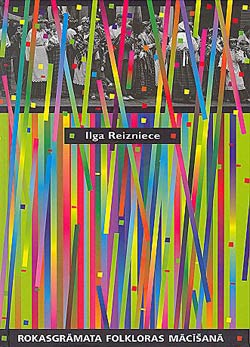
Latvian folklore was traditionally passed down from one generation to the next via family traditions. These traditions have, over the centuries, unfortunately lost their relevance in daily life, so the passing down of Latvia’s cultural heritage has largely been left to schools and community groups. Their efforts now may be aided by a new book, Rokasgrāmata folkloras mācīšanā, by Ilga Reizniece.

Not all Latvian schools both in Latvia and outside of it teach Latvian culture as part of their curriculum. Some schools, however, have included some elements of Latvian folklore in their school traditions.

Our children, who are attending school in Rīga since Sept. 1, have come across two such celebrations so far: Mikeļdiena and Mārtiņdiena. Mikeļdiena celebrations were marked by fruit and vegetable sculptures created by the children (and in many cases, the parents) and displayed in the school yard, while Mārtiņdiena was the day the children from the older grades sold homemade items to the younger kids. I asked the children if any of the teachers had explained anything more about these days that are of important ritual significance in the ancient Latvian solar calendar. “Nē”, they both replied, not much more had been explained. The younger children had painted a rooster (the traditional fare for Mārtiņdiena feasts) in art class, so I guess that was as far as the teachers wanted to go with this topic.

Some schools in Latvia, such as the Jūrmala Alternative School not far from Rīga, have embraced Latvian traditions fully with folklore lessons part of the school’s curriculum. One of the educators at this school is Reizniece, best known as the lead singer and violinist for the post-folklore band Iļģi. Reizniece is a person with boundless energy and a passion—and a gift—for the passing of Latvian traditions on to the younger generation. In the past 15 years many books have been published on the subject of Latvian folklore. Some have actually had content that is very similar to what you will find in this book—Latvian children’s games with music and actions, songs, skaitāmpantņii (children’s verses)—but this book goes one step further.

Although it is in Latvian, the book is an easy read, so don’t fret if you think your Latvian will not be strong enough to follow the text.  The tone of the book is informal and chatty, making you feel that Reizniece is talking to you directly. She relays some interesting stories from her folklore “lessons” (it seems more fitting to call them “sessions of fun and games”). Reizniece has not only included a huge variety of traditions and grouped them by season (as is usually the case when teaching traditions), but has done it in such a loving and playful way that you almost want to run out yourself, find some children and start singing and dancing with them to your heart’s content!

The seasonal approach is not the only way the traditions have been grouped. There’s a section on lullabies, sun songs, Latvian mythology in general, jokes, folksongs about mothers, birds and so forth. The sheer variety of ideas would be a delight to anyone teaching the subject in a weekly school situation as you would be guaranteed a lesson every week for the whole school year with many topics left over. The book is not meant as a curriculum. It is more a treasure chest of suggestions that can be adapted to suit the situation at hand.

Rokasgrāmata folkloras mācīšanā is practical as it recognizes that the concepts portrayed in these traditions are hard to explain to kids who live in the 21st century where technology rules and contact with an agricultural lifestyle is minimal. Reizniece has drawn from many years’ experience with children of all ages and has come up with her own solutions to this problem. Another positive element is that reference is made to other media as potential resources for teachers: the Web, videotapes and DVDs, and excursions to specific museums in Latvia, such as the Ethnographic Open Air Museum, Latvišu Folkloras krštuve (Archives of Latvian Folklore) or the Krišjāņa Barona muzejs.

The book can be used by parents or grandparents and incorported into their own family traditions. This doesn’t necessarily have to mean it is “taught” to children by an educator in the classical sense. It also is great to read even if you don’t come into contact with children in your day-to-day life. You can learn a great deal about the world view of the ancestors of modern-day Latvians from the explanations of these simple children’s songs and games.

Details

Rokasgrāmata folkloras mācīšanā

Ilga Reizniece

Rīga:  Zvaigzne ABC,  2006

ISBN 9984-37-509-9

Where to buy

Purchase Rokasgrāmata folkloras mācīšanā from BalticShop.

Note: Latvians Online receives a commission on purchases.

Daina Gross is editor of Latvians Online. An Australian-Latvian she is also a migration researcher at the University of Latvia, PhD from the University of Sussex, formerly a member of the board of the World Federation of Free Latvians, author and translator/ editor/ proofreader from Latvian into English of an eclectic mix of publications of different genres.