Choir Latvija showcases sacred works

Valsts Akadēmiskais koris Latvija

Due in part to the Latvians’ propensity to sing, there are a bewilderingly large number of choirs in Latvia. Most every institution—be it educational or commercial—has a choir (for example, the Lattelecom Choir or the Hansabanka Choir). Latvia even has a government sponsored choir, Valsts Akadēmiskais koris Latvija (State Academic Choir Latvija). You might expect the choir, being state sponsored, to be one of the best in Latvia if not the entire world. And you would be right. Latvija, along with highly respected conductor Māris Sirmais, has made a name for itself worldwide and has won the Latvian Great Music Award on a number of occasions.

Latvija also makes a point of performing and recording new music. This is not your average choir singing old standards. It is always at the forefront in terms of working with the composers of today and performing recently composed works, not just by Latvian composers, but by international composers as well (for example, the choir recently worked together with composer John Taverner). In 2006, the choir released a compact disc containing two such new works by Latvian composers: Ēriks Ešenvalds’ “Passion and Resurrection” and Rihards Dubra’s “Te Deum.”

Latvija also performs many different types of choir works, mainly focusing on large scale works such as oratorios and masses. On this CD, both works, as is obvious from their titles, are sacred works, the performance of which is one of the strengths of Latvija.

Ešenvalds’ “Passion and Resurrection” is a work in four movements and is based on the story of the suffering and rebirth of Christ, with text taken directly from the Gospels (and some other sources), both in Latin and in English. Assisted by the Liepāja Symphony Orchestra, Latvija take this powerful work and imbues it with the necessary dynamic so that the full scale of the suffering of Christ is brought through in the performance. Ešenvalds is a rising star among Latvian composers. The young composer skillfully takes such a weighty and well-known topic and develops a major work of power and subtlety. Ešenvalds himself is a tenor in Latvija, which gives the choir a particularly personal insight into the performance of this work.

The second work Dubra’s “Te Deum.” It is a truly epic composition. Although just under 15 minutes, this song of praise to God is breathtakingly moving. The sheer number of artists required to perform the work indicates its scope: boys’ choir, girls’ choir, women’s choir, men’s choir, two mixed choirs, soprano saxophone, French horn, two sets of bells, tam tam and, if that was not enough, organ. Latvija is joined on the recording by some of the brightest stars of choir music, including the Balsis youth choir, the Kamēr youth choir, the Rīga Dome Choir School Girls’ Choir, as well as the Rīga Dome Boys’ Choir. The performance of “Te Deum” as part of the 2003 Song Festival was considered one of the defining moments of the event, and not for nothing did Dubra receive the Great Music Award in 2004 for the composition.

One of the highlights of the CD is the packaging. It features extensive detail about all the performers and composers in Latvian, English and even German. But it also includes unnecessarily extreme close-up shots of the composers and some performers. Do I really need to be able to see into Dubra’s nose? Yipes! Full texts of the works (with Latvian translation) are also available in the booklet.

The State Academic Choir Latvija (and friends) has released a remarkable CD that all choir fans, as well as all sacred music fans, will appreciate. Sacred choir music is a genre that is alive and well in Latvia, and Latvija, being one of the best performers of this type of music, along with two great works by composers Ešenvalds and Dubra, make this CD an essential purchase for choir music connoisseurs.

Details

Ēriks Ešenvalds “Passion and Resurrection” / Rihards Dubra “Te deum”

Valsts Akadēmiskais koris Latvija

Valsts Akadēmiskais koris Latvija,  2006

VAK 0601

On the Web

Valsts Akadēmiskais koris Latvija

The state-sponsored choir’s Web site provides information about its repertoire, its recordings and the Sacred Music Festival. EN LV

Where to buy

Purchase Ēriks Ešenvalds “Passion and Resurrection” / Rihards Dubra “Te deum” from BalticMall.

Note: Latvians Online receives a commission on purchases.
Egils Kaljo is an American-born Latvian from the New York area . Kaljo began listening to Latvian music as soon as he was able to put a record on a record player, and still has old Bellacord 78 rpm records lying around somewhere.

Re-releases offer the sound of Līvi from the 1980s

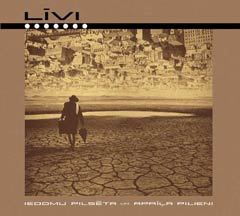
Iedomu pilsēta un Aprīļa pilieni

In its efforts to re-release most every important album on compact disc format, the recording house MICREC has finally come to the 1980s with the release of Iedomu pilsēta un Aprīļa pilieni . Approaching a total of 30 recordings in the series “Latviešu populārās mūzikas klasika,” the company has given its due to one of the most important and influential Latvian rock groups—Līvi.

This release contains the very first official full Līvi album from 1986, Iedomu pilsēta, and also Aprīļa pilieni, a song cycle from a presentation by Latvian State Television in 1985 (from which a few songs were released on a 7-inch record in 1985). Though the group did re-record many of these songs for the 1997 CD Bailes par ziņģēm, on this re-release you will hear these songs as they were originally recorded.

Līvi, which celebrated its 30th anniversary in 2006, was founded in Liepāja in 1976. Throughout the years, the band’s lineup has always changed, but the one member who has been constant is bass guitarist and vocalist Jānis Grodums.

The songs from Apriļa pilieni (with all texts by Māris Čaklais) were recorded in 1984. At that point, the leader of the group was guitarist, singer and composer Ēriks Ķiģelis. Along with he and Grodums, group members included vocalists Igo (Rodrigo Fomins) and Inga Pavītola, Modris Šterns on keyboards and vocals, and Vilnis Krieviņš on drums.

Apriļa pilieni, actually a children’s program, turned out to be rather controversial. The Soviet government did not approve of the songs’ ideologies, much less the noisy hard rock sound of some of tracks, and it came to pass that television director Lilita Eglīte was relieved of her duties. Eglīte even writes a few words about the whole event in the liner notes contained in the CD re-release.

The songs themselves are a rather eclectic. You do get the hard rock of songs like “Uzraksti uz sētas” and “Elektriskā zivs,” but you get other interesting songs like “Jānīts pīpē” (a lament about little Johnny who has begun smoking) and “Durvis” (in which the word „durvis” is repeated again and again in a low growling vocal). Also heard are songs with a poppier feel, like “Padeklītis.” And, of course, the album has the still popular hit “Apriļa pilieni” with its timeless refrain, „Aprīlim, aprīlim pilieni nav kā līdz šim” (In April, rain drops are like none before).

Even with the controversy of the television program, the group received the ultimate honor at that time—a request to record a full album (very, very few groups ever got this chance). In 1985, the group began work on its first album, Iedomu pilsēta, which was released in 1986.

Tragically, Ķiģelis died in an auto accident on Oct. 3, 1985, before the release of the record. This was a particularly severe loss for the group, as well as for Latvian rock music in general. Ķiģelis, besides being a talented guitarist and songwriter, had assertively taken over leadership of the group and was influencing its musical direction. Even though this was the band’s first full album, there were already many classics with music by Ķiģelis.

One of the most notable compositions on Iedomu pilsēta is “Saldus saule” (music by Ķiģelis, words by Māris Čaklais), a tribute to the town of Saldus in the Latvian region of Kurzeme. The song was even performed at the youth choir concert during the 2003 Latvian Song Festival. Also on the album is “Zušu dziesmiņa” (music by Ķiģelis, words by J. Plotnieks), a song about what to do if an eel is approaching you.

Not to be outdone, Grodums was also proving himself an adept songwriter. Though not on this album, one of Grodums’ most popular works was the song “Ziņģe par bailēm,” originally performed by the rock group Credo, and included on the Mikrofons 80 record. Grodums continued his composition work on this album, including the almost reggae-like “Līviskā ziņģe” and the song “Rožu laukums” (with words for both by A. Neibarts).

The packaging for this release, as with many of the other CDs in this series, is minimal. It does have the notes from Eglīte, as well as a facsimile of the back of the original vinyl release of Iedomu pilsēta, which contained an essay on the band by Klāss Vāvere. It would have been nice to have song texts, not to mention a bit more information about the group. Because Grodums has been there all along, it would be particularly fascinating to hear his thoughts on recording these songs.

These records show the origins of one of the cornerstones of Latvian rock music. From the intentional naïveté of Apriļa pilieni to the budding hard rock of Iedomu pilsēta, Līvi in the 1980s was a group that would shape the sound of Latvian rock. Līvi had already been in existence for almost a decade at this point, and even in this period of time the group had managed to leave its indelible mark. As always, great thanks to MICREC for releasing these gems on CD.

Details

Iedomu pilsēta un Aprīļa pilieni

Līvi

MICREC,  2006

MRCD 330

On the Web

Līvi

Learn more about the band at its official Web site. LV

Where to buy

Purchase Iedomu pilsēta un Aprīļa pilieni from BalticShop.

Note: Latvians Online receives a commission on purchases.
Egils Kaljo is an American-born Latvian from the New York area . Kaljo began listening to Latvian music as soon as he was able to put a record on a record player, and still has old Bellacord 78 rpm records lying around somewhere.

Spots for Latvian ski bunnies and powder hounds

Slalom.lv Web site

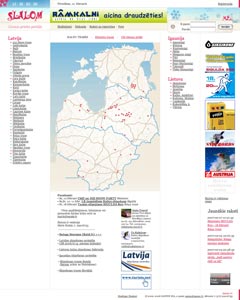
The SLALOM.lv Web site is a good starting point for gathering information about Latvia’s ski hills.

Although winter in the Northern Hemisphere technically began in December, it has been a bit slow in actually bringing on the appropriate conditions: falling temperatures and, most importantly, snow! But now that the season has finally arrived, it is fitting to have a look at the options for fanatics of the white stuff.

Where’s the Latvian angle? Our task: to find Latvian skiing options, not just in Latvia but worldwide.

To find Latvians on the slopes the most logical place to look would be Latvia. A long list of hilly districts you can head to is found at SLALOM.lv. Each trase (you can’t call them resorts, the translation would be “run”) has its own Web site, so have a look at each one to get the facts on ski lift working hours, ski rental costs and accommodation options. The site doesn’t only concentrate on downhill ski slopes. Cross-country skiers can also find the best places to go touring on the more level plains. Looking slightly farther afield, if you are looking for a Baltic skiing experience, the slopes of neighboring Estonia and Lithuania have also been included.

Here is a list of the Latvian snowfield Web sites:

If you are interested in more organised ski activities, such as clubs, schools and competitions, the Latvian Skiing Association (Latvijas slēpošanas savienība) site is worth a visit.

Many Latvians are avid skiers, so it’s no surprise those who can afford it head to the Alpine ski resorts in France, Austria, Switzerland and Italy. The central European countries of Slovenia, Croatia, the Czech Republic and Slovakia also offer cheaper skiiing options for those who have a more modest budget. Most Latvian travel agencies offer a wide variety of options to reach the slopes, usually bus tours, but these don’t always need to be exhausting three-day road trips. Travel agencies are happy to organise travel options where you book a cheap flight and combine it with a bus tour to the ski fields. Seems you could head off with other Latvians to any ski slope in Europe.

What about the rest of the world? In the United States, the Chicago Latvian Ski Club organises annual tours to Banff in Canada’s Alberta province. This is all arranged in the fall, but maybe there are still some places left. More information may be found on the Latvian Happy Hour Club site or by sending e-mail to LatvianSkiClub@aol.com

Now for the surprise option. If you’re such a keen skier that you can’t get enough skiing with one winter a year, why not head down under during the Northern Hemisphere’s summer and ski to your heart’s content in Australia.

The Blue Eyes Ski Lodge (Zilās acis) is a Latvian-run facility at Mt. Buller in the Australian Alps of Victoria. There’s just one catch: you need to get the recommendation of a member to stay at the club. But to say hello, just ring the doorbell, there’s always a Latvian or two up at the lodge in winter.

Details

Daina Gross is editor of Latvians Online. An Australian-Latvian she is also a migration researcher at the University of Latvia, PhD from the University of Sussex, formerly a member of the board of the World Federation of Free Latvians, author and translator/ editor/ proofreader from Latvian into English of an eclectic mix of publications of different genres.