
Communing with nature in Latvia

Cūkmens sticker

Stickers urging people to clean up after themselves when visiting state forests are part of the Cūkmens campaign.

If you are planning a trip to Latvia—or are already in Latvia—do you have an interest to be at one with nature? Where can you turn to find out the best picnic and fishing spots, childrens’  nature activity parks and other outdoor recreation areas? Mammadaba.lv, a literal translation of the term Mother Nature, is an initiative created by Latvijas valsts meži (Latvian State Forests, www.lvm.lv) that encourages travel to the countryside.

By countryside this state institution means the forests, the rivers, the lakes—not just the towns. The hope here is that locals as well as tourists will find these trips to the countryside enjoyable and will return and pass this information on to others. The Web site is great for ideas for the best spots for all kinds of activities, from the local Latvian favorites of berry picking, mushrooming, fishing, bird-watching and hunting to cycling routes, orienteering and nordic walking routes. So far there are around 300 areas of state-owned forest territory under the stewardship of Latvijas valsts meži that have been cleared for recreational public use.

If you’ve headed out to the woods but want to stay longer than just one day your best bet for accommodation options is Atputa laukos. The Web site is created by the country tourism association Lauku ceļotājs, which also publishes brochures that can be purchased in most bookstores. For more sites on the environment and various options for outdoor recreation have a look at the links page.

Latvijas valsts meži has also for the past two years been involved in a campaign to increase public awareness of the dumping of rubbish in Latvian forests. Cūkmens is the public face of this campaign, a litterer-turned-pig in a superman-style pink pig costume actively urging the public to clean up its act: “Nemēslo mežā! Par cuku pārvērtīsies!” (Don’t dump your rubbish in the forest! You’ll turn into a pig!). This year the campaign has focused on coastal rubbish dumping. Cūkmens has visited local school in coastal regions, educating the children as well as getting the public involved in cleaning up the coastline. Jāņi was another perfect target for a Cūkmens intervention; with so many people heading to the woods to celebrate, there has always been a tendency to leave the post-Jāņi waste behind. Learn more about the Cūkmens campaign and see video and listen to audio from the campaign at www.cukmens.lv.

School-aged children can learn more about the forests of Latvia by taking part in a program, Izzini mezu, a joint initiative of Latvian State Forests, the Foundation for Environmental Education and the Forest Development Fund. The patron of this program is Latvian writer and poet Imants Ziedonis. The aim is to teach kids the importance of the forest habitat from an ecological and cultural perspective in the early years to more complex concepts in the later years of their school life.

Details

Daina Gross is editor of Latvians Online. An Australian-Latvian she is also a migration researcher at the University of Latvia, PhD from the University of Sussex, formerly a member of the board of the World Federation of Free Latvians, author and translator/ editor/ proofreader from Latvian into English of an eclectic mix of publications of different genres.

Out from underground, Daksis reveals his personae

Mežs ieiet sevī

With the release of his sixth or seventh album this spring, prolific Latvian singer-songwriter and philosopher Imants Daksis is finally reaching larger audiences and receiving wider recognition. While the small batches of his previous, more or less self-made, recordings are now hard to come by, Mežs ieiet sevī is a larger undertaking, distributed by Lauska, a relatively new culture management center based in Rīga. This is definitely a good career move for Daksis, but the trade-off is that it might take some of the mystery and underground-ness out of his reputation.

Daksis is younger than you would think—in his mid-20s—and often seems shy in concert. He is serious and concentrates on his music, yet is a master in the art of working an audience. Sometimes he plays softly and gently, but by the very next song he could be shouting in a booming voice.

Needless to say, Mežs ieiet sevī also reflects these two personalities of Imants Daksis. The compact disc begins with “Situ vēju ar koku,” which is less of a song and more of a boastful call or a fragment of spoken word. He continues with the same deep calling voice in “Purvs tevi sauc,” and the listener’s first impression may be of a pretentious singer with an affected voice. But Daksis’ other persona—the gentle folk singer, for lack of a better description—soon takes over. “Es gribu mīlēties ar tevi šonakt” contains touches of the accordion, flutes and kokle. These instruments, accompanied by mandolin and bagpipes in other songs, keep popping up throughout the CD, reminding the listener at times of the folksy side of Jethro Tull (for example, in “Matērijas bilžu grāmata”). Acoustic guitar, though, remains Daksis’ one constant.

Despite flipping back and forth between two voices and two personalities, much of the album sounds moody and intense. One song comments about excessive drinking, another is a call to battle, another an analogy to rape, followed by childhood innocence. The title of the album refers to the thicket of loneliness, trials and rejuvenation that many creative people go through. Heavy stuff, most of it. For example, “Šī deja bij’ smaga, es piekusu drīz, bet kā vienmēr spēks pretstatā nespēkam viz…” {This dance was difficult, I tired soon; but as always, strength glitters in comparison to weakness…), or “Tu esi lidmašīna, es esmu taurenītis; Es tevi ķeru, bet vai tu arī mani redzi?” (You’re an airplane, I’m a butterfly; I catch you, but do you also see me?).

In between the philosophical songs, though, are a few wonderfully absurd gems, with lyrics such as “Pats esi pavārs, pats esi kūka, pats sevi ēd un dod arī citiem – priecājies, ka tu garšo! (You are the baker, you are the cake, you eat yourself and give some to others—be happy that you taste good!).

Although Daksis sometimes performs pretty standard sounding music (for example, “It nekas…”) and even gets air time on Latvian radio, deep down he’s an uninhibited, minor-key, operatic bard who likes holding long notes. The one song in Russian on the CD proves that he also not only feels at home, but really shines in Vladimir Vysotsky’s native language and style.

So Imants Daksis is a bit odd. Maybe too dramatic or “deep” for some, maybe too raw for others. But it seems that most Latvians are proud to call him their own.

Details

Mežs ieiet sevī

Imants Daksis

Lauska,  2007

On the Web

Imants Daksis

The singer’s Web site has news about performances, samples of his music, photographs and philosophical musings. LV

Imants Daksis on MySpace

Imants Daksis’ MySpace site has samples of his music. EN

Where to buy

Purchase Mežs ieiet sevī from BalticMall.

Note: Latvians Online receives a commission on purchases.

Vilcenes present songs of the warrior’s bride

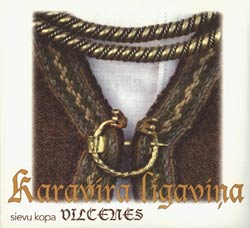
Karavīra līgaviņa

The Latvian traditional folk group Vilcenes (female wolves) are the counterpart to the more widely known male singing group Vilki (wolves); the members of Vilcenes, in fact, are the wives of the Vilki. Vilki has always differentiated itself from other folk groups in that the repertoire consists solely of songs about soldiers and war. The group also brings alive the culture of the ancient Latvian warrior. In accordance, the members of Vilcenes sing the songs of the brides, wives and mothers of those warriors from long ago, awaiting their return from the fields of battle.

Vilki has released several albums over the years, and now Vilcenes has a debut compact disc, Karavīra līgaviņa (Bride of the Warrior).

It must be said that both Vilki and Vilcenes see their main mission as attempting to recreate the traditional way of life of the Latvian and Līv tribes of the 10th-13th centuries. They do this by celebrating the solstices, equinoxes and other agricultural festivals, including familial occasions such as weddings and baptisms, as reconstructed from historical and archaeological sources. In their enthusiasm, they have learned to weave cloth, braid sashes, tool leather and smith the jewelry and weaponry to construct the complete wardrobes of their ancestors 900 years ago.

Song has seemingly always been a part of the peoples living in the Baltics, and appropriately, Vilki and Vilcenes have given singing a large role in their attempts at reliving the past. Astoundingly, many folk songs, especially those about war, have survived the centuries relatively unchanged from their original form, thus giving an added authenticity to the endeavors of these unique folklorists.

This unprecedented authenticity, with a focus on warriors and ancient warcraft, sparked interest in the general Latvian public. What started out as a rather private group of families with a shared interest in ancient history has given rise to two premier Latvian folk groups, Vilki and Vilcenes, performing in public both at home and abroad.

Almost all of the 20 tracks on Karavīra līgaviņa deal with the unenviable position of either awaiting your loved one from war or readying your son for war. That said, the songs on this album are mostly quite melancholy, but never “wailing”—true to our stoic, northern sensibilities. One of my favorites is “Lempis,” in which a young woman rides to battle in the stead of five lazy brothers. The songs are sung either a capella or with a minimal accompaniment of drums, whistle, kokle or ģīga (a stringed instrument that usually plays a bass line). The production level is quite simple, which I assume is an attempt at keeping the sound authentic, rather than “mystical” or “new-agey.” One should also keep in mind that the women of Vilcenes are neither professional musicians nor singers, as they themselves are always quick to say.

The CD insert includes all texts to the songs in Latvian, a short description of each song in English, as well as a short narrative consisting of a grandmother telling her granddaughter about the trials of sending men to war (also translated into English). The graphic design of the CD is comprised of photographs of the Vilcenes and close-ups of the members’ beautiful hand-made costumes. I would recommend this CD to those with a keen interest in Latvian folklore, as many of the songs on the album cannot be heard anywhere else.

Details

Karavīra līgaviņa

Vilcenes

Lauska,  2007

Where to buy

Purchase Karavīra līgaviņa from BalticMall.

Purchase Karavīra līgaviņa from BalticShop.

Note: Latvians Online receives a commission on purchases.