Latvian churches abroad well represented on the Web

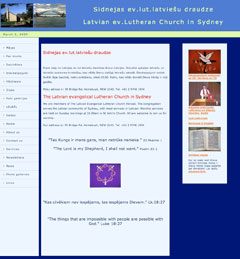
Latvian Ev. Lutheran Church in Sydney

The Web site of the Latvian Ev. Lutheran Church in Sydney provides Bible quotes and the church newsletter.

Latvians who have ended up in other parts of the world, either voluntarily or involuntarily have more often than not established their communities with the focal point being the church. In many cities the church community has founded Latvian schools, camps, folk dancing groups and other organizations. Over the years the role of the church as the hub may have changed slightly but its primary role—as the place for Latvians to be able to go and worship God in the style that they are accustomed to—has remained to this day. Even if congregation numbers are dwindling, the communities will still do their utmost to support a pastor and ensure that regular services are offered to those who wish to attend.

Dozens of Latvian churches are scattered around the world and a sizeable proportion of them have a Web site informing congregation members and the wider community of their work. Quickly skimming through the sites you get a good insight into what each community values and deems important informationwise. But it is important to bear in mind that the flashiest or most professionally designed and structured church Web site does not necessarily mean the congregation is a more caring community and the pastor is far better than others. It just may mean the congregation has steered its funds towards other service-oriented priorities. By the same token, a site that takes pride in mentioning recent christenings, shows plenty of photos featuring happy occasions in the church calendar and provides directions on how to get to the church may be a more outreach-focused church than one that focuses on the history and origins of the congregation. Each bit of information is important but in a balanced way. Nor does it necessarily mean that if the information on a particular church is in English and Latvian that the church is less focused on the Latvian language in services.

Here’s a quick summary of features on some church Web sites. By no means have we tried to list every bit of information available—or every site. Most of the sites are in Latvian, but some provide English content as well.

In Australia, the Web site of the Latvian Ev. Lutheran Church in Sydney provides Bible quotes for certain times of need, as well as a downloadable church newsletter. The site also notes all sermons are recorded on compact disc and can be ordered from the pastor.  The Church of the Holy Cross in Melbourne also has both its newsletter and monthly bulletin available for downloading and informs of the latest events and service calendar.

In Canada, St. Andrew’s Congregation in Toronto, has a few newsletters available for download as well as a video of the African Childrens Choir that recently performed at the church. We experienced some difficulty viewing and downloading these files because we were not using a Windows computer and Microsoft Internet Explorer.

In the United Kingdom, visit the Web site of the United London Latvian Lutheran Church and you won’t have an excuse for missing the next service: A popup message reminds visitors. The site allows vistors to download the latest newsletter and MP3 files of sermons and songs. A link takes visitors to a forum where they can discuss church-related and broader Latvian issues.

In the United States, the New York Latvian Ev. Lutheran Congregation takes pride in its various church properties as well as the summer camp in the Catskill Mountains. The church Web site provides information and photographs of these properties. The site also has MP3 audio files of various services by various pastors in 2007. Visitors also can download a membership application form and a donation form.

The Web site of the Latvian Ev. Lutheran Church of Washington D.C. is in English and Latvian and has instructions on how to get to the church. The local Latvian school founded by the church also gets a mention.

St. John’s Latvian Lutheran Church in Philadelphia wins hands down as the Web site with the most colorful introduction. The site has a service and events calendar followed by the school calendar, showing that school events are coordinated with the church calendar.

We tracked down the Latvian Evangelical Lutheran United Church of Kalamazoo within www.saites.org, a portal for Latvians in Michigan. We found the church pages to be very limited informationwise. The Saginaw Latvian Ev. Lutheran Church had more news but it unfortunately was slightly outdated. The site contains an invitation to pay church dues and to donate money to the congregation’s sister church in Latvia.

The Latvian Ev. Lutheran Church of Indianapolis, which is included in the Indylatvians.com portal, has a brief paragraph informing of its location and services.

The biggest surprise was hearing a Latvian worship song and seeing a scrolling announcement at the top of the site of the Chicago Latvian Zion Ev. Lutheran Church. The availability on the site of the church bulletin, the annual report and dozens of photos of church events all show that this is a community with many helping hands.

The Minneapolis-St. Paul Latvian Ev. Lutheran Church has a well-structured and visually appealing site with information on the church and its school, choir, folk dancing group, ladies auxiliary, library and more. The site also has a personal touch: announcements of latest christenings.

The Boston Latvian Ev. Lutheran “Trimda” Congregation site has plenty of photos of members at various functions and events, showing the community is a fairly active one. The structure and design of the site are easy on the eye. This is the only site that informs visitors how to reach the church by public transport.

Three more broad sites are worth a mention:

  • The Latvian Evangelical Lutheran Church in America (LELBA) is the umbrella organization for all the previously mentioned churches in the United States. LELBA puts out two publications, the magazine Ceļa biedrs and the newsletter LELBA Ziņas. Tables of contents and summaries are available online for Ceļa biedrs, while the newsletter is available as Adobe Acrobat PDF files. LELBA’s Web site also lists the various divisions of the board and the work each division is involved in.
  • The recently unveiled Union of Latvian Baptists in America site provides brief information on the various Latvian Baptist churches in this region.
  • The Latvian Ev. Lutheran Church in Germany site has a church and pastor list and service calendar for the various churches scattered throughout central Europe, including Germany, Belgium, Denmark, the Czech Republic and the Netherlands.
Details

Daina Gross is editor of Latvians Online. An Australian-Latvian she is also a migration researcher at the University of Latvia, PhD from the University of Sussex, formerly a member of the board of the World Federation of Free Latvians, author and translator/ editor/ proofreader from Latvian into English of an eclectic mix of publications of different genres.

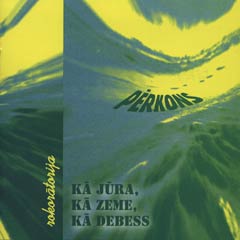
Pērkons re-release features rehabilitative work

Pērkons

After a rowdy concert in 1983, the popular Latvian rock group Pērkons was banned by Soviet authorities, meaning the band could not perform or release recordings. A potential road to “rehabilitation” became visible in 1984, when noted Latvian composer Imants Kalniņš met with the group. Pērkons keyboardist and lead composer Juris Kulakovs had worked with Kalniņš before in the group Menuets, so the two had years of history together. Pērkons asked the composer if perhaps there was any music of his that they could record and perform, and Kalniņš went as far as to suggest working together to compose something completely new.

Kalniņš had in mind composing a rock oratorio based upon the Māris Čaklais text, “Kā jūra, kā zeme, kā debess.” The various parts of the text were divided up among composers Kalniņš, Kulakovs, and Pērkons bass guitarist Juris Sējāns. Even though Kalniņš was a bit of an antiestablishment guy himself, he still was a member of the Latvian Composers’ Union, and helped get the composition approved, as well as approval for the group to perform the work.

At the Liepājas dzintars festival in 1984, the group—Kulakovs, Sējāns, Raimonds Bartaševičs (vocals), Leons Sējāns (guitar), Dainis Strazdiņš (drums), Ieva Akurātere (vocals) and Nauris Puntulis (vocals)—took the stage again to perform the work. Having worked with respected composer Kalniņš allowed the group to perform publicly again. However, a short time after, the group was banned for a second time, but that is another story.

Kā jūra, kā zeme, kā debess was released on cassette in 1994, but for a long time now had been out of print. Earlier this year it was released for the first time on compact disc, after being re-mastered over the last two years by Kulakovs himself, along with three instrumental bonus tracks recorded by Kulakovs and Justīne Kulakova.

To be honest, I prefer Kulakovs’ later compositional work like “Sarkanais vilciens” and “Vēstule no bruģa” to this work. Perhaps it is because Kā jūra… has three different composers, and, to my ears, sounds a bit disjointed. There are certainly memorable moments, such as opener “Līgo” (music by Juris Sējāns) and “Vīru dziesma” (music by Juris Kulakovs), and the performances by the band are, as always, excellent. But there isn’t that much that holds my attention here. I’ve always been a big fan of Pērkons but this CD probably won’t find its way to my player as often as the band’s other recordings do. The three instrumental bonus tracks “Romance,” “Triumfa arka” and “Svētku uvertīra” are pleasing enough works, but don’t really fit in with the rock oratorio itself. In any case, I still hope this CD is successful so that Kulakov’ other compositional works also find their way to CD some day. And, of course, the historical significance of this work is undeniable—this work returned Pērkons to the stage and helped “rehabilitate” the band’s image.

The booklet has all the lyrics, as well as a short excerpt from the recently published book about Pērkons, No zemes un debesīm Pērkons by Māris Ruks. The CD was released by the same publishing company, Antava, that released the booka.

Though perhaps the almost 25 years since this work was first composed and performed may have diminished its major impact, it is still very historically significant and one of the most important compositions in the Latvian rock genre of the 1980s. Though not my favorite of Pērkons’ work, if you are a fan of the “art rock” genre (for example, Emerson, Lake and Palmer) you may very well enjoy this.

Details

Kā jūra, kā zeme, kā debess

Pērkons

Antava,  2007

Egils Kaljo is an American-born Latvian from the New York area . Kaljo began listening to Latvian music as soon as he was able to put a record on a record player, and still has old Bellacord 78 rpm records lying around somewhere.

A whole year’s worth of folk songs

Dievsēta ļaudis

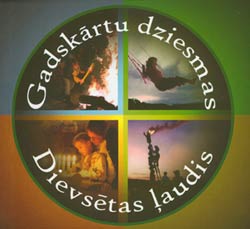
The number of Latvian folk music recordings seems to be growing almost as quickly as wild mushrooms after a rainy summer. Some recordings have specific themes, such as war songs or lullabies, while others cover songs from a certain holiday such as Jāņi or the winter solstice. Until now, I have not been aware of a single recording that attempts to incorporate music of the entire Latvian calendar with all of its holidays. A group of Latvian-Americans has filled exactly this shortcoming. An informative new compact disc, Gadskārtu dziesmas, has recently been released by Dievsētas ļaudis (the folks of Dievsēta).

For 30 years a group of Latvians with a keen interest in folk traditions has been gathering at Dievsēta, a property owned by the Latvju dievturu sadraudze in central Wisconsin, to celebrate holidays—not just the popular Jāņi, but also lesser known ones such as Mārtiņi and Meteņi.

The booklet that accompanies the CD is a treasure trove of information. Its 64 pages include English and Latvian language descriptions of the seven holidays represented by songs on the CD, lyrics and notes for all 43 songs, as well as a number of beautiful photographs from Dievsēta. Each song is also described in one or two succinct sentences in English. The following holidays are represented on the recording: Meteņi (5 songs), Lieldienas (5 songs), Ūsiņi (2 songs), Jāņi (7 songs), Apjumības and Miķeļi (7 songs), Mārtiņi (7 songs) and Ziemassvētki (10 songs).

Glancing at the list of individuals who participated in the CD recording, I noticed names of people who have sung or currently sing with folk ensembles based both in the United States and Latvia. Thus, the quality of the music on the recording is actually quite good. The CD contains a variety of a cappella songs by just one person or a group, as well as songs accompanied by a number of different instruments.

One of the things that I love most about some Latvian songs is the imagery. This is most evident in songs about the sun. The fifth track is a Meteņi song called “Saule savus kumeliņus.” As beautifully summarized by the liner notes, “At sunset the sun takes her horses to the sea to swim, while she herself sits at the top of the hill with the golden reins in her hand.” This song has a simple yet lovely melody. On the CD the song is sung a cappella by just one female, which unfortunately makes it sound a bit too plain. But, with more than three dozen songs on the recording, I did find quite a few songs that I greatly enjoyed.

Many listeners might find track 11, “Tumša nakte, zaļa zāle,” of interest. Listeners might assume this song to be a familiar one, as it is the title of a popular folk song that many children learn in school. Yet, one needs to remember the great diversity in Latvian folk music and thus not be surprised that the melody and—indeed—most of the lyrics of this song are different than the one many people will know.

The seven Jāņi songs have a nice variety of melodies. Anyone who ever tries to sing songs at Jāņi could learn something from these. It seems that most Latvians know only one overused, tired melody for līgo songs. One of the Jāņi songs is sung by children, reminding the listener of the importance of passing traditions down to the younger generations.

Two other songs I greatly enjoyed were “Rudzu druva lielījās” (track 20), a song about work sung at Apjumības, and “Laid iekšā, saimeniece” (track 34), a Ziemassvētki song with a great, party-like tempo and sound.

Many Latvians have never celebrated a holiday such as Miķeli, therefore most songs on the recording will be new to listeners. Even as someone who sings with a Latvian folk ensemble and has participated in a number of folklore activities at 3×3 camps, the majority of songs on this CD were unfamiliar to me. This might be a turnoff for some people, as many individuals seem to prefer the familiar to the unfamiliar. Precisely that is the frustrating thing about Latvian folk music: it is ironic that so many Latvians are familiar with only a couple dozen tunes when the wealth of Latvian folklore is in its folk songs, most of which unfortunately go unsung and unheard.

Because these songs have such specific purposes, this is also probably not the type of CD one would listen to over and over again. However, if one has an interest in Latvian folklore and its traditional holidays and in the diversity of Latvian folk music, and has always wondered how a holiday such as Mārtiņi is celebrated, then Gadskārtu dziesmas will be a wonderful addition to one’s music collection.

Details

Gadskārtu dziesmas

Dievsēta ļaudis

Lauska,  2007

ISBN 978-9984-39-187-8

Where to buy

Purchase Gadskārtu dziesmas from BalticShop.

Note: Latvians Online receives a commission on purchases.