That wonderful scent from the kitchen

If the word “Latvian” is associated with one certain scent, then first prize would go to the humble pīrāgs. One of the unique Latvian symbols that foreigners discover about Latvians worldwide is the often mispronounced, but never forgotten, little bacon and onion delicacy that smells absolutely divine while baking and tastes like heaven when just out of the oven.

This crescent-shaped mini-pie looks like an Italian calzone and has similar ingredients, but the taste is quite different. The Russians and other Eastern Europeans have similar dumpling or bun variations called perogi, piroghi, pierogi or piroshki. Other variations are boiled dumplings called pelmeņi, originating in Siberia, and varenyky, the Ukrainian version of the same thing. Many of these versions are boiled or boiled and fried, whereas the Latvian pīrāgi are baked using bread dough, hence the resemblance to calzone. The Latvians have also elaborated on the theme and created other savoury fillings as variations on the original: kartupeļu pīrāgi (potato buns), sēņu pīrāgi (mushroom buns), kāpostu pīrāgi (cabbage buns) and the list goes on. Those with a sweet tooth are not left wanting: apple pīrāgi, rhubarb pīrāgi, cottage cheese pīrāgi… the possibilities are endless!

If there’s one way to get someone to remember your nationality, it’s through their stomach, so why not discover the secrets of the ancient Letts in the fine art of the baking of pīrāgi or speķa rauši, as they are also called in Latvia.

For an insight into the myriad recipes that are out there, the recipe portal receptes.lv is the first port of call. It’s important to note these are recipes that have been sent in by people who live in Latvia, so their recipes will mention local brands of flour, margarine and other ingredients. Latvians living elsewhere may need to adapt the recipes after trial-and-error to reveal the best local brands in their part of the world.   

For a pictorial how-to, revealing the basics with easy-to-follow steps, have a look at Cāļa virtuve, part of the family oriented Cālis portal. Another step-by-step guide is found on Handy Home Projects, a blog by a family in Canberra, Australia, that is “trying new things, living naturally and frugally, having fun.” Be sure to review part 1 and part 2.

Elvis Stumbergs, who immigrated to the United States in 1990, describes pīrāgi and associated folklore. Although th site is not as specific in terms of quantities for ingrediants, the author makes one very important point: the joint effort of baking for a specific event stimulates community solidarity. This can be cross-generational (passing the tradition down to the next generation) or simply strengthen individuals’ ties with their heritage.

For a more personal take on the subject have a look at Silvija and Pēters Vecrumba’s Latvians.com, which draws the following conclusion: “Pīrāgi are the Latvian woman’s secret weapon. None can withstand their delightful onslaught!”

Don’t forget Latvians Online has its own Latvian Culture and Cooking Forum, where many of the topics are related to recipes that have been handed down from generation to generation.

Details

Daina Gross is editor of Latvians Online. An Australian-Latvian she is also a migration researcher at the University of Latvia, PhD from the University of Sussex, formerly a member of the board of the World Federation of Free Latvians, author and translator/ editor/ proofreader from Latvian into English of an eclectic mix of publications of different genres.

You will be happy listening to this album

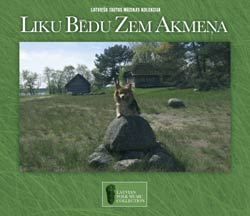
Liku bēdu zem akmeņa

Liku bēdu zem akmeņa, the newest compact disc in UPE Recording Co.‘s Latvian Folk Music Collection, is a variation on an earlier CD containing the “most beautiful” songs. As the title suggests, the songs on this disc are meant to be music by which to bury your sorrows, music to put you in a good mood.

It is, in fact, very happy music. Most of the songs are also quite well-known among Latvians, so listeners need not become accustomed to rarely heard melodies. The CD begins with “Div’ dzelteni kumeliņi” and the very catchy tune “Es uzkāpu kalniņā.” “Strauja, strauja upe tecēj’” and a Cajun-inspired “Aiz kalniņa dūmi kūp” follow on their heels. The version of “Puiši, puiši, kas tie puiši” reminds me of an American hoe-down. Although in a minor key, “Ķēvīt, mana svilpastīte” is upbeat and hearty, as usual. It is followed by “Tur es dzēru, tur man tika” and “Es nenācu šai vietā,” both very popular drinking songs. “Lobs bej puika myusu Jezups” in the Latgalian dialect is a less common song that borders on a Slavic sound. It tells of Jezups—a good young man, only a little bit short—who proposes to the neighbor girl Madaļonka. Then comes “Bēdu, manu lielu bēdu,” “Visi ciema suņi rēja” and “Tumša, tumša tā eglīte.” The disc ends with the good old standard “Div’ pļaviņas es nopļāvu.”

Some of the songs are played a bit too fast for singing along. Kristīne Kārkle is skilled enough to sing “Strauja, strauja upe tecēj’” with almost no time for a breath between verses, but mere mortal singers may not be able to keep up. Līga Priede’s slightly smoky voice is just as strong as Kārkle’s but prefers the higher ranges. Kārkle and Priede sing on only four songs; brothers Valdis and Māris Muktupāvels’ voices dominate the rest of the CD. Ainars Mielavs and Kristaps Rūķītis also sing, while Māris Muktupāvels and Aleksander (Kep) Dmitrijev provide accompaniment on accordion and an assortment of guitar-type instruments, including banjo and mandolin.

The liner notes provide lyrics for each song, as well as literal translations into English. As would be expected, none of them has a sad ending. Liku bēdu zem akmeņa contains only folk songs, no new compositions. The musicians stay true to the traditional lyrics and melodies, but this is not hard-core folklore. Except for the tender hay-mowing song at the very end, the overall sound of this CD is not unlike that of UPE’s Alus dziesmas minus some of the beer. It’s good, foot-tapping, jolly music. But, even though the musicianship is impeccable and each song in and of itself is very well-arranged, it seems that the disc as a whole lacks a bit of inspiration. I also find that the constant happy tempos and volume of the recording are too much to take in at one sitting. I almost feel like Liku bēdu zem akmeņa is trying too hard to put me in a good mood.

My advice is to listen to two or three songs when you need a fix of happy music. Then set the disc aside until you need another fix, listen to a couple more songs, set the disc aside again, and so on. It is kind of like brief regular dates with your therapist: periodically airing out the sorrows from your mind and burying them under a rock, rather than letting them pile up in your mind for years. That was probably UPE’s intention for this CD all along.

Details

Liku bēdu zem akmeņa

Various artists

UPE Recording Co.,  2007

UPE AMCD 006

Where to buy

Purchase Liku bēdu zem akmeņa from BalticShop.

Note: Latvians Online receives a commission on purchases.

Director’s feature debut captures Latvia’s zeitgeist

Monotonija

Having failed her audition, Ilze (Iveta Pole) stares into a mirror and considers her future.

Juris Poškus’ debut full-length feature film Monotonija (Monotony), the Perspectives Award winner for first- and second-time filmmakers at the 29th Moscow International Film Festival, and a nominee for best full length feature film in this years Lielais Kristaps, can be best described as a Latvian Dogme film as done by the English director Mike Leigh.

The focus of the Dogme film movement, headed by Lars von Trier and Thomas Vinterberg in the mid-1990s, was to return to a more naturalistic style of filmmaking, one free of special effects, artistic flourishes or genre. It produced such diverse and notable films as Søren Kragh-Jacobsens Mifune, Lone Scherfig’s Italian for Beginners and Thomas Vinterberg’s The Celebration. Leigh, the director of respected films as Secrets and Lies, Naked and Life is Sweet, is known for an improvisational style that relies heavily on his actors to create character, improvise dialogue and develop the plot. While Monotonija doesn’t exactly reach the lofty standards set by the aforementioned films, it comes close and, if nothing else, establishes Poškus as a talent to watch on the Latvian film scene.

The film is an improvised collaboration between Poškus, director of the 2003 Lielais Kristaps winner for best documentary for Bet stunda nāk (But the Hour is Near), and actors from Jaunais Rīgas Teātris (the New Rīga Theater). They started out with only one precondition. Each character in the film needed to have a dream. “We wanted to make a movie about everyday banality where there is no big story. We just wanted to show (a) small guy story that usually (is) not being shot in movies,” Poškus said at the Moscow festival. What results is the story of a woman from a small Latvian village who leaves the routine monotony of small town life for what eventually turns out to be the routine monotony of the big city.

As the film opens Ilze (Iveta Pole) is part of a crew of cannery workers who still use old fashioned methods to catch fish. As we follow Ilze through her daily routine we are introduced to a village where life and time seems to have stood still. It’s a place where people still chop wood by hand and have to use that wood to heat their houses. It’s a place where people still get their milk straight for the cow and rely on horses as their beasts of burden. It’s a drab and grey dead-end place with little future or promise for the young.

Ilze comes across a newspaper advertisement for an open audition for a film shooting in Rīga. After mulling it over with her boyfriend Ojārs (Varis Piņķis), Ilze leaves him and her village behind for a shot at the big time in the big city. Arriving in Rīga she moves in with her cousin Linda (Madara Melberga), fails the audition, has a fling with Archie (Artuss Kaimiņš), reconciles with Ojārs, breaks up with Ojārs, finds a new job and, in short, falls into the routine monotony of big city life.

Monotonija‘s greatest strength is in capturing the zeitgeist of Latvia as it continues emerging from the shadow of the Soviet Union and into independence and the present of the European Union. It’s a place where the young often find themselves with few options and where the future always seems to lie elsewhere. For those growing up in the rural areas it’s in the big cities. For those who are already in the big cities it’s in Ireland, and Germany, and the United States. It’s a country whose people seem to be trapped in a vicious cycle where they are always searching for that greener grass and that greener grass is always just slightly out of reach.

Poškus’ documentarian’s eye serves him well and allows the actors to disappear into their characters. When it works, like during the opening sequence when we are introduced to life in Ilze’s village with virtually no dialogue, we are treated to moments of movie magic where the line between fiction and reality blurs. When it doesn’t work, like during Archie’s exercise at self-absorbed and bad joke telling, it feels forced, artificial and, well, self-absorbed. Overall, Monotonija is an interesting film filled with talented, if sometimes spotty, performances that gives us a glimpse into the present day lives and experiences of Latvian youth.

Details

Monotonija

Juris Poškus, director

Fa Filma,  2007

Notes: In Latvian with English subtitles. Feature, 93 minutes, in color. Cast: Iveta Pole, Varis Piņķis, Artuss Kaimiņš, Andis Strods and Madara Melberga; camera: Andrejs Rudzāts, Stefans Doičmans and Juris Poškus; sound: Ernests Ansons; set designer: Ilva Kļaviņa; costumes: Ginta Vasermane; editors: Liene Bāliņa and Uģis Grīnbergs.