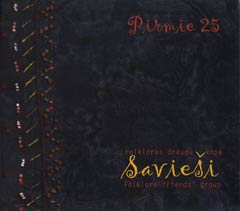
Savieši album has favorites and more treasures

Pirmie 25

When you find a compact disc with your favorite song on it—particularly when it’s a less-often heard Latvian folksong—you buy it. This is precisely what happened when I saw the CD Pirmie 25 by Latvia’s folk ensemble Savieši. Fortunately, the CD contains a number of treasures and is worth buying for more than just one song. 

Although Savieši has been in existence for a number of years, it only recently released its first CD. The recording’s 25 songs offer a wide variety musically, geographically and historically. Savieši was formed in 1980 by the now well-known ethnomusicologist Valdis Muktupāvels. The group’s mentors were Skandenieki, widely known as the grandparents of the Latvian folk movement.

Most of the songs on the CD are sung a cappella, but a few are accompanied by instruments such as kokle, trejdeksnis or a drum, and there is one instrumental dance tune, “Augškojenieku dancis.”

The first six songs are from the group’s early years. They have the simple yet pleasant sound of Latvian folk music recorded in the 1980s.

The song for which I bought the CD is “Dziedātaju māsu devu.”  I knew only three verses, but on the CD the song is five verses long. The lyrics are about the power of song—how very Latvian!

One song I have grown to love thanks to this CD is “Saule rāja mānestiņu,” which has beautiful lyrics about the sun, moon and stars, as well as a lovely harmony.

The songs that I enjoyed most were the ones which showcased the pure strength and energy of Latvian music.  One example is “Es piedzimu māmiņai,” another song about the importance of song. In this tune the men drone while the women sing the lyrics, an effective method that Savieši employs more than once for those that are considered women’s songs.

“Zīdit, zīdit, uora pļovas” is a powerful song that makes me want to quickly learn the Latgallian lyrics so that I can sing along from the depths of my lungs. The Savieši version makes it sound like there are several dozen people singing, although in reality I imagine that no more than a dozen did.

The CD contains several rather uncommon songs. One is “Kur tu teci miega pele,” a peaceful children’s lullaby. It has a “pai pai” refrain that I’d never heard and, like so many Latvian folk songs, a great little story. Two songs, “Pa vējame es dziedāju” and “Suni reja, vilki kauca,” were first collected by a member of Savieši in Lithuania in 1988. Both of these songs have melodies unlike anything one would hear among other Latvian folk songs. Another interesting song is “Gotiņ, gotiņ, lelo,” which follows few of the conventions we are used to when it comes to traditional Latvian songs.

Of course, not all Latvian songs are about happy events such as weddings or about the beauty of nature.  “Svātdin agri buoryneite” is about an orphan girl visiting her deceased mother’s grave and crying about the treatment she receives from her new stepmother. Even if one were unable to understand the lyrics, one would sense from the heartbreakingly beautiful melody that the song is not about a joyful topic.

The liner notes contain a short history of Savieši both in Latvian and Eglish. The notes also contain lyrics for each song, but unfortunately no English-language synopsis. My favorite thing is that the listings for many songs also indicate from which area of Latvia they come, and often in what year the songs were first collected. Additionally, several list the name of the person from whom the song was collected. Many Latvians are familiar with Krišjānis Barons, who collected folk songs in the late 1800s and early 1900s, yet few people know that enterprising individuals continued to collect Latvian folk songs for many years after that. This CD includes songs collected in surprising years such as 1940 and 1945, and as recently as 1988 and 1991, when members of Savieši undertook expeditions to collect folksongs in areas such as Lubāna (in Latgale, Latvia’s eastern region) and Lithuania’s Butinges Sventaja. 

The CD also contains a couple dozen photographs of Savieīi through the years. These can only be looked at by using a computer.

Overall Pirmie 25 is an excellent CD that will be enjoyed by anyone who appreciates Latvian folk music.

Details

Pirmie 25

Savieši

Savieši,  2007
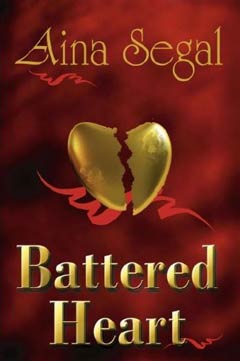
Author emerges content after life as a victim

Battered Heart

Aina Segal’s life was scarred, like that of thousands of other refugees the world over, displaced from their homeland by circumstances out of their control, compelled to start their life afresh in a new world with strange customs and little understanding of their plight. Segal was born in Latvia in 1934. After a picture-perfect childhood as an only child in a well-to-do family, World War II shattered her life into a million pieces. They needed to be put back together slowly, her psyche set back on an even keel, through the course of her later adult life in the United States. Hence the title of the book, Battered Heart. Thankfully, a heart that can be battered can also be healed.

War, it seems, affects each individual differently. Some may appear relatively unscarred, others turn to drink. Others internalise their traumas but maintain a brave exterior. Their pain is masked by the need to survive, to work and to feed their families. A sense of guilt for having survived may start to snowball. Faith in a higher being takes on a certain role in the healing process. For others a sense of apathy and clinical depression sets in, making them unable to “snap out of it.” For some, it takes a few years to regain a life and function as normal, if there is such a state. For others it takes a lifetime of soul-searching and therapy.

Segal seems to have reached a state of contentment in her life after a lifetime of anger, guilt and blame for the bad cards that Fate has dealt: dealing with a complex relationship with her mother; surviving the war; living in a Displaced Persons’ camp; starting life afresh on a different continent with no language and a completely different set of values and customs; the tragic loss of her only child, Kim, to cancer, and a string of bad relationship choices. All contributed to Segal viewing herself as a victim of circumstances, never the one who could be the one in charge.

Life took a positive turn when Aina met Norman, who was supportive like no other person had been in her life. The love and commitment of her new partner, coupled with a conversion to Judaism, her education and later career successes, close friends and a good therapist and a realisation that her connection with her horse, Minka, is an essential for her emotional well-being—all provide the stability and healing needed.

Part of Segal’s healing has been the unfolding of her career as a psychotherapist. The soul-searching required during her studies, especially a master’s degree in psychology at Queens College where two years of personal psychoanalysis was compulsory as part of the course, all set Segal on the road to accepting herself for who she is. No doubt writing Battered Heart has also been therapy in itself.

The book clearly shows the triumph of the human spirit. Every person’s life is in a constant state of flux. The onus is then on each of us to take on the challenges that are inevitable in life. The victim will always find someone else to blame and, more often than not, circumstances, fate, God—call them what you will—are responsible for our lot in life. The circumstances may be extreme, as in Aina’s case: war, displacement, loss of loved ones. No matter what the circumstance you face the defining thing is your response. Are you a victim or are you a survivor? How do you cope with the grief of a loss of a loved one, of one’s childhood, one’s homeland? How ready are you to adapt to new situations? Every person has to find their own coping mechanism, work through their own issues, often with the help of others, but ultimately by themselves, for themselves. Only then can we say we are free of the past and ready for the future and the beauty of its uncertainty.

Details

Battered Heart

Aina Segal

Sarasota, Fla.:  The Peppertree Press,  2006

ISBN 1934246069

Where to buy

Purchase Battered Heart from Amazon.com.

Note: Latvians Online receives a commission on purchases.

Daina Gross is editor of Latvians Online. An Australian-Latvian she is also a migration researcher at the University of Latvia, PhD from the University of Sussex, formerly a member of the board of the World Federation of Free Latvians, author and translator/ editor/ proofreader from Latvian into English of an eclectic mix of publications of different genres.

Violent cyberthriller takes social protest to extremes

Headcrusher

Alexander Garros and Aleksei Evdokimov, two Russian journalists working in Latvia, wrote a “cyberthriller” that in 2003 won the Russian Literary National Bestseller Prize. Headcrusher, now translated into English, provides an unsettling and at times absurd entrance into Rīga’s underbelly and leaves me wondering what I dislike most: the human garbage depicted in the book, the book itself and its authors, or myself for at times sympathizing with the book’s anti-hero, Vadim Apletaev.

The premise of the book is simple. Twenty-six-year-old Apletaev works in the public relations department of REX International Commercial Bank, billed as the largest financial institution in Latvia. A former columnist for the Russian-language SM newspaper, Apletaev has gone over to the dark side—as journalists sometimes say of PR practitioners—and it’s about to get darker fast. Apletaev appears to suffer from the particular Eastern European ennui, which he nurses with emotionless sex and by playing a first-person-shooter computer game called Headcrusher.

And then one evening in the office, after his boss Andrei Vladlenovich Voronin (a.k.a. Four-Eyes) has discovered a violent anti-bourgeois diatribe on Apletaev’s computer, Apletaev smacks him on the head with a dinosaur statue.

That first murder leads to a series of other killings, as Apletaev sinks further and further into a private hell where the real world and its human filth comes to resemble the fantasy world of Headcrusher.

Other reviews have compared Headcrusher to a Quentin Tarantino film. It certainly has its similarities, what with the linguistic and physical violence. That may be enough to turn off some readers who have little stomach for such fare. And I cannot promise those who choose to engage the novel will come away any better.

Headcrusher has also been described as a work of social protest. In the context of a post-Soviet Latvia where dirty money, dirty politics and dirty crime were (and in some cases continue to be) an accepted condition, Vadim Apletaev takes things into his own hands, not unlike Danila Bagrov, the lead character in Russian director Aleksei Balabanov’s vigilante film Brat. Both are fed up with the way things are in the place they call home. However, Apletaev is so much more twisted.

Apletaev’s solution to what he sees around him is to kill. His killing at times may seem justified, but if you find yourself sympathizing with him, be sure to do a reality check and ask if killing another human being is ever justified. More unsettling is the abandon with which he kills, as if he were playing a computer game the perpetual goal of which is to make it to the next level, rather than encountering a real world in which there is no “restart” button.

When Headcrusher first appeared, it was hailed by some critics as the next big thing in Russian literature. That may say more about the state of contemporary Russian literature than about this book. It is strong stuff, but I’m still not convinced its over-the-top nature makes it worthy of the accolades. Is make-believe violence appropriate social protest, even if it is cathartic?

If you make it through Headcrusher, be prepared to ask yourself the same questions.

Details

Headcrusher

Alexander Garros and Aleksei Evdokimov

London:  Chatto & Windus,  2005

ISBN 0-701-17757-8

Where to buy

Purchase Headcrusher from Amazon.com.

Note: Latvians Online receives a commission on purchases.

Andris Straumanis is a special correspondent for and a co-founder of Latvians Online. From 2000–2012 he was editor of the website.