Reborn, Otra puse releases career highlights

Description of image

The early 1990s were one of the brightest periods for Latvian rock and popular music. Perhaps it was the newly restored independence of Latvia, but so much creative and enduring popular music was composed during that time. The period saw the debut of standard bearers like Prāta vētra, Labvēligais tips and bet bet, as well as groups like Jumprava reaching a new artistic peak. With so much good music being released and performed, some groups unfortunately would get lost in the shuffle.

One such group is Otra puse. After the temporary breakup of Jumprava in 1992, Jumprava’s lead singer and guitarist Aigars Grāvers wanted to keep active in music performance, so he and drummer Aigars Krēsla (also of Jumprava), as well as previously unknown singer Normunds Pauniņš, keyboardist Ivars Makstnieks (formerly of Vaidava and Linga) and bassist Aldis Miodle, formed the group Otra puse.

Much like Jumprava, the group’s sound was based upon keyboards and synthesizers, with many layers of together to make deeply textured melodies and songs.

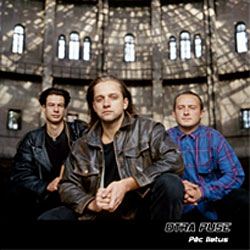
Thankfully the group has not been completely forgotten, as Pēc lietus, a collection of its best work was released in early 2007 by the recording company MAPLS. The compact disc collects all the great songs the group recorded over its more than 10 years of history. Many of the songs were only available on a long out-of-print cassette issued in the mid 1990s. Some of the songs were also included on the also out-of-print Grāvers retrospective Pret vēju pēc 90-ta. The CD includes one new song “Ieskaties.”

Otra puse had a turbulent history. Grāvers, Krēsla and Miodle departed the group in 1994. The group was then joined by Arnolds Kārklis (formerly of the Latvian-American band Akacis) on guitar and Mārtiņš Linde (later a member of Time After Time) on drums. Later the band was joined by Gints Saulītis on bass guitar. Today, Otra puse is a three-piece band made up of Pauniņš, Makstnieks and Saulītis.

One of my favorite songs by Otra puse is “Balāde par 3 saucieniem” (music by Grāvers, text by Aigars Grauba). It has almost a folk song sound to it.

The departure of musical heavyweights Grāvers and Krēsla did not affect the songwriting quality of the group. Keyboardist Makstnieks turned out to be an excellent composer in his own right, composing the music for songs such as “Dziesmiņā,” “Rīts” and “Enģelis” (all with words by frequent collaborator Ivars Kurpnieks). Pauniņš also established himself as a capable songwriter with “Dejas sapnī,” providing both words and music.

The CD booklet has all the lyrics for the songs, as well as a short biography of the group by journalist Daiga Mazvērsīte.

I am overjoyed that these songs are now collected on CD. Otra puse is one of the best groups from the 1990s. To lose these songs would have been tragic. Hopefully this will rekindle interest in the group, which is working on a new album, and it will continue to record and perform great songs.

Details

Pēc lietus

Otra puse

MAPLS,  2007

MVTT CD 020

Egils Kaljo is an American-born Latvian from the New York area . Kaljo began listening to Latvian music as soon as he was able to put a record on a record player, and still has old Bellacord 78 rpm records lying around somewhere.

Tumors tackles real-life issues in short album

Ideoti

What to say about a group that doesn’t seem to have said too much about itself? Or about a group that doesn’t seem to say too much in general? Tumors’ first album, Ideoti, runs just over 35 minutes and with it the band has made a short—but not necessarily sweet—addictive addition to the Latvian music world.

Tumors can be given many genre labels, such as “pseudo-punk rock” and “post-punk revival.”  But the members of Tumors have made a point to say that they themselves have not set those labels. They’ve also said that the band’s name doesn’t mean they endorse tumors or cancer (which is a strange point to make, however valid it may be), the quick explanation being that just as there are many kinds of tumors, so exist many different sides and facets to the group.

Tumors members Pēteris Riekstiņš (vocals, guitar), Valters Suķis (guitar), Jānis Riekstiņš (bass, back-up vocals) and Oskars Kaņeps-Kalniņš (drums, back-up vocals) started unofficially playing together in spring of 2003. Since then the band has played in many music festivals and received good reviews and a hefty fan base.

Tumors reminds me of the U.K. band Art Brut (an observation also made by a reviewer for delfi.lv). While Art Brut has more of a pop sound to it, Tumors is essentially similar. Both bands predominantly use non-singing vocals with more of a “speak-singing” vocal format. Both bands also seem to stick to topics that may be only fleeting thoughts in anyone else’s mind.

Other than that, Tumors has been compared to other Latvian groups that fall into the category of “not to be taken seriously.” At first listen Tumors really does sound like a ridiculous group. However, if you pay attention to the lyrics, you find that the band touches on several social issues and aspects. Some of the issues are culturally specific (like the name day invitation in “Bē da”), while others are universal (“Neviens”). The lyrics are incredibly normal, yet very well put together, with easy-going music as a nice addition.

The first track, “Bē da,” starts out as a general song about how the world is full of troubles, how people are plagued by troubles (bird flu, natural disasters), and how people are the ultimate plague.  Then it becomes more of a cultural issue about name days. The narrator explains how he ran into an acquaintance, who then invites him to her name day party. As a societal norm, people aren’t invited to name days, they just show up unannounced to celebrate, so as a result, the narrator’s entire day is ruined because now this person has broken the norm and expects him to show up.

The second track, “Tieši tieši,” might be my favorite song. It’s basically a song about birthday wishes, and how even though everyone wishes you the best of luck on your birthday, each person dictates whether or not he or she is lucky in life. I can’t say exactly why I like it. Maybe it’s the extreme simplicity of lines like “Eju pie Līgas uz dzimšanas dienu, bruņojies tikai ar teikumu vienu: Daudz laimes, LĪga!” (I am going to Liga’s on her birthday, armed with just one phrase: Happy birthday, Līga!).

The third track on the album, “Nauda,” may be better known as Barret Strong’s 1959 hit, “Money (That’s What I Want).” Or it may be better known as the same song covered by any number of artists. It’s just that no one’s done it in Latvian before. Even though the track is a tweaked cover, it goes along well with the overall theme of “social issues/this is reality, folks” the album seems to have.

The next two tracks, “Puisis ar pistoli” and “Kārtības sargi” take a look at a darker side of society. I welcome corrections if I’m wrong, but “Puisis ar pistoli” seems to be a kind of morbid point-of-view song about a boy who, after finding bullets for his gun, goes into town and shoots at people, not understanding why they’re afraid of the pretty bullets. “Kārtības sargi” takes a shot at policemen and how they misuse their authority.

The sixth track, “Neviens,” is not as dark as the former two, but the lyrics strike true: “No one wants to be young, No one wants to be old” and “Girls dress like women, boys act like men; Women dress like girls, men act like boys.” It’s an age-old truth that everyone can identify with.

“Putnubiedeklis,” the seventh track, is from the point of view of a scarecrow and also deals with social issues. Personally, it makes me think of the horror film Jeepers Creepers and then I don’t want to hear anymore.

The eighth and ninth tracks are a bit tongue-in-cheek. “Dogma,” like the title indicates, is about certain social rules. “Sakrāls sakars” is also like the song title suggests, a song about a minister who goes astray.

The next few tracks are again more somber, but the album finishes up with Tumors’ well-known song, “Panka nav miris” or “Panks nat ded.” The song isn’t about the punk music genre, but more an observation on the narrator’s part on how the personality or character type “punk” is still alive and well. The song is upbeat and involving, the album ends on a good note, and 35 minutes of fun have been had.

I find it interesting that such a different type of music is easily accepted. I’ll admit that the first time through the album I wasn’t sure this kind of music worked in Latvian, but Tumors does it justice.  It’s hard to explain exactly why the music is good—there’s just a general goodness about it. For people who may want to be confronted with real-life issues in a relaxed and unobtrusive manner (because who likes to be preached to?), or for people looking for something just a little bit different in the Latvian music world, Ideoti is a good place to start. It could very well be that the guys of Tumors had that in mind for themselves.

Details

Ideoti

Tumors

Raibā taureņa ieraksti,  2007

Things are going well for Double Faced Eels

Double Faced Eels

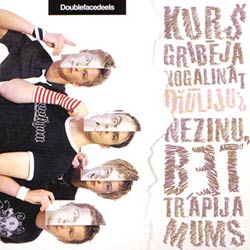
Following the successful debut album from 2005, Zilais valis (The Blue Whale), the Latvian alternative-pop group Double Faced Eels has released its second album. The new album’s title, Kurš gribēja nogalināt Džūliju? Nezinu, bet trāpija mums, roughly translates to “Who Tried to Kill Julia? Don’t Know, But We Got Hit.” The group has left its former label, Platforma Records, and has signed with the Lithuania-based company Antena.

The band also recently was nominated for a MTV Europe Music Award as Best Baltic Act. Things seem to be going well for the Eels.

The album starts off with the first single, a little pop song about a teacher named Dagmāra that has a cool effect with a scratching LP sound at the beginning and end of the track. The next song, “Radio,” is sung in English. Lead singer Mārtiņš Gailītis has received coaching for his English pronounciation and it is getting a lot better, though there’s still room for improvement. This song does rock and could be aired on any radio station outside Latvia without any problem.

“Prāts un sirds” (Mind and Heart) seems to be the serious song on the album. Guitarist Reinis Briğis really shines on this song with his haunting guitar solos. “Dārza rūķis” (Garden Gnome) is a satirical song about the political and social situation in Latvia. The lyrics to this song are not included in the album sleeve. Drummer Pauls Ķesteris shows off vocal abilities on “Salda dzīve ievārījumā” (Sweet Life), a snappy little song with honky-tonk piano and acoustic guitar. Midway through the song, Ķesteris gets messed up, but the band continues recording and the song keeps rolling along. I heard this song quite often on the radio when I was in Latvia this summer.

The title track, “Džūlija” (Julia) is next. It’s a nice song that asks the musical question, “Where is Julia, the girl who doesn’t care about anything?” Next is the MC5 classic “Kick Out the Jams” with Briğis doing a great lead vocal. His singing voice reminds me a lot of Grand Funk Railroad drummer Dom Brewer. Then follows a 21-second track called “Normunds negrib palaisties.” I think it’s Ķesteris making a lot of confusing and uncomprehendable sounds.

Two typical DFE powerpop songs follow, “Konfekte” (Candy) and “Šarmants vīrs” (Charming Man), not to be confused with The Smiths’ “This Charming Man.” Some listeners may have heard enough of DFE at this point, but if you like party music with power riffing guitars and tight drums and bass, DFE is certainly the kind of band you should be listening to.

Bassists Eduards Veinbrants takes his crack at lead vocals on “Mīlestība” (Love), which is a little sing-along song. It sounds like it was recorded at 3 a.m. after a party. Next is the beer commercial song, “Himna” (Anthem). Everbody stand up and raise your can of beer and salute!

“Kefīrs” (Kefir) is a popular and healthy dairy product in Latvia. The song is about this drink and the refrain goes “Man garšo kefīrs…bet naudas man nav” (I love kefir, but I don’t have any money).

You wonder if the Eels were looking in the crystal ball when they wrote “Dakteris” (Doctor). The song was written and recorded before Valdis Zatlers was nominated and became the new Latvian president. The chorus, “Dakteri, palīdzi Tu mums!” (Doctor, help us!) sounds like the Latvian people are pleading to the new president to help their country.

Who knows, maybe the Eels can look into the future? Let’s see if the band can win that MTV award later this fall in Munich, Germany, and perhaps 2007 will be the Year of the Eels.

Details

Kurš gribēja nogalināt Džūliju? Nezinu, bet trāpija mums

Double Faced Eels

Antena,  2007

Raitis Freimanis lives in Stockholm, Sweden, and is a founding member of the Latvian-Canadian band Skandāls.