Critic’s worst nightmare is start to mystery

Freedom

Isadora Purins, the main character in Ilze Berzins’ latest mystery, Freedom, dreams of putting a bullet into the head of the critic who ravaged her novel. If that’s a warning, so be it.

“Izzie” Purins is, like the author, a Latvian-Canadian artist and writer. She lives in rural Freedom, Maine, with her boyfriend Nick Andersons and her old Aunt Marija. Freedom is a real place, as is Belfast, the port town where some of the action takes place.

Freedom is Berzins’ eighth mystery novel. Her first book, published in 1994, was the autobiographical Happy Girl, which focused on the author’s yearlong attempt at repatriating to Latvia. Shades of her experiences in Happy Girl are found in Freedom.

Freedom starts off with the frustrated author day-dreaming about planning the murder of the critic. It is a better start to a Berzins novel than I’ve read in a while, grabbing my attention right away. Purins is angry with Roberts Kauls, a writer for The Baltic Times who has ripped her novel, Riga House. Coincidentally, the real-life Rīga-based weekly newspaper in 2005 bashed Berzins’ book, Kolka.

The next several chapters delve into the psychology of Purins, the doubts she faces and her personal history.

At the same time, Berzins piles on the characters. Besides the protagonist, her partner and her aunt, there are the neighbors, Ricky and Bonnie, whose son disappeared a while ago; psychotherapist Edith Halton; the ex-hippie Larry, Ricky’s father; the Art Student, who is stalking Purins for a film class project; the critic Kauls; Dzintra Birzgale, a caretaker from Latvia; and several others.

That’s where the novel drags a bit, a problem encountered in a few other Berzins mysteries. Berzins tries to build the plot in the first third of the book—foreshadowing some of the coming tension—but at times the development seems too abbreviated, overwhelmed perhaps by too much time being spent in the protagonist’s head. The fact that a number of chapters are very short may be part of the problem (Chapter 19, for example, is not even two complete pages of text, while Chapter 23 is just about two).

But then it gets better. Larry, the guy whose attentions Aunt M craves, takes the elderly woman on a boating excursion, falls overboard and drowns—or so it seems. As a story, Freedom takes off, adding a number of twists and getting darker in the process. Revenge and child abduction are just some of the variables introduced by Berzins.

Like several other Berzins books, the close is a bit abrupt. Resolution is important in any novel, but the end of Freedom leaves a few questions unanswered. To raise them here would give away the story, so the reader will have to judge for themselves. I would have preferred Berzins to provide some deeper exploration of motive, delving more into the darkness of certain characters. However, I do like how the very last sentences on the very last page add just one more twist.

In reviews of earlier works, I have criticized Berzins’ books for a lack of proofreading. Happily, Freedom is free of the typographical errors that in past dogged her stories. The Baltic Times, in its review of Kolka, picked on too many “wearisome references to God,” as in “Oh for God’s sake.” While reading Freedom, I looked up that review and immediately wished I had not, because the similar “wearisome” references suddenly seemed to jump off page after page. But perhaps Berzins meant to do that. In any case, if the character of Izzie overuses references to God as part of her exclamations, that is part of her nature.

Freedom, despite its rough spots, is a good read. Those familiar with Berzins’ ethnic mysteries should enjoy it.

Details

Freedom

Ilze Berzins

Ottawa, Canada:  Albert Street Press,  2007

ISBN 978-0-9686502-8-8

On the Web

Ilze Berzins

Latvian-Canadian author Ilze Berzins’ Web site has information about all her books. EN

Andris Straumanis is a special correspondent for and a co-founder of Latvians Online. From 2000–2012 he was editor of the website.

Labvēlīgais Tips tells a tale on latest CD

Svīres tango

Many people attending the 2003 Latvian Song Festival in Rīga noted that the Youth Concert was one of the highlights. Many of Latvia’s youth choirs joined together to sing both recent and not-so-recent popular songs arranged for choir voices. However, one glaring omission I noted in the repertoire was the complete absence of any songs by Latvian group Labvēlīgais Tips. How could that be? One of the country’s most popular groups was completely ignored. Miscarriage of justice, I say. Was there truly no room for “Alumīnijas cūka,” “Omnibuss” or “Džins ar toniku” in the concert?

Much to my surprise, during this year’s song festival Labvēlīgais Tips will get a whole performance of its own as part of one of the shows. On July 8, the band (along with other groups, not to mention 2,300 dancers) will play at a dance performance. The group has recorded an album particularly for this event, 2007’s Svīres tango. Remarkably, this is the band’s ninth studio album—and 12th overall—since 1995. No other major group in Latvia has been as prolific.

Topping the band’s 2006 album, Naukšēnu disko, would be difficult. It was an album I thought to be just about the best stuff Labvēlīgais Tips had ever done. Wisely, the group decidedly to vary things slightly in its songwriting and performance, and the resulting album yet again proves why this long-running band is so consistently good at what it does.

The 2007 lineup includes Andris Freidenfelds (vocals), Normunds Jakušonoks (keyboards, vocals), Ģirts Lūsis (guitar), Ainis Zavackis (drums), Pēteris Liepiņš (bass), Artūrs Kutepovs (guitar), Kaspars Tīmanis (trombone) and Oskars Ozoliņš (trumpet, replacing the recently departed Andrejs Ābelīte).

Svīres tango is slightly unusual in that it is a “concept” album. From beginning to end, the album tells a story about a young man who, tired of life in the countryside of Latvia, comes to the big city (Rīga) looking for work and adventure. He runs into a bit of trouble in the capital, meets some questionable characters and, in the end, realizes that—as always—“there’s no place like home.”

The story begins on a train—documented in the Latin-tinged song “Pa sliedēm”—as the young man, yearning for life beyond the countryside, heads to Rīga looking for fortune.  In the march-like “Nevienam es tās Rīgas neatdošu,” he is much impressed by the city, though there is much to be wary of, but still he doesn’t want to trade life in Riga for anything. Of course, he needs to find a job, a theme addressed in “Kurš neko nedara,” which features lead vocals by Jakušonoks. (Jakušonoks, who also sings lead on “Jaunekļa sirds,” joined Tīmanis as part of the sextet Bonaparti.lv, which represented Latvia in the 2007 Eurovision Song Contest with the Italian song “Questa notte.”)

There is also a students’ drinking song, “Mīļumiņ, nāc padzert ūdentiņ,’” and, of course, this water also has malt, hops and yeast along with it. As in most every other big city, there are other temptations to distract the young hero, such as the ladies sung about in “Jaunekļa sirds” and the “Naktstauriņu pilsēta,” sung from the perspective of the ladies themselves.

Pop singer Ance Krauze is featured on the title track, “Svīres tango,” as well as the song “Pavediens,” where she reminds the young man that true happiness awaits him at home.

The only real criticism of the album is that it is very short, just barely over 30 minutes. I know some consumers grumble about having to pay full price for a shorter-than-usual album, but if the quality is good (like Svīres tango) I don’t mind so much. The liner notes could be better, though: no lyrics, no photos, not much of anything really besides the song listing and the group members.

Labvēlīgais Tips is on a roll, releasing yet another album of catchy songs full of subtle (and not so subtle) humor. To dismiss the band as being jokesters would be to miss the bigger picture of what the band is all about. Svīres tango features the band showing a slightly more serious side, but still staying true to its whimsical and satirical roots. I, for one, will be picking up tickets to the show on July 8 as soon as they are available.

Details

Svīres tango

Labvēlīgais Tips

MICREC,  2007

MRCD 362

Where to buy

Purchase Svīres tango from BalticShop.

Note: Latvians Online receives a commission on purchases.

Egils Kaljo is an American-born Latvian from the New York area . Kaljo began listening to Latvian music as soon as he was able to put a record on a record player, and still has old Bellacord 78 rpm records lying around somewhere.

Radio choir reveals Vasks’ skills with sacred music

Pater Noster

Perhaps the best known modern Latvian composer is Pēteris Vasks. His name is often mentioned with other classical luminaries such as Estonia’s Arvo Pärt and Poland’s Henryk Mikołaj Górecki. His compositions have been performed and recorded by well-known ensembles such as the Kronos Quartet and Kremerata Baltica. He also has been awarded the Latvian Great Music Award three times—in 1993, 199, and 2000.

The term “modern classical music” may bring to mind dissonant, noisy, almost unlistenable compositions. Sure, there is plenty of that today, but I think one of the many reasons Vasks is the most famous Latvian composer in the world today is that he transcends all of the stereotypes about modern classical music. Certainly there are works of his that some may call “difficult to listen to,” not to mention “really depressing,” but that might be because so many of his works are deeply emotional and—unsurprisingly, as he is the son of a minister—intensely spiritual.

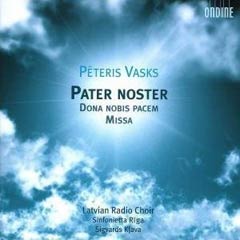
One field that Vasks particularly excels in is compositions of a sacred nature. An excellent example of this is Pater Noster, the 2007 compact disc of sacred choir music released by the Finnish record company Ondine. The CD contains the Vasks sacred works “Pater Noster,” “Dona Nobis Pacem” and the five-movement “Missa.” All the works are performed by the distinguished Latvian Radio Choir conducted by Sigvards Kļava. The Radio Choir is backed up by the orchestra Sinfonietta Riga.

The Latvian Radio Choir was founded in 1940 and is considered one of the best choirs in Latvia, which quite something, considering how many hundreds of choirs there are in Latvia. The choir has won the Latvian Great Music Award four times (1994, 2000, 2004 and 2005) and has won other awards all over the world. Sinfonietta Riga was founded in 2006, and is directed by the conductor and oboist Normunds Šnē.

The liner notes include the original Latin texts of the works, as well as English translations. Also contained is a revealing interview with Vasks about these works conducted by Ināra Jakubone of the Latvian Music Information Centre. Helpfully, the interview is translated into English, German, French and Finnish.

The work “Pater Noster” is quiet and sincere (it is a prayer, after all), not to mention very mature. It is a work that Vasks has said he believed he could only compose properly after he had matured as a composer. And, of course, there is the fact that during Soviet rule sacred music was frowned upon, so the work was composed in 1991, at the time of the renewal of Latvian independence.

“Dona Nobis Pacem” has only three words in it, so it is a particularly difficult task to compose a work that only repeats these words. Interestingly, with sacred works Vasks moves away from a more modern, experimental sound, to what the liner notes call “as traditional as traditional can be.” Vasks himself says these works contain “simple, honest sounds.” Such is “Dona Nobis Pacem,” a work that is absorbing through its 14 minutes.

“Missa” is a large form work of five movements: “Kyrie Eleison,” “Gloria,” “Sanctus,” “Benedictus” and “Agnus Dei.” This is actually the third version of the mass, as it was originally an a capella work, then revised for organ and choir. The most recent (and, as per Vasks, the final) revision is the one on the CD. It is for choir and orchestra. One can see why there will be no further revisions, as the strings work truly elevate this work, from the playfulness of the “Sanctus” to the piety of the “Benedictus.”

This collection of religious works is yet another testament to the power of the music of Vasks. From the subtle to the dramatic, always full of emotion, and with deep spirituality pervading all of the works, listening to this CD is a moving experience. It is an engrossing spiritual journey, made possible by the world class singing of the Latvian Radio Choir, as well as the clarity and sincerity of Sinfonietta Riga, reinforcing Vasks’ place among the greatest modern composers.

Details

Pater Noster

Pēteris Vasks

Ondine,  2007

ODE 1106-2

Where to buy

Purchase Pater Noster from Amazon.com.

Note: Latvians Online receives a commission on purchases.

Egils Kaljo is an American-born Latvian from the New York area . Kaljo began listening to Latvian music as soon as he was able to put a record on a record player, and still has old Bellacord 78 rpm records lying around somewhere.