Searching for family history online

By unveiling the online service Raduraksti in December, the Latvian State Historical Archives (Latvijas Valsts vēstures arhīvs) has put a smile on many peoples’ faces. For various archive users—from professional researchers to amateur genealogists—this new service will make researching family histories much easier.

It will no longer be necessary to physically turn up on the archives’ doorstep to access some of the records. Admittedly only a small percentage of records are online so far, but by the end of 2008 the plan is to have all church records of all denominations digitalized. Headway also is expected on making available census data from 18th and 19th century tsarist Russia (which Latvia was a part of intermittently). So far on offer are Lutheran church records dating back to the middle of the 18th century, searchable by region or congregation. Available records only go forward in time as far as 1905.

The records contain a register of births and baptisms, including the names of parents and their profession, godparents’ details and name of the person who performed the baptism. Also available is a register of confirmations, engagement announcements, marriages and deaths.

You will be required to register as a user of this online service. Having reached the digitalized records, you will find that they are usually handwritten in German (using the old German orthography) or in Russian. Although you can zoom in to try to make more sense of the text, bear in mind that by increasing the size of the text you lose resolution and the text will become distorted. Deciphering the records may be tedious and time consuming.

The Latvian project was inspired by the Estonian Saaga service launched in 2005 by the Estonian Historical Archives. All Lutheran and Russian Orthodox church records from Estonia, as well as other documents, are available online.

Various other places provide tips and offer access to information regarding Latvian genealogy. One such site is the Ciltskoks blog, where an enthusiast shares his tips (in Latvian only) on searching the Web for specific Latvian genealogy sites.

Meanwhile, ciltskoks.lv provides an online tool to create your own family tree, complete with a photo and video gallery, a calendar and a travelogue section. You will need to register before you can use the site, but click on “Kas ir ‘boon’?” for a preview of what the site offers.

Also worth a mention is Roots=Saknes. The site was originally started in 1993 by Bruno Martuzāns at LATNET (the Latvian Academic Computer Network). Having received numerous requests for help from all over the world, and not being able to reply to many of them initially, he decided to set up a Web site that would at least point people in the right direction and contain tips on how to go about researching genealogy in Latvia. The site is in English and doesn’t look that flashy, but it is very helpful. 

Don’t forget the Latvians Online Looking for Friends and Relatives Forum where some of our helpful members also have a wealth of genealogy information to share with others.
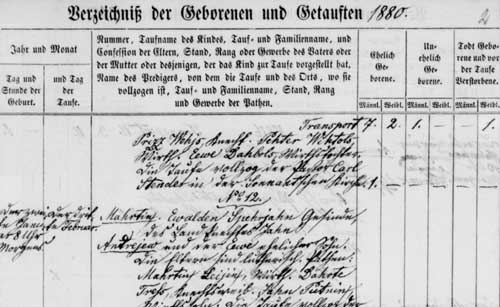
Raduraksti

The Raduraksti site created by the Latvian State Historical Archives allows users to peruse church records, such as this one from Sunākste, to find information about genealogy.
Details

Daina Gross is editor of Latvians Online. An Australian-Latvian she is also a migration researcher at the University of Latvia, PhD from the University of Sussex, formerly a member of the board of the World Federation of Free Latvians, author and translator/ editor/ proofreader from Latvian into English of an eclectic mix of publications of different genres.

Sudraba shows why Latvians are great musicians

Ex animo

One source of continual amazement about life in Latvia is that most every town has a music school. Any student, should they so desire, can spend time learning about music and playing instruments. Unlike my experience growing up in the United States, when music education in public school was limited to less than an hour per day playing in band, Latvian kids, if they choose to, can spend multiple hours per day in music school. Though this is perhaps not the most practical use of their time, it does ensure that the musicians of Latvia are of a world-class level. It may not be good for the Latvian economy to have a nation of starving musicians, but it sure does make for a nice soundtrack.

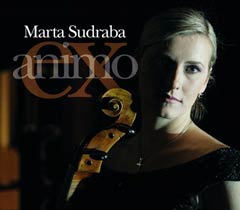
Latvia-born violinist Gidon Kremer has long been aware of this. He formed the Kremerata Balica chamber orchestra in 1997, featuring young musicians from Estonia, Latvia and Lithuania. One of the key musicians in the group has been cellist Marta Sudraba, who has been with the group since its founding. Educated at the Latvian Academy of Music and the Guildhall School of Music and Drama in London, her playing has been one of the cornerstones of Kremerata Baltica. The record label Upe tuviem un tāliem, in its quest to spotlight talented young Latvian musicians, last year released Ex animo, a compact disc of chamber music works featuring Sudraba.

Sudraba is joined by pianist Ventis Zilberts on the CD, as they tackle the classic (Beethoven), the impressionistic (Debussy), Russian (Shostakovich) and Latvian (Vasks).

The Beethoven work is the Seven Variations on “Bei Männern, welche Liebe fühlen” (from “Die Zauberflöte) for cello and piano. I’ve always thought Beethoven was one of the most difficult composers to perform because so very many musicians have performed his work, making it difficult to stand out. However, Sudraba ably takes on this work. The original song is about love and is meant to be charming and playful, and Sudraba and Zilberts approach it with the necessary lightness to make the variations a joy to listen to.

Dmitri Shostokovich is represented by the “Sonata in D Minor for Cello and Piano.” Shostakovich, a 20th century Russian composer, often ran into trouble with the Soviet government, but is considered one of the greatest composers of that era. The sonata has a broad emotional range. As Sudaraba says in the liner notes, it displays “seriousness and craziness, mourning and sarcasm and light humor.” Deftly navigating the varied emotions, Sudraba brings out all the nuances of the work.

Modern Latvian classical music is represented by its most famous composes, Pēteris Vasks, and his work for solo cello, “Grāmata čellam.” This is another work of a very heavy emotional weight, as Vasks’ music can be very difficult and somber. Range again here is key. The first part of the work is fortissimo, and the second and final part is pianissimo, so the artist must be able to perform both the loud and the quiet, and give each part its own individual life. Especially in the fortissimo, Sudraba gives the work the urgency and tension expected. No less tense is the more melodic and subtle pianissimo, which also features Sudraba singing a simple melody over the sound of the cello.

To close out the CD, a work by the French impressionist composer Claude Debussy, the “Cello Sonata,” is included. Sudraba captures the very French charm of this work from the final years of Debussy’s life.

The packaging is excellent. Liner notes are in both Latvian and English and include short biographies of Sudraba and pianist Zilberts, as well as some discussion of the works contained on the CD. Upe tuviem un tāliem has once again done an excellent job in presenting a distinguished young Latvian artist. The CD highlights a truly gifted cellist, performing works of several different eras and styles, and is yet another document that shows why Latvian musicians are considered some of the best in the world.

Details

Ex animo

Marta Sudraba

Upe tuviem un tāliem,  2007

Upe TT 025

Where to buy

Purchase Ex animo from BalticMall.

Note: Latvians Online receives a commission on purchases.

Egils Kaljo is an American-born Latvian from the New York area . Kaljo began listening to Latvian music as soon as he was able to put a record on a record player, and still has old Bellacord 78 rpm records lying around somewhere.

Mednis and Kīns take flight with first album

Lidojums

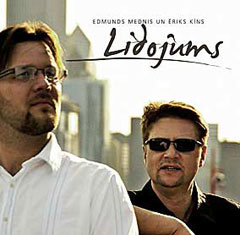
The very fact that there still remains interest in Latvian music in North America is rather remarkable. The “glory days” of groups like Čikāgas piecīši and Trīs no Pārdaugavas, bands that could fill Latvian centers to bursting, has long since passed. However, Latvian music has remained a fixture at Latvian events—not just at song festivals but other events as well. Two musicians who have been keeping the flame alive are Edmunds Mednis and Ēriks Kīns.

Mednis, as readers might already know, was a longtime member of the popular Latvian šlāger group Bumerangs, playing drums and singing, as well as composing a number of the band’s most popular songs. Mednis, though born in Latvia, has been living in the United States since 1999. Ēriks Kīns, from the Chicago area, performed in such groups such as the Minnow Buckets and Adam Zahl. Mednis joined Adam Zahl in 2004 and in 2006 the duo branched out to work on their own material.

At Bumerangs’ 20th anniversary concert in Rīga on March 4, 2006, the duo appeared via video to perform their new song “Putni” (Birds). From there, the song became a major hit in Latvia, and the duo began work on a full length album, Lidojums, which was released this summer. On the record, Mednis no longer plays the drums, but sings and plays guitar and keyboards, while Kīns sings and plays guitars. They are joined by other musicians, including Artūrs Rūsis on guest vocals, Juris Skrajāns on guitars, Eduards Glotovs on bass and Vilnis Krieviņš on drums. The group has become popular enough that it was able to give a concert tour in Latvia this summer.

Listening to the record, one can understand why Mednis and Kīns have become so popular. Building on Mednis’ work with Bumerangs, as well as Kīns’ work with Adam Zahl, the group has recorded an album full of catchy and memorable songs. On their profile on the networking Web site draugiem.lv they describe themselves as “alt country.” Mednis’ vocals and the harmonies with Kīns give their music more than just a passing resemblance to Bumerangs—but this is a positive thing, as Bumerangs is far and away among the best of the legion of šlāger or country groups in Latvia.

Mednis is also a very talented songwriter, composing some of Bumerangs’ most popular songs, such as “Deju zāle,” “Klaidonis” and “Mazais ceļinieks.” He shows no sign of slowing down, as mega-hit “Putni” is also by his pen, as are songs like “Lidojums” and “Tevis man nav par daudz.”

Kīns also has a talent for songwriting. His tracks on Lidojums include “Kā tas var būt?” and two songs that had originally appeared on Adam Zahl’s Pirmā plate album: “Acu spēles” and “Iesim peldēties!”. There is also “Vaimanas,” a Latvian version (text by Kīns) of the song “Valentine” by alt country group Old 97’s.

To my knowledge, no other “new” Latvian group based in the United States has had a full album released in Latvia. The fact that Latvia’s largest music label, MICREC, has released their album is just another indication of the duo’s talent and hard work. With many catchy songs and soaring harmonies, Mednis and Kīns have a rare chemistry that shines through all the songs on Lidojums. This is one flight well worth taking.

Details

Lidojums

Mednis un Kīns

MICREC,  2007

MRCD 358

Where to buy

Purchase Lidojums from BalticShop.

Note: Latvians Online receives a commission on purchases.

Egils Kaljo is an American-born Latvian from the New York area . Kaljo began listening to Latvian music as soon as he was able to put a record on a record player, and still has old Bellacord 78 rpm records lying around somewhere.