Voice, saxophone combine on unusual recording

Duende

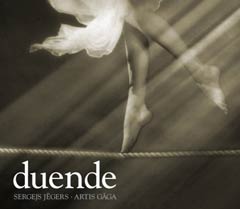
Continuing to showcase talented young artists, in 2007 record label Upe tuviem un tāliem released Duende, a collection of duets between countertenor Sergejs Jēgers and saxophonist Artis Gāga. The collaboration is unusual as it is just voice and saxophone—no orchestra, no piano, nothing besides the two musicians themselves (though one song does feature a tambourine). Can just two musicians, who are limited to playing one note at any given time (so there are not even any chords on this compact disc), engage the listener throughout the length of the album?

Jēgers has achieved much in a very short period of time. According to his Web site, he has given solo performances at the Latvian National Opera and has performed the role of the Angel in A. Rubinstein’s opera “The Demon,” as well as roles in other operas. His first solo CD, Ave Musica (2006), was a collection of sacred baroque songs. The album won the 2006 Latvian Music Recording Award for Best Debut.

Saxophonist, composer and arranger Gāga has performed with many different ensembles in a variety of styles. He has given concerts with various orchestras, including the Latvian National Symphony Orchestra, the Latvian National Opera Orchestra and other orchestras internationally. He has also performed with New Age group Kopējā izteiksme on its 2000 CD Putni maina virzienu. Earlier this year, he picked up three Latvian Music Recording Awards for 2007, including Best Debut Album and Best Instrumental, Film, or Theater Music Album for his solo CD, Mūzikālās impresijas: Zīmējumi debesīs.

Duende was recorded at the Sesava Lutheran Church, which, as the liner notes indicate, has excellent acoustics (proven admirably by this recording). Most of the songs on Duende are by French composers and, much like the songs on Ave Musica, are of a sacred nature. We get a performance of “Pie Jesu” from Gabriel Fauré’s “Requiem.” There are also two “Ave Marias” by Camille Saint-Saëns, not to mention “Amarilli, Mia Bella” by early Italian baroque composer Giulio Caccini. The CD also features the duo’s interpretation of the old French standard “Placer D’Amor” (elsewhere titled as “Plaisir d’amour”) by Jean Paul Martini.

The booklet features plenty of photos of the artists, as well as some philosophical musings by Latvian writers, and we also discover that the term “duende” is taken from Spanish poet Federico Garcia Lorca. I would not have minded if the recording company had dropped some of the deep thoughts and replaced them with perhaps a bit more information about how these two artists came to collaborate and their own thoughts on the collaboration. The liner notes are in Latvian and in English.

Though an unusual pair, the countertenor Jēgers and saxophonist Gāga have made one of the most interesting and absorbing recordings in recent memory. To answer the question from before, yes, these two artists, with just voice and saxophone, make for compelling listening. The melodies effortlessly flow between voice and saxophone, complementing each other with beautiful textures and deep emotions. The jury of the Latvian Music Recording Awards agreed and awarded the CD the Best Academic Music Award of 2007, acknowledging and rewarding the performance and talents of these two exceptional musicians.

Details

Duende

Sergejs Jēgers and Artis Gāga

Upe tuviem un tāliem,  2007

UPE TT 030

On the Web

Artis Gāga

Hear samples of Artis Gāga’s music, read about his life, learn about his concerts and recordings on this official Web site. EN LV

Kontrtenors Sergejs Jēgers

Sergejs Jēgers’ Web site includes his biography and information about his repertoire, recordings and foundation. LV
Egils Kaljo is an American-born Latvian from the New York area . Kaljo began listening to Latvian music as soon as he was able to put a record on a record player, and still has old Bellacord 78 rpm records lying around somewhere.

Daksis, still strange, grows on reviewer

Imants Daksis

He’s done it again. Imants Daksis has released another album in less than a year’s time. If his previous album was my curious introduction to Daksis, then with this album—titled Vēl nedzimušas reliģijas templī (In the Temple of a Still Unborn Religion)—he’s kind of beginning to grow on me. He’s still a strange one, though.

Take, for instance, the compact disc release concert he gave last fall at the Rīga Circus. At the performance-art-like event he treated the audience to a unique “song”: a 5-minute yell and variations thereof, all the while possessed by a tearful stare into a super-bright spotlight. Despite the location of the concert and the inclusion in it of mimes, acrobats and a llama, only the very last track on the CD hints of the circus.

Daksis’ first song, “Meitene no Antarktīdas,” greets us with a charming text about (at least superficially) pen pals from opposite sides of the world. The second song is a conversation with a bee that compares our existence to honey. Musically the two songs—both featuring an acoustic guitar—sound almost identical and are quite pleasant, but not half as charismatic as Daksis is live. The third song, “Lodes,” is basically a more intense variation on the first two. One begins to wonder whether Daksis has gotten into a rut. Does the mood and sound finally change with the fourth song? Not really. The melody is different, the guitar has switched to arpeggios and the bass has quieted down. But the mood is more of the same: windy, dark, brooding and intense. The theme of the song—“Vientuļš bērns” (Lonely Child)—fits right in.

“Gaismas dievs” finally provides a welcome musical change. It begins on a lighter note, albeit in a mostly minor key, but eventually turns typically intense. The refrain is catchy, though. “Lido!” is a short song full of the interplay between minor and major keys that Daksis is so fond of. It is followed by “Pasaules bērni” (Children of the World) and then a fluid and serene song titled “Pļava” (The Meadow), but again Daksis imperceptibly morphs into a passionate climax before leaving the meadow behind.

Parts of “Puisēns no Tibetas”—a song dedicated to Tibet—sound like spoken poetry. In fact, many of Daksis’ songs don’t have much of a recognizable melody but sound rather like poetry put to music, which, I suppose, they are. In addition, his poetry often does not follow a set poetic meter and therefore doesn’t always fit the musical lines, either. The result is, well, just plain Daksis’ style. The experimental radio sounds of “Antarktīda” run into the last song, “Šūpolēs.” Circus horns and bells in the background provide the listener with a smile at the end of the disc, and maybe even a feeling of guarded optimism.

Daksis’ main instrument is the acoustic guitar. His style is clear, sharp and distinct, with prominent and repetitive, though not over-powering, bass lines. This CD also contains plenty of electronic effects, echoes, random noises and the like. Even more distinctive of this artist are his two voices: one is the rich, dramatic, intense, sometimes even comically operatic voice of Daksis the Extrovert, while the other voice is of the folksy introvert.

Daksis’ style stays more or less the same throughout the recording. A 7-year-old’s comment after the circus concert: “I liked how he sang, but it got kind of boring after a while.” Likewise, his style has not changed too much from his previous works. So, if you’ve liked his earlier recordings, then by all means buy this disc and support one of the few characters in Latvian alternative music to reportedly make his living solely from his music. Daksis is an odd, philosophical guy and much of his music’s essence lies in his lyrics. Personally, I have a hard time getting into the lyrics, much less understanding them, but I quite enjoy his music.

Details

Vēl nedzimušas reliģijas templī

Imants Daksis

Lauska,  2007

CD16

On the Web

Imants Daksis

The singer-songwriter’s official Web site. EN LV RU

Compilation captures musical spirit of the Reawakening

Tautas laiks

It is about time someone released a compilation album of the songs that were most significant and popular during the “Singing Revolution.” These songs of the late 1980s and early 1990s inspired and awoke long dormant thoughts in many listeners, both in and beyond Latvia. As a teenager in the United States who had never been to Latvia, when I heard the song “…pie laika” by Remix and its final exhortation “Brīvību tēvzemei – pieprasām!” (Freedom for the fatherland – we demand it!) I realized something big was happening.

And it wasn’t just in that one song. So very many songs of the period dealt with the Reawakening and a yearning for independence. Most all of the songs on the compilation records Mikrofons 88 and Mikrofons 89 dealt with this very theme. Though multiple factors led to the return of Latvia’s independence, one cannot deny the power of song in these events and their effect on what transpired.

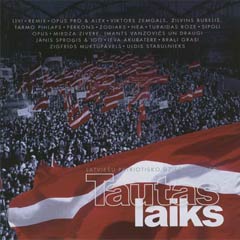
In 2007, MICREC released the compact disc Latviešu patriotisko dziesmu izlase: Tautas laiks, a collection of the songs of the era (plus a few older songs) that played a part in the “Singing Revolution.” Most all of the hits of that time are here: the aforementioned “…pie laika” by Remix; the Pērkons song dedicated to the nascent Latvian green movement, “Zaļā dziesma”; two songs, “Manai tautai” and “Lūgšana,” by Ieva Akurātere, who was the “voice” of the Reawakening; and “Taisnība” by Zodiaks. Older songs included are “Tik un tā” by Uldis Stabulnieks and “Vairogi” by Līvi. The Stabulnieks song, with lyrics by Māra Zālīte, dates from 1980 and is perhaps one of the first to express an unabashed patriotism and love for Latvia. The Līvi song was first recorded in 1972, but the version on this CD is the re-recorded 2002 version.

Most of these songs have been released and re-released a number of times, but what makes this particular collection a true treasure is a number of songs that, to my knowledge, have never been released on CD (and if they have, they are not readily available). These include songs like “Daugaviņa” by the group Sīpoli, “Senā kalpu dziesma” by Opus and “Veltijums LTF (Latvijas Tautas Frontei)” performed by NEA. A particularly pleasant surprise was the inclusion of “Zeme, zeme, kas tā zeme” by Brāļi Grāši of Germany. Rarely do these compilations include songs by diaspora Latvian groups. Interestingly, this song’s melody is based on the Jewish song “Dona dona” by Aaron Zeitlin and Shalom Secunda.

Some songs have not aged particularly well. For example, “Atmostas Baltija” is a song that repeats its verse and chorus in Latvian, Lithuanian and Estonian by, respectively, singers Viktors Zemgals, Žilvins Bubelis and Tarmo Pihlaps. Though certainly an admirable display of unity, the novelty of the song wears off quickly. There is also the less than subtle “Brīvību Baltijai!” from Opus Pro, which bludgeons the listener with its message. Or “Ai, māsa Lietuva” by Turaidas Roze, which repeats the title of the song way too many times. Contrast those with the song “Tautas laiks” (music by Jānis Lūsēns, lyrics by Imants Ziedonis), performed by Zigfrīds Muktupāvels. It still gives me the shivers whenever I hear it.

No collection of songs will ever satisfy everyone, but I would have dropped some of the previously mentioned songs and found a place for “Mēs pārtiekām viens no otra” by Pērkons (the most popular song in Latvia in 1989), as well as other songs that, to my knowledge, have not yet been released on CD, such as “Līdz palodai” by Zodiaks and Akacis or “Putnu ceļš” by Jumis, both from Mikrofons 89. And I would have added more diaspora songs, such as “Par mani, draudziņ, nebēdā” or “Pazudušais dēls” by Čikāgas piecīši.

Unfortunately, one particularly disappointing aspect of this collection is, as always, the packaging. There are a few pictures from that time, as well as an all-too-short essay by lyricist and musician Guntars Račs. Though certainly one could write a dissertation about the Reawakening (and plenty have been written), this is truly a missed opportunity to give newer listeners an understanding of what happened during that time and why these songs were so special. A younger listener, especially one not born before the Reawakening, will not get a full historical picture of what went on. So much more could have been written. Why not ask major figures of that era, such as Ieva Akurātere or Imants Kalniņš, to write a few thoughts and impressions? That would make for some fascinating reading for both young and old.

In any case, Tautas laiks is an essential collection of songs from the 1980s and early 1990s, particularly since it contains many songs not available elsewhere. Packaging deficiencies aside, I recommend this highly, not just as a collection of great songs, but as a historical musical overview of that period of time—a time of unprecedented unity in Latvia, and as a harbinger of what was soon to come.

Details

Latviešu patriotisko dziesmu izlase: Tautas laiks

Various artists

MICREC,  2007

MRCD 365

Where to buy

Purchase Latviešu patriotisko dziesmu izlase: Tautas laiks from BalticShop.

Note: Latvians Online receives a commission on purchases.

Egils Kaljo is an American-born Latvian from the New York area . Kaljo began listening to Latvian music as soon as he was able to put a record on a record player, and still has old Bellacord 78 rpm records lying around somewhere.