Cosmos breaks out of the box into turbulence

Turbulence

On the evening of May 4, my friends and I stumbled out of the Latvian National Opera in a silent stupor. We had just seen six-man a capella group Cosmos give a two-hour performance showcasing the new album, Turbulence. And I, for one, felt like I had just been explained quantum theory and had actually understood every word. I therefore had little objection (or choice) when, on the following Tuesday, my friend grabbed me and shook me like a rag doll outside of the Randoms music store in Rīga saying “Gasp! Cosmos! New CD!”, and steered me through the shop doors. I had the album set on loop for the entire next week.

Though Turbulence only hit shelves April 16, the tracks have been available online for preview and purchase since the beginning of April. The group’s last compact disc was released in 2005. However, in complete contrast to its previous work, Cosmos has stepped out of the standardized a capella box and done something quite uncharacteristic: The group put together a collection of almost 100 percent original material. 

Cosmos is Jānis Šipkēvics (countertenor), Andris Sējāns (countertenor), Juris Lisenko (tenor), Jānis Ozols (baritone), Jānis Strazdiņš (bass) and Reinis Sējāns (vocals, rhythm). The group’s beginning can be traced back to 2002. Cosmos is well known for its renditions of pretty much any pop song, its Christmas album and cutesy Latvian theatre pop. Among other accomplishments and victories, the group in 2004 won the international “New Wave” competition for young singers of popular music and in 2006 represented Latvia in the Eurovision Song Contest.

The album, apparently stemming from turbulence in the individual lives of the group members, does anything but make you reach for the nearest sick bag. If you’ve been following Cosmos since Day 1 and are comfortable with it being just another great a capella group, be prepared to step out of the box yourself. The guys have put their vocal skills to a whole new use. Literally something people of all ages and walks of life can enjoy, Turbulence is a mish-mash of subgenres, all squeezed under a single roof called a capella. Don’t pack up your fan bags and run just yet. It’s worth sticking around to see what they can do.

The first track of the album, “Aptieka” (Pharmacy), is an airy, upbeat song accompanied by thematic pen scratching and bottle tinking. I can’t say that the song immediately draws you into the album, but because it moves so fast, it prevents you from becoming immediately bored. Otherwise, there is really nothing wrong with the track: It’s a whirlwind of catchy, simple sounds and manages to be simultaneously pro-love and anti-“medicated nation.”

The second track, “Maskava” (Moscow), should have been the first. I’ve heard some people say it’s “the song” of the album. It’s a picturesque, haunting composition that lulls you into an almost familiar feeling and seems more appropriately a capella than most of the other tracks on the album because it has a more “classic” feel to it. The subject matter of the song, as well as its sound, is a contrast to the previous track.

If you’ve regained a sense of Cosmos’ genre, “Parasta/neparasta diena” (An Ordinary/Unusual Day) will freak you out. This track is the epitome of experimentation. It starts out slowly and gradually builds up, kind of like a spring storm. At 3:42, the song breaks loose, working into a frenzy led by Reinis Sējāns’ beat box skills. Think the song uses synthesizers? Listen closely and you can hear the guys taking breaths between the crazy sound effects. Then the storm dies down again, reaching an almost lethargic state. I’m confused as to why the song starts out with a short spoken introduction in Latvian and then switches to English later on, but I guess turbulence is as turbulence does. I don’t dislike it, but as one of the stranger tracks, “Parasta/neparasta diena” definitely takes some getting used to.

The fourth track, “Vindo”, is one of my favorites from the album. I can always go for some good tribal or folk stuff. “Vindo” takes yet another turn from stereotypical a capella and adds one more subgenre to the album’s makeup. The song would be perfect for yet another Lion King film if, God forbid, Disney decided to make one. It starts out with a Jew’s harp (bad for your teeth, great for your music) and heads into a repetitive chant. More rhythm effects are put to good use here and the style of singing makes you want to stand on a mountaintop and shout at the top of your lungs, but in a good way. If anything, this one merits turning up the bass.

Ah, yes, Track 5. “Tu kā, es kā” (You’re Like, I’m Like), is a new a capella-born bubble-pop love anthem, so to speak. It’s the simplest song on the album and by far the people’s favorite. The extensive list comparing the narrator to his sweetheart isn’t the slightest bit annoying or boring, as there are normal comparisons—“Tu kā dāma, es kā kungs” (“You’re the lady, I’m the gentleman”)—to more unusual ones—“Tu kā auzas, es kā kombains” (“You’re the oats, I’m the combine”). Toward the end of the track, verbal dexterity is tested as the music speeds up for two increasingly faster re-caps of the list. Another nice aspect of the song is that it gives each Cosmos member a solo, the final items being sung by Strazdiņš, whose voice gets to your bones. However, for as simple as the song seems, the similes hold deeper meaning than may initially appear; there are things that physically fit together and things that conceptually fit together. Simple, deep, endearing, humorous and it rhymes? You might as well make it your new ringtone.

Although Track 6, “Trejdeviņi slepens” (Infinitely Mysterious) is my favorite song on the album, it’s worth mentioning that there is a one-and-a-half minute intro of anti-climactic vocal effects. It’s not until the effects are paired with the melody that they cause some goose bumps. In addition to really liking the beat of the song, the main reason why I adore it is that it screams old-time Latvian folk tales.

…sirmais bārdainis ar platu smaidu sejā
runāja mazliet.
Tik ogļu melns un trejdeviņi slepens
bij’ vīra stāsts.
To visu dzirdēju un laimīgs gāju projām
pavisam citāds.

Trejdeviņi is decidedly one of my favorite words. It’s so Latvian and it’s a single word that, in combination with a phrase or just by itself, elicits so many meanings or feelings of bravery, valor, pride, romance, fear, etc. It could be trejdeviņi pits of pickled beets and I’d still go nostalgic. The word choice combined with the vocal accompaniment threw me back to my childhood when I was read Latvian tales at bedtime about things like magic pike helping maidens in distress, evil stepsisters growing horns as a repercussion of being evil and how, each time you chop off the head of a multi-headed devil creature, three heads will grow back to replace it. Of course, the song contains no such gore, but the undercurrent is loaded with the past.

The next three tracks don’t take anything away from the album, but they’re not as dynamic as the rest. Track 7, “Vienreiz” (Once), has a very clean and clear sound in a laid back setting. It’s also the kind of song that would, on a normal basis, make me roll my eyes and check my watch. Sort of on the sappy side, the song is about patriotism: As a people we should collectively pay attention to and fight the good fight, but also (collectively) know when to not get involved. The only reason I am tolerant of the subject matter this time is because I first heard it in Latvia on May 4, which made it more material and closer to home. Basically, I was tricked.

The next track, “Destination: Heaven,” is another strange one and makes me kind of uncomfortable. I’m pleased with the auditory aspects of the song, but find the lyrics to be somewhat creepy. If that was the goal, bravo, they’ve done it, they’ve successfully written a creepy song. Once again, we’re given a simple subject matter with text that strikes true, accompanied by sweeping hand rhythm and vocal echo effects.

The last original track on the album, “Pasaules galiņš” (The End of the World), completely reminds me of Prāta vētra or Reigani (or are we all still in denial that they weren’t one and the same?). One reason could be the prominent presence of a drum set. This song is also catchy, complete with whistling. It is not only a huge contrast to the previous track, but to the rest of the album as well. If “Destination: Heaven” was a melancholy song about accepting or not accepting death, “Pasaules galiņš” is its “Tra-la-la, I’m the end of the world, are you ready?” opposition. I am amazed by the lung power of the Cosmos members, but am not so thrilled with the ending of the song, which sounds more like a football (soccer, for you Western Hemisphere folk) crowd cheering off-beat after one too many cheap beers.

That brings the album’s original material to an end. The final and only cover track is Muse’s “Unintended.” I’ll admit that had I not read the CD jacket, I wouldn’t have noticed the difference, save the flawless English. Some more solos are passed around and impeccable harmonies displayed. The song is the perfect ending to the album—another haunting and wholly emotional song that Cosmos absolutely makes its own.

There is no room to take a breather during Turbulence and it’s not necessary. The collection of songs offers something for everyone, proving it’s OK if an a capella group sings something you’ve never heard before. And to all the nitpickers who say there is no real continuity in the album, I ask you to take a second look at its title. Need I say more? I’d say the guys of Cosmos have set up a pretty solid defense and have done exceedingly well, all without having to borrow material from someone else.

Details

Turbulence

Cosmos

MICREC,  2008

Where to buy

Purchase Turbulence from BalticShop.

Note: Latvians Online receives a commission on purchases.

DVD honors history of Liepājas dzintars festival

Liepājas dzintars

Rare is the town in Latvia that so actively promotes itself as a place of music as does Liepāja. In guide books, marketing materials and brochures, Liepāja goes out of its way to remind readers of the importance of music and how very many musicians come from there, not to mention that it is the home of the always excellent Liepāja Symphony Orchestra. Along with the beach, the sea and, of course, the prison, music is one of the most compelling aspects of visiting Liepāja. Who can argue, when even composer Imants Kalniņš (among many others) states that Liepāja is the rock music capital of Latvia—not even Riga can compete.

Because it is home to so many great musicians and so much great music, it seemed only natural that an almost yearly music festival would be held in Liepāja. Appropriately dubbed Liepājas dzintars, the festival began in 1964 and celebrated its 30th anniversary in 2006 with a massive concert. In honor of this long-running tradition, MICREC at the end of 2007 released a two-DVD set celebrating the festival. The exhaustive collection features one disc with various performances throughout the years, as well as a short documentary feature on the festival. The second disc collects highlights of the 30th anniversary show.

The first DVD offers many fascinating glimpses of noteworthy and perhaps lesser known artists performing at the festival. The bulk of the clips are from 1991 and later, but there are plenty of interesting older clips, such as “Baletomānija” performed in 1987 by the Ensemble of the Region of Tukums (so called because the band at the time could not go by its real name: Pērkons). There is singer Ieva Akurātere’s historic and moving performance of “Manai tautai” from 1988, with many in the audience singing along and in tears. Particularly interesting is an all-too-brief clip from 1964 of the group Zvaigznīte (featuring Uldis Stabulnieks on piano and Gunārs Rozenbergs on trumpet) performing “Rotaļa.” And, of course, there is the inevitable performance of the Liepāja anthem, “Pilsētā, kurā piedzimst vējš,” performed by Menuets in 1994. I’ll probably have all of Liepāja breaking down my door for this, but I really could do without hearing the song for a long while. The title is repeated way too many times in the song for my tastes.

It is not just Latvian artists who performed at Liepājas dzintars. Many international artists appeared, too, including Dva Samoļota from Russia, performing “Bambula” in 1991; Mciri from Georgia performing a folk song in 1991; the New Murphy Band from Estonia performing “Let’s Twist Again” in 1992, and Išjunk Švieša from Lithuania performing “Opapā” in 1994.

Children get into the act as well. Children’s group Auri performed “Melanija” in 1991 (featuring Lauris Reiniks, who, although maybe at most 10 years old at the time, already had a breathtaking mullet). The Children of Liepāja in 1992 performed “Vīrs ar vijoli.”

At just under an hour, the documentary Es būšu, ja tu būsi (I Will Be There, If You Are There) is a very short overview of the history of the festival, including clips from interviews with many of the artists and the composers of Liepāja. The film is in Latvian with no subtitles and is directed by Svetlana Rudzīte.

I must say that one of the first things that strikes you when viewing the documentary is how old everyone looks now. Tumsa’s lead singer, Mārtiņš Freimanis, in his early 30s, is by far the baby of the bunch. Since the documentary is so short, it is too brief to do a proper history of the event, and limits the artists to rather brief sound bites. Overall, the documentary is slightly unfocused. But there are plenty of interesting tidbits, such as Freimanis recalling his pants getting pulled off at a concert, as well as Valdis Vikmanis, the former director of the Leipāja School of Music, giving his impressions of composer Imants Kalniņš as a student. Zigfrīds Muktupāvels, singer for Zodiaks and bet bet, also tells a story of how while he was a student in the music school (and, as he puts it, not a particularly good student), Vikmanis gave him a ruble to get some food since he was tall and thin and needed to keep his stomach working.

And that’s just the first DVD. The second DVD has highlights of the 30th anniversary show. Many of the performances are backed up by the Liepāja Symphony Orchestra, including the winner of the Best Vocalist award at the very first Liepājas dzintars in 1964, singer Zdislavs Romanovskis, who sings “Baltijas jūra.” Many performers and award winners at previous Liepājas dzintars festivals returned for the anniversary concert, including Zodiaks performing “Taisnība,” Credo performing “Sāpe,” Menuets performing “Alvas zaldātiņi,” Pērkons performing “Kamēr es tevi mīlēju” and Līvi performing “Dzelzsgriezējs.”

Sound and video quality is generally good, but on the first DVD, due to the fact that much of the footage is very old, the video is often grainy and the audio also uneven. Sadly, not all years were recorded or archived, so there are many great performances at the festival that are lost forever. Though I would like to have seen more clips from before 1991, the overview is still very thorough. On subsequent viewing, I usually skip over the children’s acts, the non-Latvian acts and some of the lesser songs—composer Uģis Praulinš, performing with the group Vecās mājas in 1991, and Ivo Fomins, performing with the group Libau in 1992, would go on to far bigger and better things.

It is hard to believe that even at two full DVDs, this is just the tip of the iceberg. Liepājas dzintars is one of the most important and longest running music festivals and this two-DVD set amply collects many of the highlights of this significant Latvian event.

Details

Liepājas dzintars

Various artists

MICREC,  2007

MRDVD012

Egils Kaljo is an American-born Latvian from the New York area . Kaljo began listening to Latvian music as soon as he was able to put a record on a record player, and still has old Bellacord 78 rpm records lying around somewhere.

Huskvarn’s aggressive music, growling vocals not so special

Huskvarn

One would think that heavy metal, full of aggressive notes and despairing lyrics, would have quite the following in Latvia, where the long dark winters and varied social problems would facilitate a particular fondness for this type of music. Tickets for seminal metal band Metallica’s July 2007 concert in Rīga’s Skonto Stadium sold out in a very short period.

Oddly though, local Latvian metal bands have had a much tougher time. Very few, if any, reach any kind of critical or commercial success. The only groups I can think of that have been somewhat successful are Dzelzs vilks (though some might call the group more “industrial” than “metal”) and Skyforger (which plays pagan folk metal).

A heavy metal band with a long history, not to mention a devoted if small following, is Huskvarn. From the band’s Web site, we find out that Huskvarn was founded in 1989. For those wondering, the name Huskvarn (or, originally, Husqvarn) was taken from of all things Husqvarna, a company that manufactures chainsaws and other power tools. This may very well explain the cover of the band’s first album, On the Road, featuring a zombie-looking guy holding a rather demonic chainsaw.

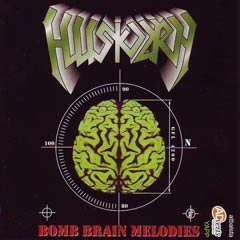
In celebration of its almost 20-year existence, the group in March re-released its first two albums—1992’s On the Road and 1995’s Bomb Brain Melodies—as a set of two compact discs. On On the Road, band members are Edgars Ķauķis (Blackie) and Ivars Talcis (Sheriff) on guitars, Normunds Orļonoks (Urbix) on vocals, Kaspars Žers (Long) on bass and Māris Balcers on drums. Orļonoks also is the principal lyricist. Bomb Brain Melodies features Orļonoks and Ķauķis joined by drummer Ēriks Šalapajevs, bassist Sergejs Karševs and guitarist Andrejs Mingačovs.

Huskvarn plays a rather ferocious type of heavy metal, often called “death metal,” mainly due to its relentless aggression both in music and lyrics, as well as (more often than not) unintelligible vocals, either screamed or growled. For this reason, this type of music is inaccessible to most listeners, except the very dedicated. Even though I was brought up on a strict diet of heavy metal, I myself found it a struggle to listen to these CDs all the way through. Where others may quickly dismiss this type of music as noise made by talentless hacks, I would strongly disagree with those sentiments. It is certainly a difficult task to be able to play the guitar or bang the drums at such a blinding speed, and it takes powerful vocal chords to be able to sing this type of music for a long period of time. Thankfully the lyrics for all the songs are included, otherwise it would be difficult to make sense of what they are singing.

On the Road features longer songs. Although there are only six songs, the album is nearly 40 minutes in length. It begins with “Dark Side,” featuring a somber introduction on keyboards, before launching into the first of many aggressive musical assaults. “Absurd Confusion” features a particularly shredding guitar solo by Talcis. The song “On the Road” also begins with an uncharacteristically melodic acoustic guitar before launching into an almost march-like, thundering distorted guitar riff.

With Bomb Brain Melodies, the group began writing slightly shorter songs, but what the band lost in length it made up with intensity. Compared to this album, On the Road seems almost melodic. I assume the title indicates that these songs should make your head explode, which I believe it will after too many listens. Bomb Brain Melodies begins with “Deliberately Lost in Infinity,” featuring a rather sinister introduction on acoustic guitar (reminding one slightly of Metallica’s song “Battery”). From titles like “Crazy Death,” “Bloody Nightmare” and “The Right to Revenge,” one can see the group has stepped up the intensity in its song writing. There are also three songs in Latvian—“Divas sejas,” “Pasaule mūsu palāta” and “Zudušais laiks”—though I probably wouldn’t have been able to tell that they were in Latvian without the lyrics sheet. The slower song “Follow Our Trail,” in contrast with most of the other songs, has a hopeful message, with the words “Together we’ll find all we need.”

I prefer On the Road to Bomb Brain Melodies mainly due to the fact that, ironically, On the Road features more melodies as well as tempo changes—and slightly more intelligible vocals.

A minor quibble about the packaging: To keep the albums separate, there are two separate booklets, one in the front cover of the CD and one in the back cover. Unfortunately, the booklet in the back cover is a few millimeters too large for the case, thereby leading to a slightly mangled booklet. There are also a few spelling mistakes here and there, which give the impression that this is not the most professional release.

The group continues to soldier on. Its most recent release of new material was 2006’s Sadistika.

It is admirable that Huskvarn refuses to compromise and plays the most aggressive music it can. The problem with that approach is that it leaves the group (and many other groups like Huskvarn) in a bit of a rut, which, sadly, makes many of the songs sound similar. Though it clearly takes a certain level of talent to be able to perform music like this, there is simply not enough to distinguish Huskvarn from the legions of other metal bands that sound virtually alike. On these albums, the group had yet to find its own unique sound and niche, which leads to rather generic songs, and two full CDs of this stuff was difficult to digest. If you like your music relentless and uncompromising, and are not too fussy about lyrics and originality, then this is the band for you. Otherwise, give this one a pass.

Details

On the Road / Bomb Brain Melodies

Huskvarn

Pasadena Group Promotions,  2008

On the Web

Huskvarn

The band’s official Web site provides background on the band, details on upcoming concerts, a space for comments from fans and a listing of band merchandise. LV

Huskvarn on MySpace

The band’s MySpace page has basic information about the group, plus some song samples. EN

Egils Kaljo is an American-born Latvian from the New York area . Kaljo began listening to Latvian music as soon as he was able to put a record on a record player, and still has old Bellacord 78 rpm records lying around somewhere.