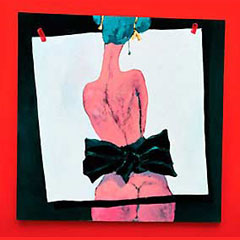
Prāta vētra takes risk, but result is baffling

Tur kaut kam ir jābūt

Unlike many pop groups, Prāta vētra goes out of its way to make each new record noticeably different than the last one. Perhaps due a desire to fully and unequivocally break with the past, on its latest album, Tur kaut kam ir jābūt, the band has gone off on a very unusual tangent, diverging completely with the styles of previous records and resulting in a rather baffling work.

Not content to simply recreate a previously used winning formula, the band likes to explore new avenues and to surprise listeners with new sounds and arrangements. Sometimes this can be a bit surprising (if not shocking) to the listener. For example, there’s the move from the light and catchy pop of 1999’s Starp divām saulēm to 2001’s synth-heavy and slightly darker Kaķēns, kurš atteicās no jūras skolas and then back to a guitar-driven sound on 2003’s Dienās, kad lidlauks pārāk tāls.

Četri krasti (2005), was one of the band’s weaker efforts. Outside of the title track and the songs “Pilots Tims” and “Kur milžu kalni liekās mazi,” there wasn’t much memorable or inspired on the record. So, with the tiniest bit of apprehension, I picked up Tur kaut kam ir jābūt.

Firstly, it is worth pointing out that the group has moved away from recording in other countries and using internationally known artists and producers. Songs on previous records had been recorded in Germany, Denmark and elsewhere with producers such as Steve Lyon. For Tur kaut kam ir jābūt, most everyone involved is Latvian. Also, this is the first album since Starp divām saulēm to be entirely in Latvian. Not a single song of the 13 tracks is in English (last I heard, the English version of the album is forthcoming and will be titled Fire Monkey). The album’s producer is Latvian hip-hop artist Gustavo (Gustavs Butelis), the album was recorded entirely in Rīga and album artwork was provided by Latvian painter Otto Zitmanis.

The core of Prāta vētra remains singer Renārs Kaupers, guitarist Jānis Jubalts, keyboardist Māris Mihelsons and drummer Kaspars Roga. Hired hand Ingars Viļums plays bass.

The choice of Gustavo as producer was certainly a fateful one, as it would appear the hip-hop artist had a significant influence on the sound of the album. Not only producing, he also provides lyrics and backing vocals on a number of songs. The drums and bass guitar are brought forward on these songs, with guitar buried further back in the mix, and the songs have a far more aggressive sound. For example, in “Ja tikai uz mani tu paskatītos” Kaupers urgently shouts the lyrics of the song, which contains some rather cringe-inducing moments such as “Mobīlais tavs, kas vienmēr ir zonā” (I will be your mobile phone, that always has reception).

That is followed up by the equally aggressive “Bronza,” which now has added distortion on Kaupērs’ vocals, also featuring backup vocals by Gustavo.

Much like on the Kaķēns record, guitarist Jubalts is rarely heard, which is unfortunate. Prāta vētra is at its best when the guitar is at the forefront. I remain convinced that the guitar-heavy Dienās kad lidlauks pārāk tāls remains the band’s best work, both musically and lyrically.

The new album’s first radio single, “Ai nu lai” (released in English as “And I Lie”), reminds me of some of the Rolling Stones’ work from the 1980s with attempts to make the music more funky (with varying results) and overly depending on backing vocals (on this song, provided by Gunārs Kalniņš and the GG choir).

One of the brighter moments on the album is the lyrically dense “Par podu.” To be honest, I am not quite sure what the song is about, but I enjoy the rambling lyrics and the simple yet captivating melody. Another enjoyable song is the title track, which has Kaupers singing a melody over sparse instrumentation and an interesting rhythm from drummer Roga, but the “rap” by Gustavo on this one detracts from the song itself.

Reflecting the eclectic nature of the songs, there is the Asian-sounding instrumental “Sīama” (featuring kanun performer Taner Sayacioglu), leading into the song “Es jau nāku,” featuring nei flute performed by Senol Filiz and guitar by Birol Yayla. Though a Latvian-Asian song could have been rather interesting to listen to, this winds up being one of the duller moments on the album.

Prāta vētra has been at its best with quirky yet catchy pop songs. Even the otherwise unremarkable Četri krasti had the poppy “Pilots Tims.” The only song on Tur kaut kam ir jābūt resembling a pop song is “Bēdz,” but even that song has some rather odd and distracting sound effects near the end.

It is commendable that the group continues to explore new avenues in its songwriting and sound and does not continue to recycle the same formula. It would certainly be dreadful to have to listen to an album made up purely of songs similar to earlier hits like “Brīvdienas nav manas laimīgās dienas” and “Spogulīts.”

Listeners well acquainted with songs like “Starp divām saulēm” and “Es gribu” may be a bit shocked by the new direction of the band. However, this latest venture of Prāta vētra’s winds up being slightly too eclectic for its own good, with uneven focus.

In the end, it is not much fun to listen to. It reminds me of efforts by other groups to prove that they are “mature” songwriters, in order to impress their critics (and, at the same time, alienating a certain section of their fanbase). Looking at some other reviews of the album, it seems that I am in the minority here, so your mileage may vary. The record certainly isn’t bad. Production and performance remain top notch, but I find this album, due to the divergent styles of the songs, difficult to listen to and missing the off-beat humor that many of the band’s earlier songs had.

The group, which remains Latvia’s most popular ensemble, has taken a big risk with this album. I am not sure it has paid off.

Details

Tur kaut kam ir jābūt

Prāta vētra

BrainStorm Records,  2008

BRCD219

Where to buy

Purchase Tur kaut kam ir jābūt from BalticShop.

Note: Latvians Online receives a commission on purchases.
Egils Kaljo is an American-born Latvian from the New York area . Kaljo began listening to Latvian music as soon as he was able to put a record on a record player, and still has old Bellacord 78 rpm records lying around somewhere.

‘Tumšie briežie’ follows tradition of doom, gloom

Tumšie brieži

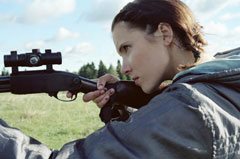
Kristīne Krūze plays Ria in the Viesturs Kairišs film Tumšie brieži, based on a play by Inga Ābele.

If you were to judge the Latvians by their films you would have to arrive at the conclusion that the Latvians are a very, very unhappy people. Viesturs Kairišs’ Tumšie brieži (The Dark Deer), based on a play of the same name by Inga Ābele, follows in that rich tradition of doom and gloom where things start out bad and then they get worse.

Latvian filmmakers seem to be primarily interested in making two types of film, the depressing or the tragic.

The characters’ entire lives are spent in a cycle of manic depression punctuated by brief spells of exhausted catatonia. Few are the films offering escapist fare and simple entertainment. If a Latvian filmmaker were to make It’s a Wonderful Life, George Bailey would jump off that bridge, Clarence would not get his wings and be relegated to the depths of hell, and Mary would become Mr. Potter’s unwilling mistress. And those would be the cheerful parts.

Tumšie brieži follows the lives of Aija (Elita Kļaviņa), Alfs (Kaspars Dimiters) and Augusts (Juris Žagars). The film opens with the three riding in a car. A pregnant Aija sits in the back, Alfs in the passenger seat and Augusts at the wheel. The relationships between the three aren’t clear, but it’s evident that they are intimately close. They’re returning from an evening at the theater when the car runs into a deer and crashes. The next scene picks up 17 years later. Aija is now a semi-catatonic recluse tended to by Alf and his new wife Nadine (Maija Doveika), Aija’s former nurse. They all live on a game farm and hunting lodge managed by Alfs and his father Opis (Pēteris Martinsons). Times are evidently hard, but a group of German hunters, among them Augusts who is now a successful businessman in Germany, has just arrived and the money they’ll spend just might save the day.

There’s just one problem. Ria (Kristīne Krūze), Aija’s and Alfs’ daughter, has grown up with and loves the deer. She will do everything in her power to disrupt the hunt and save them.

Kairišs is a talented filmmaker with a very strong feel for pacing, composition and mood. His 2001 Pa ceļam aizejot (Leaving By the Way) was a lyrical and mystical film despite some uneven performances. In Tumšie brieži we have the opposite. Despite some very strong performances from his cast, the film never really engages us. The characters somehow never really connect. We never seem to care about any of them. The motivation of the actors is never clearly explained.

While Aija is certainly a very attractive woman, we are never really sure why the two men would be so attracted to her or she to them. Why is Aija in the state she’s currently in? An accident can certainly be a traumatic experience, but is that enough to drive Aija to madness? Why does Alfs not just run away from his crazy family and why does Nadine put up with any of it? Why did Augusts leave? And why did he come back? Obviously there’s a lot of missing backstory. The film hints at its presence, but most of it doesn’t find its way to the screen. Ultimately, the answer to all of these questions seems to be that it’s in the script and that’s the way the actors play it.

It’s not that Tumšie brieži is necessarily a bad film. It has a definite feel to it and Kairišs’ strong visual sense and feel for mood and pacing are evident. The acting, with the possible exception of Krūze, is strong. Both Dimiters and Žagars bring a presence to their roles which goes beyond just their lines of dialogue. Kļaviņa does the best with what the limited script offers her. Krūze, unfortunately, brings the least to the table. Her Ria seems to alternate between petulance and cliché teenage rebellion. It’s Ria’s role that has to be the focal point of the film. All the action flows through or from her. How much of that is the fault of Krūze and how much is the fault of the script is debatable, but it never really seems to come together on the screen.

Details

Tumšie brieži

Viesturs Kairišs, director

Kaupo Filma,  2006

Notes: In Latvian. Feature, 85 minutes, in color. Screenplay by Viesturs Kairišs, based on a play by Inga Ābele; cast: Kaspars Dimiters, Maija Doveika, Elita Kļaviņa, Kristīne Krūze, Pēteris Martinsons, and Juris Žagars; producer: Guntis Trekteris; director of photography: Gints Bērziņš; music: Artūrs Maskats. DVD offers original Latvian and Russian dubbing, as well as English subtitles.

Pete Anderson plays good old rock-and-roll

Description of image

Pete Anderson (or Pīts Andersons in Latvian) is one of the most unusual musicians in Latvia. His latest album, Brass-a-Billy, is an excellent collection of classic songs as well as Anderson originals. The album’s title comes from the style of music Anderson performs: a combination of brass instruments with rockabilly melodies.

Anderson’s entire career is based upon the concept that rock music pretty much reached its peak in the 1950s, and certainly a very strong argument could be made for that theory. The music Anderson plays glorifies that era, a time when music and lyrics were simple, fun and exuberant, and much of the angst of today’s music was nowhere to be found. Even in deepest, darkest Soviet times, Anderson was performing this style of music and was just about the only person in Latvia to do so.

His biography is at times tragic and at times inspirational. Playing rock-and-roll, not to mention songs in English, was frowned upon by the Soviets. Anderson was called before the State Security Committee many times, and one time the committee even threatened his family if he didn’t give up doing what he was doing. Fortunately, with time the situation changed and he was able to continue doing what he did best. Anderson has also performed in many different countries, including the United States, Great Britain and all over Europe.

On Brass-a-Billy, Anderson provides all the vocals and is joined by an impressive list of musicians. All the songs are in mildly accented English, but there is not much else that would indicate they are performed entirely by Latvians. If the goal is to authentically recreate a 1950s sound, that is quite the accomplishment.

Included on the compact disc are songs like “R-O-C-K” by Bill Haley and the Comets, “Little Sister” by Doc Pomus and Mort Shuman, “Am I Blue” by Grant Clarke and Harry Akst and many others.

Anderson also has a few originals on the album, including “Brassabilly Boogie” and “Red Corvette,” which seamlessly fit in with the classic tracks of the past.

Also included on the CD are two bonus tracks, “Calling all Comets” recorded in 1989 and “Jump, Jive an’ Wail” recorded in 1990—long before Brian Setzer had a big hit with the song. The CD also has the music video for “Jump, Jive an’ Wail.”

It is refreshing to hear a record that is so very unpretentious. Anderson’s goal is to play good old rock-and-roll, without any of the moroseness and misery that creeps into a lot of modern music. The music, as well as Anderson himself, is unabashedly retro and a blast to listen to from beginning to end.

Details

Brass-a-Billy

Pete Anderson

Razzle Dazzle Records,  2008

RDCD 101

On the Web

Pete Anderson

Pete Anderson’s official Web site has lots of background on the artist’s life and his music. His biography offers insight into how rock music was received during the Soviet occupation. EN LV RU

Where to buy

Purchase Brass-a-Billy from Amazon.com.

Note: Latvians Online receives a commission on purchases.

Egils Kaljo is an American-born Latvian from the New York area . Kaljo began listening to Latvian music as soon as he was able to put a record on a record player, and still has old Bellacord 78 rpm records lying around somewhere.