How to play zolīte

Zole—or, in its diminutive form, zolīte—is by some accounts the national game of Latvia. That’s probably true… unless of course you’re a diehard novuss player. Zolīte certainly is a favorite pastime among young and old. For some North American Latvians, however, the card game has become only a memory.

We’ve searched in vain for information about the history of zolīte in Latvia. The closest we’ve come is to learn more about the German game called “sheepshead,” which has similarities to zole and may be related. Sheepshead, however, employs 32 cards rather than the 26 Latvian zole players use.

When about two months ago SVEIKS.com posted a request for zolīte rules, we didn’t get much response from people in the know. Rather, several readers sent e-mail saying they’d like to know the rules, too. Finally, however, Rūta Vitande of Chicago came through. Below, we present her understanding of the rules for zolite.

How to play zolīte

From a regular deck of cards, use only face cards, aces, 10’s, 9’s, 8 of diamonds, 7 of diamonds—a total of 26 cards. Three players are needed, but generally four are preferred. When four play, the dealer sits out.

Decide on the dealer by drawing cards. The deck is cut by the dealer’s right Deal four cards to the left, next four to his or her left, next four, then two to the pot. Repeat four at a time.

The player to the dealer’s left has first say as to whether he or she wants to “buy” the middle cards, meaning the player will add those to his or her hand and discard two (which do count for points) and take on the other two players.

The object for the “solo” player is to get 61 points or more, thus the duo wins if the solo player only gets 60 (or less).

If the first to the left of the dealer turns down the chance to “buy,” he or she defers to the next left, etc.

If all three players pass, each adds a chip to the ante, to be taken by the next winner (however, an ante is not distributed during a “zole” play). Only one set is doled out at a time to the next winner, should the ante accumulate. If a pool has been started and a player loses, he owes the ante a single round (three or four chips, depending on number of players).

The player to the left ofthe dealer leads the first card, regardless of the who the ‘soloist’ is. Each player must follow suit, if possible; if not, any card goes.

Whoever takes the trick leads the next card.

If a trump is led, trump must be played.

Zole has 12 trump, in descending order of power: Queen of clubs, queen of spades, queen of hearts, queen of diamonds, jacks in same suit order as queens, ace of diamonds, 10 of diamonds, 9, 8, 7 of diamonds.

The point system, however, seems to have nothing to do with trump power:

Ace—11 points
10—10 points
King—4 points
Queen—3 points
Jack—2 points
Other—0 points
Total possible—120 points

And remember these notes:

  • A solo player may decide to “zole,” in which case the player forfeits the cards in the middle and they are revealed only after the game and added to the duo’s score.
  • For winning with points 61 to 90, the solo player wins a chip from each player, thus two chips in a threesome or three in a foursome. A win of 91 to 119 gets the player two chips from each; 120 (or all the tricks), three from each. If the player has declared “zole,” add four chips from each player to the regular scoring schedule, thus five for a score of 61 to 90, six for leaving the opponents in “johns,” seven for an all-tricker.
  • For losing to the two opponents, add one to the above scoring pattern and, of course, these points count against the soloist.
  • The language that accompanies this game is very much a part of the game and can only be learned with time and exposure.
  • The game has many “rules” or nuances ranging from where one sits after drawing cards to determine the dealer, to not allowing the dealer to look at the two cards in the middle. Usually they differ according to the region of Latvia in which the game originated. Defining the nuances before starting is recommended, especially with serious players.

As Vitande notes, zolite has many nuances. If you know of different rules or variations, add your comments at the end of this article. In the meantime, our thanks to Rūta Vitande for supplying the rules for this game.

(Editor’s note: This article originally appeared on SVEIKS.com.)
Andris Straumanis is a special correspondent for and a co-founder of Latvians Online. From 2000–2012 he was editor of the website.

An Easter parade of Latvian Web sites

The Christian celebration of Easter—Lieldienas, in Latvian—is almost here. For many Latvians around the world, it will mean early morning church services, followed by a feast with family and friends. Among the food items sure to be found on the table will be eggs colored with onion skins.

For those who follow the Latvian folk religion dievturība, the marking of the first day of spring on the vernal equinox (saulgrieži) is already complete. The dievturi no doubt got up before sunrise to wash their faces with the cold water from a nearby stream. Then, after greeting the dawn with song, they, too, participated in a feast.

If you’d like a bit more information about how Latvians celebrate Easter, we’ve searched the Web to find a few sites that might be useful.

Easter Postage Stamps

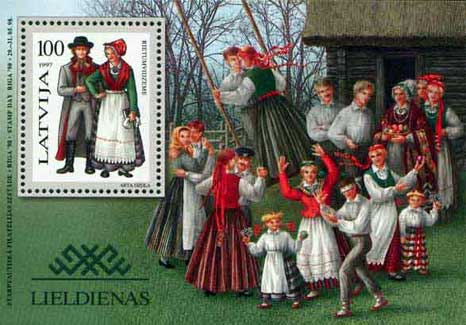
In its series of postage stamps commemmorating traditional Latvian folk costumes and celebrations, the Latvian Post Office in 1997 issued a 10-santīmi stamp and a 1-lat souvenir sheet depicting the costumes of western Vidzeme and the Latvian Easter tradition of swinging in a swing. EN

Fisherman’s Work And the Sea In the Livonian Folk Calendar

Kristi Salve’s article from the June 1996 issue of Folklore contains quite a bit of information about how the Livonian people—who still are found in small numbers in Latvia and Estonia—would traditionally celebrate the Easter season, particularly because Easter for the sea-faring Livs also marked the beginning of the fishing season. The page is part of the Estonian Folklore Web site. EN

folklora.lv

Ansis Ataols Bērziņš’ rich site devoted to Latvian traditional culture has a section devoted to folklore eduction, including pages on Lieldienas, eggs and the vernal equinox. LV

Latviešu folklora

A site about Latvian folklore, part of Latvijas Izglītības informatizācijas sistāma, includes background on Easter traditions. LV

Lieldienas

A 1993 article about Latvian Easter traditions, part of a series from Dienvidkalifornijas latviešu informācijas biļetens. LV

Tautas dziesmu izlase

The University of Latvia’s Artificial Intelligence laboratory’s online collection of folk song texts, or dainas, includes a section on Lieldienas. LV

Souvenir sheet

A 1997 Latvian postal souvenir sheet depicts a traditional Easter celebration and highlights the folk costumes of Vidzeme.

Andris Straumanis is a special correspondent for and a co-founder of Latvians Online. From 2000–2012 he was editor of the website.

An introduction to Draudzīgais aicinājums

Begun in 1935 as a way to help rural Latvian schools and libraries enrich their book collections, the tradition of Draudzīgais aicinājums continues today in North America. Literally meaning “friendly invitation,” the event is usually commemorated in late January as close to the 28th as possible. That date is the names day for Kārlis, as in Kārlis Ulmanis, the last pre-World War II leader of independent Latvia.

This is grassroots alumni development. In Latvian churches, schools and community centers in the U.S. and Canada, the event often is marked with speeches, concerts and—central to the tradition—presentation of books and other gifts to schools and libraries.

It was Ulmanis who issued the first Draudzīgais aicinājums call on Jan. 28, 1935. In the invitation to the people of Latvia, he wrote: “Let us give them books, paintings, artworks. Let us each help our old schools to receive good musical instruments. Many schools, many community centers are still without their own radios. Our church walls are bare and cold, country church bells with their old sounds find it difficult to warm hearts and bring them together. Therefore, only rarely do we hear those ringing. Whoever at home has many books, many paintings or other beautiful artwork, let us donate, let us give a portion of those to our county community organizations, and to our county schools.”

Latvia at the time had a government-run Culture Fund that had collected and distributed books nationwide, but demand was greater than the fund could meet. According to historian Adolfs Šilde’s Latvijas vesture: 1914-1940 (Stockholm: Daugava, 1976), Ulmanis believed culture could not be left only in the hands of a government organization. Ulmanis, Šilde wrote, “wanted to motivate people towards the interests of the spirit and open a path for thoughts on social ethics.”

Ulmanis had always loved books himself and therefore asked that first of all the empty library shelves of country schools be filled. He himself gave books and materials to his first school and other Latvian schools, and many followed his example.

Two years after it was started, Jānis Celms noted, “Draudzīgais aicinājums is not just a single fundraiser, but it is the beginning of a continuing Latvian tradition whose foundation is based within a sense of responsibility, a burning love for the homeland and a united spirit whose goal is to cultivate to the fullest the pillars of our culture—school, church, and Latvian society.”

By March 1939, more than 1.6 million books had been donated in response to Draudzīgais aicinājums. In addition, the Culture Fund had received donations for the purchase of school curricular materials, radio receivers, and musical instruments valued at LVL 501,506. Also donated were 4,300 paintings, art reproductions and portraits, 90 busts and sculptures, as well as other valuables. So that the Draudzigais aicinajums would not lose momentum, teachers, local politicians, and ministers were involved in the process.

Today, however, the Draudzīgais aicinājums tradition often goes unnoticed in Latvia. Some have criticized the event as an extension of the political and cultural policies of Ulmanis, who in 1934 disbanded Parliament and made himself a dictator, albeit one who is remembered fondly by many first generation exiles as well as older Latvians in the homeland.

The well-known writer Jānis Jaunsudrabiņš credited Draudzīgais aicinājums for developing in Latvian culture a high regard for books.

(Editor’s note: Andris Straumanis contributed to this article, which originally appeared on the SVEIKS.com site.)