Thousands join protest in Dome Square

An estimated 8,000 demonstrators—about half the number organizers had expected—converged Nov. 3 on the Dome Square in Old Rīga to call for change in Latvia’s government.

The meeting, the second large-scale protest in two weeks, was in response to recent controversial actions by the government of Prime Minister Aigars Kalvītis and the parliament. A number of well-known politicians, journalists and cultural workers attended the protest, according the media reports.

President Valdis Zatlers, whom opponents of the government have asked to dissolve parliament, made an appearance at the meeting. He encouraged citizens to become politically active.

The demonstration was advertised with a motto of “Par tiesisku Latviju! Par godīgu politiku!” (For a lawful Latvia! For honorable politics!”).

The protest continued the theme of what some observers have called the “umbrella revolution.” Where the Oct. 18 demonstration outside the Saeima building was marked by people protecting themselves from a steady rain, the Nov. 3 protest was dampened by a wet snowfall—which may have kept the number of protestors to less than expected.
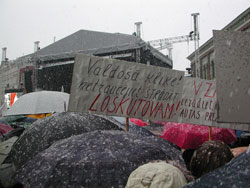
Scene from Nov. 3 protest

Demonstrators carry umbrellas, and some hold up signs, during a Nov. 3 protest in Rīga against the Latvian government. (Photo by Arnis Gross)

Andris Straumanis is a special correspondent for and a co-founder of Latvians Online. From 2000–2012 he was editor of the website.

Canada lifts visa requirement for Latvian visitors

Canada has lifted its visa requirement for citizens of Latvia effective immediately, Diane Finley, Canada’s minister of citizenship and immigration, announced Oct. 31.

That means Latvian citizens will be able to travel to Canada with just their passport.

The news was immediately welcomed by the Latvian Ministry of Foreign Affairs, which has been pushing for both Canada and the United States to lift visa requirements.

Canada also lifted the visa requirement for travelers from the Czech Republic.

“Canada enjoys strong ties with both of these countries, and lifting the visa requirement will help us build on those relationships to the benefit of Canadians and the citizens of the Republic of Latvia and the Czech Republic,” Finley said in a press release.

Latvian citizens will be able to stay in Canada for up to six months during a year. Almost 1,100 temporary resident visas were issued by Canada to Latvian citizens last year.

The Latvian Foreign Ministry said in a press release that it is convinced Canada will extend the visa-free status to other new members of the European Union. Estonia was granted visa-free status last year, but Lithuanian citizens still need a visa to visit Canada.

Canada has been warned by the European Union that if it does not extend visa-free status to all EU nations, then the EU might retaliate by adopting visa requirements for certain classes of travelers.

The U.S. visa requirement for Latvian citizens remains in place, but Prime Minister Aigars Kalvītis is visiting Washington, D.C., from Oct. 31 to Nov. 1 in part to lobby for adding Latvia to the Visa Waiver Program.

Andris Straumanis is a special correspondent for and a co-founder of Latvians Online. From 2000–2012 he was editor of the website.

Welfare minister is latest to quit coalition government

Yet another Latvian cabinet member, this time Welfare Minister Dagnija Staķe, is quitting the coalition government led by Prime Minister Aigars Kalvītis.

During the Oct. 31 parliamentary caucus meeting of the Greens and Farmers Union (Zaļo un Zemnieku savienība), Staķe announced she is stepping down because she failed to get more money for pensioners in the proposed 2008 national budget, the Welfare Ministry said in a press release.

The promise of higher pension payments would mean reconsidering other welfare measures planned in the new budget, including support for the disabled, the unemployed and new parents.

“Given this situation, I do not see the possibility to continue working in the government,” Staķe said.

The Saeima is expected to vote on the final budget on Nov. 8.

Staķe has been the welfare minister for five years.

She becomes the fourth minister to leave the Kalvītis government in the past two months.

Jurijs Strods, the economics minister, quit in September to spend more time with his family. Artis Pabriks, the foreign minister, quit Oct. 19 in protest over the government’s sacking of the head of the Corruption Prevention and Combating Bureau. Aigars Štokenbergs, the minister for regional development and local government, was asked by Kalvītis to step down after he was shut out Oct. 19 from the People’s Party (Tautas partija) in a dispute with party leader Andris Šķēle.

Andris Straumanis is a special correspondent for and a co-founder of Latvians Online. From 2000–2012 he was editor of the website.