Large-scale protest against Saeima turns violent

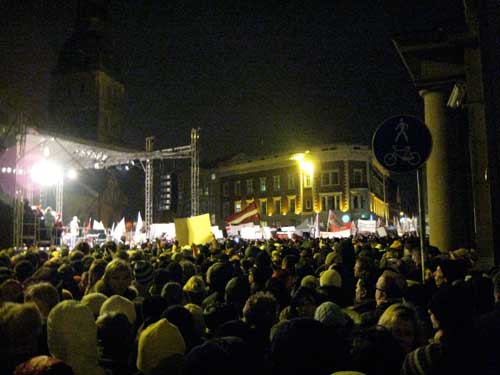
Police and ambulance sirens were heard Jan. 13 in downtown Rīga after hundreds of people attacked the Saeima building following a peaceful evening protest that drew an estimated 10,000 demonstrators.

Initial media reports said rioters numbering in the thousands threw rocks at the parliament building, broke windows and set automobiles on fire. More than 30 protesters were reported to have been injured and more than 100 arrested. At least one police officer was hurt, too.

The action against the parliament building followed a 90-minute demonstration featuring speeches by politicians such as Aigars Štokenbergs, trade union officials and others. The speeches were interrupted by frequent shouts of “Atlaist Saeimu!” (Dissolve the parliament!).

The demonstration was organized by the political party Sabiedrība citai politikai and a number of other groups demanding that President Valdis Zatlers call for the dismissal of parliament, a move that could lead to new elections. Organizers had said they expected 20,000 demonstrators.

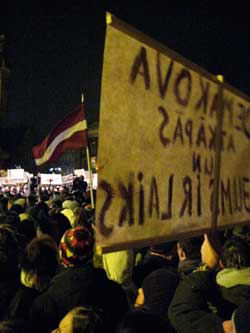
Banners from a number of opposition political parties, including Jaunais laiks (New Era) and the Latvian Social Democratic Workers Party, were interspersed with signs critical of the Saeima or of specific political leaders, Latvians Online observed. One man carried a sign professing his love for a woman named Līga.

Zatlers, attending a meeting of the European Parliament in Strasbourg, France, was sent a letter with the demands earlier in the day.

The large demonstration began at 5:30 p.m. and concluded about 90 minutes later with singing of the national anthem. Organizers urged the demonstrators to peacefully leave the square or to head to Zaķusala for a ceremony commemorating the January 1991 anti-Soviet barricades movement.

The attack on the Saeima building began shortly thereafter. Video on Latvian television stations and Web portals showed people hurling bottles at the structure and police in riot gear attempting to push the crowd back away from the Saeima. Some people ripped cobblestones from the streets.

Windows in a number of storefronts were broken as well, and one report said the Latvian National Library’s Letonika Division on Jēkaba Street also sustained damage. One local police vehicle was overturned and at least one other damaged.

Local media reported that most of the disturbance had been quelled by about 10 p.m.

The State Security Police was reported to be investigating postings last week on several Web sites urging an attack on the parliament with Molotov cocktails.

By the end of the night, accusations were flying between rival political forces about who was to blame for the unrest. Sabiedrība citai politikai demanded the resignation of Interior Minister Mareks Segliņš, saying he should have done more to prevent the unrest. Segliņš belongs to the People’s Party (Tautas partija), of which SCP leaders Štokenbergs and Artis Pabriks once were members.
Protests par Saeimas atlaišanu

Thousands of demonstrators gather Jan. 13 in the Dome Square to call on President Valdis Zatlers to dissolve the Saeima. (Photo by Andris Straumanis)
13.janvāra demonstrācija

In the foregound, a demonstrator holds up a sign referring to the Jan. 12 resignation of Culture Minister Helēna Demakova, while in the background another demonstrator waves one of several Latvian flags seen during the protest. (Photo by Andris Straumanis)

Andris Straumanis is a special correspondent for and a co-founder of Latvians Online. From 2000–2012 he was editor of the website.

Citing health, culture minister Demakova resigns

Saying her health prevents her from participating in the political process, Latvia’s Minister of Culture Helēna Demakova has submitted her resignation to Prime Minister Ivars Godmanis.

Demakova has served as culture minister since 2004. She submitted her resignation Jan. 12.

A founding member of the People’s Party (Tautas partija), Demakova has tapped actor Juris Žagars to be her replacement. In a press release announcing her resignation, Demakova said her replacement “must be a person with a national and politically conservative presence,” but should also have authority in the cultural sector and experience in culture management. If party leaders agree, they would nominate Žagars to the prime minister.

Demakova has been diagnosed with a bone infection.

Demakova’s resignation came after President Valdis Zatlers criticized as “amoral” a decision to sign a LVL 6.77 million contract for design of a new concert hall at a time of government belt-tightening.

The contract was signed by the state agency Jaunie Trīs brāļi, part of the Ministry of Culture. Formed in 2005, the agency has been responsible for the planning, design and construction of the new Latvian National Library, the Rīga Concert Hall and the Museum of Contemporary Art. The same day Demakova handed in her resignation, the ministry also announced that the Jaunie Trīs brāļi agency will be liquidated and its functions given over to the Ministry of Finance.

Construction of the library, known as the “Gaismas pils” project, continues, but construction of the concert hall has been put off until at least 2011. The art museum is still being planned.

Work on the three projects is one of the achievements of her time in office, Demakova said in the press release. During her tenure, she said, the cultural sphere in Latvia has grown from an “orphan” and “beggar” to one that receives funding that is in keeping with being a European nation.

Andris Straumanis is a special correspondent for and a co-founder of Latvians Online. From 2000–2012 he was editor of the website.

Demonstration to press for Saeima’s dissolution

A demonstration to demand that President Valdis Zatlers dissolve Latvia’s parliament is scheduled Jan. 13 in Rīga’s Dome Square, while the nation’s Security Police is investigating an Internet-based call for the violent overthrow of the government.

The demonstration is being organized by Sabiedrība citai politikai, a political party led by Aigars Štokenbergs and Artis Pabriks, as well as other groups.

“We ask all of Latvia’s patriots to come to the Dome Square on Jan. 13 to show that we are concerned about our nation’s future, justice and democracy,” organizers state on a Web site promoting the demonstration, www.tavabalss.lv. The two-hour demonstration is to start at 17:30 hours local time.

The call for the demonstration, reminiscent of the “umbrella revolution” protests of late 2007, comes as the public’s unhappiness with the Latvian government has risen with the country’s deepening economic crisis.

It is not the first time Zatlers has been asked to dissolve parliament and call for new elections. Under Latvia’s constitution, the president may call for the dissolution of the Saeima. A national referendum must then be held. If the referendum succeeds then the parliament is dissolved, but if it fails then the president must step down.

In August, voters failed to pass a referendum on a constitutional amendment that would have allowed citizens the right to call for a dismissal of the parliament. Although turnout fell short of what was needed, those who did vote were overwhelmingly in favor of the amendment. That led Zatlers to call on the Saeima to approve such an amendment on its own, but the parliament has yet to consider a bill.

Amid efforts to promote the Jan. 13 demonstration, an unnamed individual or individuals have suggested that a violent overthrow of the government is needed, too. Under a headline of “4.atmoda ir klāt” (The Fourth Awakening Has Arrived!), a call to action posted last week on several Web sites explains how to make a Molotov cocktail and tells readers to throw them at the Saeima building.

The State Security Police is investigating the Web postings, the Apollo portal reported Jan. 9. At least two of three Web sites carrying the message had been blocked by the morning of Jan. 12.

Andris Straumanis is a special correspondent for and a co-founder of Latvians Online. From 2000–2012 he was editor of the website.