Long-time New York basketball coach receives two honors

The prestigious New York Metropolitan Basketball Writers Association has named Indulis Ray Raņķis 2009 All-Met Men’s Division III Coach of the Year.

He was also awarded Coach of the Year honors by the Atlantic Region National Association of Basketball Coaches and the City University of New York Athletic Conference (CUNYAC).

The awards were announced in April and March, respectively.

Raņķis, in his 26th season at CUNY’s Baruch College, is the longest-serving men’s basketball coach in CUNYAC history. Baruch recorded a perfect 13-0 record in the regular season and a berth in the 2009 conference championship game.

This season Raņķis coached the Bearcats to a 23-6 record and the program’s third appearance in the NCAA Tournament. His teams have won nine CUNY North Division Championship titles.

A 1970 graduate of DeWitt Clinton High School in the Bronx, Raņķis played college basketball for Lehman College where he was selected First Team All-CUNYAC and inducted into the Lehman College Sports Hall of Fame.

Raņķis also is a 25-year veteran player and coach for the New York Latvian basketball team Rakte, which has won 10 titles in the American Latvian Association’s “Finālspēles” tournament. Raņķis twice won the Visvaldis Melders Memorial Award as the tournament’s outstanding basketball player as well as has received the Imants Štāls Memorial Cup for outstanding basketball contributions on and off the court. In 1993, he was inducted into the Latvian Sport Hall of Fame for achievements in sports outside of Latvia, receiving the Latvian Sports Council’s “Lielā nozīme” award.

Raņķis, along with his wife and two children, resides in New Rochelle N.Y. He also serves as associate athletic director at Baruch and starts the 2009-2010 basketball season with 367 career victories.
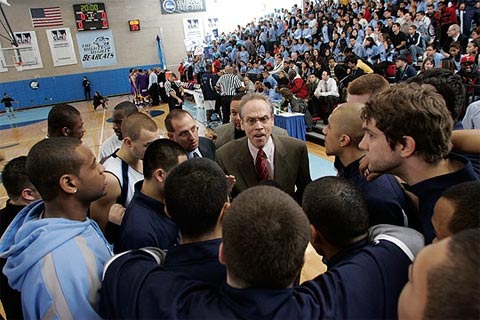
Raņķis talks to players

Coach Indulis Ray Raņķis talks to his Baruch College players during a break in a game. (Photo courtesy of Baruch College)

Rīga gets nod to be a European Capital of Culture in 2014

Rīga is expected to be one of two cities designated as a European Capital of Culture in 2014, raising its profile across the continent, officials announced in a Sept. 15 press conference in Latvia.

The designation, expected to be confirmed by the European Union’s Council of Ministers next spring, could provide Latvia’s capital city with a boost in tourism and other investment.

“This is the beginning of a great adventure,” Ján Figel’, the member of the European Commission responsible for education, training, culture and youth, said in a press release.

Rīga was one of three Latvian finalists for the title. Cēsis, which marked its 800th anniversary in 2006, and the Baltic Sea port of Liepāja also were under consideration.

“I am delighted with Rīga’s success and would like to congratulate the local authorities and the team that prepared the application,” Figel’ said. “Rīga has great potential for being the European Capital of Culture. Bearing this title for one year will certainly place this city in the spotlight and create enormous potential for it to develop locally and raise its profile across Europe.”

Figel’ noted that Latvian officials have plenty of work ahead to benefit fully from the designation. According to the European Commission, being chosen a European Capital of Culture requires an “exceptional” program of cultural events take place during the year a city has the designation. The events should highlight the city’s European character and must involve its citizens.

Rīga Mayor Nils Ušakovs said the designation will help strengthen Rīga’s and Latvia’s role in the Baltic Sea region.

“All inhabitants of the state will benefit in 2014, because Rīga is prepared to be the gateway to Latvia,” the mayor said in a press release.

Ojārs Kalniņš, director of the Latvian Institute, also expressed pleasure with the designation.

“It’s no secret that Rīga has been the diring force of Latvia’s tourism boom in recent years,” he told Latvians Online in an e-mail. “I think this decision gives a clear signal to the state and city governments that continued development of Latvia’s tourism infrastructure is one the keys to our economic recovery. This is clearly an advantage for the city of Rīga, but we must learn how to turn it into an economic benefit for all of Latvia.”

Rīga would share the designation with the Swedish city of Umeå.

Vilnius, Lithuania’s capital, is one of two European Capitals of Culture this year. Estonia’s capital, Tallinn, will share the designation with Turku, Finland, in 2011.

The first European Capital of Culture was Athens in 1985.

Andris Straumanis is a special correspondent for and a co-founder of Latvians Online. From 2000–2012 he was editor of the website.

Migration to U.K. rising, data show

The number of Latvian inhabitants who left for the United Kingdom in the first quarter of this year is the highest since 2002, British government data show, and a University of Latvia professor predicts even more will have emigrated in the second quarter.

Mihails Hazans, who studies labor markets, made his prediction Sept. 11 during a presentation in Rīga of a soon-to-be-published book, EU Labor Markets after Post-Enlargement Migration, the daily newspaper Dienas Bizness reported.

In the first three months of this year, a total of 4,360 persons from Latvia registered for U.K. National Insurance Numbers (NINo). That is the highest tally of new registrations in a single quarter since 2002, according to data compiled by the Department of Work and Pensions.

The NINo is used in dealings with the British government and to track certain benefits, such as social security contributions. Persons living in the U.K. may apply for a number once they are 16 years old.

The data suggest the number of migrants from Latvia will continue to rise this year. In just the first three months of this year, the number of migrants had already reached nearly 55 percent of last year’s tally. During all of 2008, a total of 7,970 persons from Latvia registered for a NINo.

Since 2002, more than 51,000 persons from Latvia have registered for National Insurance Numbers. Migration to the U.K. exploded after Latvia joined the European Union in 2004. That year, 3,700 persons from Latvia registered for a NINo, but in 2005, the total shot to 13,500—a 264 percent increase. Although the pace of migration declined in the following years, thousands of Latvian inhabitants continued to leave for Britain: 11,420 in 2006 and 9,320 in 2007.

The British data do not necessarily track permanent immigrants, just people who are living in the U.K. According to Latvia’s Central Statistical Bureau, the number of permanent emigrants from the country last year totaled 6,007, less than the total who in 2008 registered for a NINo in Britain.

Since 2002, more than 4 million immigrants to the U.K. from around the world have registered for the insurance numbers, according to the Department of Work and Pensions. They include 10,280 from Estonia and nearly 113,000 from Lithuania.

The book, EU Labor Markets after Post-Enlargement Migration, suggests that workers from foreign countries have not in general displaced native workers or lowered their wages. Hazans is co-author of a chapter on the Baltic labor markets.

During his presentation in Rīga, Dienas Bizness reported, Hazans noted that the most recent emigrants from Latvia tend to have higher education and are heading abroad for good. Of those who emigrated in previous years, more than half have returned to Latvia after one year.

Hazans said the same trend might take place with current emigrants, but that state policies will have to be changed to foster return migration, Dienas Bizness reported.

The book, EU Labor Markets after Post-Enlargement Migration, is edited by Martin Kahanec and Klaus F. Zimmermann. It is being pubished by the Germany-based Springer.

Andris Straumanis is a special correspondent for and a co-founder of Latvians Online. From 2000–2012 he was editor of the website.