Fitch Ratings raises outlook for Latvia

Calling improvements in Latvia’s economy encouraging, the London-based Fitch Ratings has revised its outlook for the country’s creditworthiness to stable from negative.

The ratings service also forecast that Latvia’s medium-term economic recovery will be led by exports, but noted that the country’s gross domestic product will remain “below-trend” until 2012.

Latvian Finance Minister Einars Repše expressed pleasure at the upgrade.

“This rating is very important for our foreign investors and for the international community, because it is a meaningful signal that affirms what Latvia has done to overcome the economic crisis,” Repše said in a press release.

Last year, rating services Fitch, Moody’s Investors Service and Standard & Poor’s all lowered their evaluations of Latvia’s creditworthiness. The country has been among the hardest hit in Europe in the wake of the global economic crisis. High unemployment spurred continued emigration, and the government was forced to drastically slash the national budget and raise taxes to avoid going bankrupt.

“Although Latvia’s fiscal deficit remains high, consolidation measures enacted to date have been substantial,” Douglas Renwick, associate director in Fitch’s sovereign group, said in a press release. “Fitch expects further budget tightening over the coming year, even if a change of government follows October’s elections.”

Latvian voters go to the polls Oct. 2 to elect a new parliament, which will approve a new government. Current Prime Minister Valdis Dombrovskis and his centrist Vienotība (Unity) coalition face strong competition in the election from the center-left and Russian-oriented Saskaņas Centrs (Harmony Centre) and the conservative Par Labu Latviju! (For a Good Latvia!). In all, 13 parties are vying for seats in the parliament.

Fitch noted that “further budget tightening measures will be required by the next government if public debt sustainability is to be restored.” While acknowledging that the Dombrovskis government might be forced out, the ratings service added that “there is a high degree of consensus across the Latvian establishment regarding the need for consolidation to fulfill the long-standing aim of adopting the euro.”

In March, Moody’s revised its rating of Latvia’s creditworthiness to Baa3 stable, up from Baa3 negative. The Baa3 rating overall is the lowest investment grade rating, just above “junk” status. Standard & Poor’s in February raised its rating of Latvia to BB stable from BB negative. A BB rating is still below investment grade in Standard & Poor’s evaluation system.
Andris Straumanis is a special correspondent for and a co-founder of Latvians Online. From 2000–2012 he was editor of the website.

Summer of 2010 is Latvia’s warmest

This summer in Latvia has been the warmest on record, topping the previous heat wave of 2002, according to the Latvian Environment, Geology and Meteorology Centre.

The record was broken in part thanks to the average temperature in August reaching 18.4 degrees Celsius, beating the old average temperature for the month by 2.6 degrees.

The highest temperature reported this summer was 34.8 degrees Celsius on July 13 in Ventspils, the hottest day on record in the port city’s history. Temperature records were broken around the country this summer, according to a Sept. 1 press release from the meteorology center. However, none managed to top the hottest day on record: 36.4 degrees Celsius (97.5 degrees Fahrenheit) reported Aug. 4, 1943, at Daugavpils.

On Aug. 15, for example, temperature records fell in at least 11 locations around Latvia. The thermometer on that day in Rēzekne reached 32.9 degrees Celsius (91.2 degrees Fahrenheit), breaking the previous record of 28.4 degrees Celsius.

The following day, Aug. 16, high temperature records fell in at least 12 locations, including Daugavpils, where the thermometer peaked at 33.1 degrees Celsius (91.6 degrees Fahrenheit).

Most of June was mild in temperature and humidity, according to the meteorology center. But beginning June 24, the air temperature held above the norm for more than two months. On 23 different days, according to the meteorology center, the temperature in Latvia rose to more than 30 degrees Celsius.

July proved to be not only warm but also rainy. Frequent thunderstorms were reported during the month, some with intense rain and wind. July 18 saw especially unsettled weather in Rīga, with many reports of flooding in streets and buildings, as well as of tree limbs being blown down, damaging electrical lines and blocking traffic.

Andris Straumanis is a special correspondent for and a co-founder of Latvians Online. From 2000–2012 he was editor of the website.

Number of green cards declines, while U.S. sees more Latvian visitors

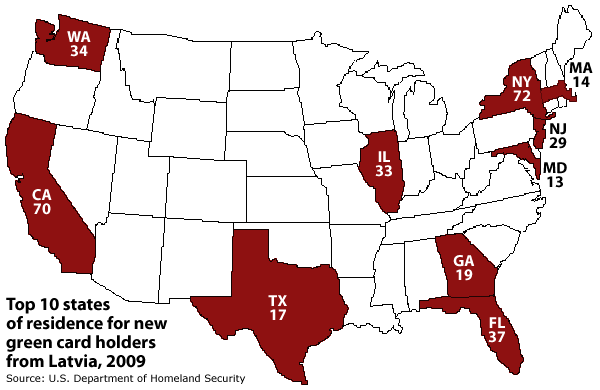
States with the most Latvian green card holders

U.S. Department of Homeland Security statistics reveal which 10 states have the most new legal permanent residents from Latvia. (Illustration by Latvians Online)

The number of persons from Latvia who have become legal permanent residents of the United States dropped last year to its lowest point in the past decade, according to recently released government statistics.

However, the latest edition of The Yearbook of Immigration Statistics, prepared by the U.S. Department of Homeland Security (DHS), reveals that tourist and other non-immigrant admissions from Latvia continue to rise.

The 444 persons born in Latvia who in 2009 became legal permanent residents—also known as holders of “green cards”—continued a declining trend that began after peaking in fiscal year 2006. That year, 892 persons from Latvia became legal permanent residents.

Of those who became legal permanent residents last year, nearly 69 percent were immediate relatives of U.S. citizens. Nearly 68 percent were female, according to DHS statistics. The majority, 67 percent, were 34 years old or younger.

The state with the most new green card holders from Latvia was New York, with 72 persons. California was second with 70, followed by Florida (37), Washington (34), Illinois (33), New Jersey (29), Georgia (19), Texas (17), Massachusetts (14) and Maryland (13).

Meanwhile, the number of persons from Latvia admitted to the U.S. as non-immigrants, including tourists, students and business travelers, rose to 15,892 in fiscal 2009, according to the statistics yearbook. That is more than a 9 percent increase over 2008.

Latvia joined the U.S. Visa Waiver Program in November 2008, meaning Latvian citizens no longer need to apply for a visa to visit America.

Of the non-immigrant admissions, 641 were students or individuals involved in other exchange programs.

According to other statistics reported in the yearbook:

  • In 2009, a total of 27 children from Latvia were adopted by U.S. citizens. Of those, 11 are boys and 16 are girls. Four-fifths of the children were age 5 or older.
  • A total of 404 persons born in Latvia became naturalized U.S. citizens in 2009, a decline from the 455 reported in 2008.
  • Three persons from Latvia last year were granted asylum in the U.S.
  • A total of 27 persons from Latvia were removed from the U.S. in 2009, three of them for criminal convictions.

DHS reports immigration statistics throughout the year, but prepares the yearbook for release in August, according to the department’s website, www.dhs.gov.

Andris Straumanis is a special correspondent for and a co-founder of Latvians Online. From 2000–2012 he was editor of the website.