NATO would defend Baltics from Russian attack, WikiLeaks reveals

Nine divisions of U.S., British, German and Polish troops could be called on to defend the Baltic states and Poland in the event of an attack from Russia, according to a secret NATO defense alliance contingency plan revealed by the WikiLeaks organization.

The plan, reported on Dec. 6 by the Guardian newspaper in London, would include Latvia, Estonia and Lithuania along with Poland in a regional defense strategy called “Eagle Guardian,” according to one diplomatic cable. Its approval was urged by Germany.

The document is one of about 250,000 U.S. diplomatic cables the WikiLeaks organization says it has acquired and is releasing on its website and through several newspapers.

U.S. Secretary of State Hillary Rodham Clinton in January signed off on the NATO plan, according to the cables, the Guardian reported. The plan is part of an effort to refocus NATO’s defense strategy.

Latvia in 2004 joined NATO along with Bulgaria, Estonia, Lithuania, Romania, Slovakia and Slovenia. Under Article 5 of the NATO defense treaty—originally approved in 1949—all members of the alliance agree to defend each other in the event of an armed attack. However, the Guardian noted, “the three Baltic states have complained they are treated as second-class members because their pleas for detailed defence planning under NATO’s ‘all for one and one for all’ article 5 have been being ignored.”

Although economic relations between the Baltics and Russia have improved, political tensions remain. Russia has frequently alleged Latvia and Estonia discriminate against their large Russian-speaking minorities.  In 2007, the Guardian story reminded readers, a cyber-attack against Estonia was suspected to have originated in Russia. Last year, Russia staged military exercises that simulated an invasion of the Baltics and a nuclear attack on Poland, the newspaper reported.

The contingency plan pleased Latvia, according to a December 2009 cable from the U.S. Embassy in Rīga posted on the Guardian website.

Kaspars Ozoliņš, director of security policy in the Ministry of Foreign Affairs, “expressed his government’s profound happiness” at the plan, according to the cable.

The contingency plan apparently also was discussed during last month’s NATO summit in Lisbon, Portugal.

NATO leaders adopted a new and broad Strategic Concept during the summit. The document is meant to serve as a roadmap for the alliance over the next 10 years. It reaffirms NATO’s principle of mutual defense, but also opens the door to increased cooperation with Russia.

“NATO-Russia cooperation is of strategic importance as it contributes to creating a common space of peace, stability and security,” according to the Strategic Concept. “NATO poses no threat to Russia. On the contrary: we want to see a true strategic partnership between NATO and Russia, and we will act accordingly, with the expectation of reciprocity from Russia.”

Latvia leaders—including President Valdis Zatlers, Defense Minister Artis Pabriks and Foreign Minister Ģirts Valdis Kristovskis, all of whom attended the Lisbon summit—endorsed the Strategic Concept, saying the document strengthens the country’s defense.

Zatlers is scheduled to visit Russia from Dec. 19-21.
Andris Straumanis is a special correspondent for and a co-founder of Latvians Online. From 2000–2012 he was editor of the website.

PBLA honors 3×3 movement’s founder Ruperte with annual award

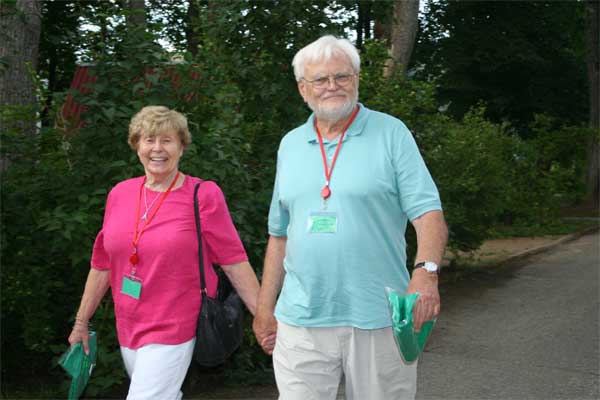
Līga and Arnolds Ruperti

Līga Ruperte, seen here with her husband Arnolds, has been honored by the World Federation of Free Latvians.

Līga Ruperte, founder of the 3×3 culture camp movement that now is active on three continents, has been named this year’s recipient of the top honor awarded by the World Federation of Free Latvians (Pasaules brīvo latviešu biedrība, or PBLA).

The honor, which includes a cash award of USD 5,000 and a diploma, is announced on Nov. 18, the anniversary of Latvia’s declaration of independence. The honor recognizes Latvians for their noteworthy work in science, politics, the community or the arts. The honor was first bestowed in 1963, according to PBLA’s website.

The first camp was held in 1981 at the Latvian Center Gaŗezers in Michigan. Since then camps have been held also in the Catskill Mountains of New York, in Canada, France, Sweden and Australia, according a PBLA press release. In 1990, the first 3×3 camp was held in Latvia.

Ruperte, who was born in Daugavpils in 1932 and moved to the United States after World War II, developed the culture camp movement in 1980. Leaving maintenance of Latvian identity in exile to the existing system of ethnic education was insufficient, Ruperte suggested. Adults especially needed to be motivated, according to the PBLA press release.

Ruperte’s idea for the 3×3 camp called for a week-long experience in which Latvians of all ages would participate. Although structured, the camps are informal and include a variety of activities and topics, covering areas as politics, foodways, ceramics, music and dance.

Since the first one, a total of 180 3×3 camps have been held around the world, serving 26,000 ethnic Latvians, according to the PBLA. Ruperte herself has led a number of the camps or served as a lecturer. She remains a board member of the camp movement in the United States, Australia and Latvia.

Ruperte earned her doctorate in education in 1973 from the University of Michigan. She has worked as a teacher and school director. Besides her work with 3×3, she also has participated in Latvian summer high schools in the U.S. and Australia, as well as an instructor in the 2×2 camp movement, which is geared toward training young leaders for Latvian communities.

Ruperte also served on the board of the Americn Latvian Association, from 1977-1993 leading the organization’s efforts in extracurricular education. From 1979-2003, she led the PBLA’s education board. In 1995 she founded and until 2003 led the Family Support Coordination Center (Ģimenes atbalsta koordinācijas center) in Latvia.

Ruperte is married to Arnolds Ruperts. They have a son, also named Arnolds, and three grandchildren, Anita, Arnolds and Andrejs.

Doctor at center of political scandal faces repercussions in Minnesota

A Latvian-American physician’s comments about ethnic Russians in his homeland have apparently resulted in professional repercussions, but no details are available.

Dr. Aivars Slucis, a radiologist with the Albert Lea Medical Center in southern Minnesota, has become the focus of debate in Latvia, Russia and the United States following publication on the investigative journalism website pietiek.com of an e-mail exchange between him and Ģirts Valdis Kristovskis, who became Latvia’s new foreign minister on Nov. 3.

A spokesperson for the clinic, which is part of Minnesota-based Mayo Health System, said in a statement that the clinic has “taken appropriate actions” in the case.

“We have completed our internal review of the situation involving Dr. Slucis, which included an analysis of the e-mail communication, a meeting with Dr. Slucis and a review of comments and data posted within this discussion,” the statement reads. “We have taken appropriate actions based on this review. Out of respect for Dr. Slucis and in accordance with our procedures, we will not share the results of this review or the actions taken.”

Patricia Hareid, director of community relations for the clinic, confirmed for Latvians Online on Nov. 10 that Slucis remains employed by the healthcare facility.

Slucis has not responded to requests for comment.

The e-mail exchange took place in October 2009. In an e-mail sent to members of the Pilsoniskā savienība (Civic Union, or PS) party in Latvia, Slucis questioned the party’s commitment to defending the interests of ethnic Latvians. Slucis, who was born in Latvia and escaped to the west with his parents during World War II, has been a vocal critic of Russian influence in his homeland.

In the e-mail, Slucis wrote that as a doctor he would find it difficult to treat Russians equally to Latvians.

Kristovskis, head of the PS party, replied to Slucis and other PS members. While agreeing with the doctor’s sentiments, he warned against hysterical responses and cautioned party members to avoid discussions that would be counterproductive to the party’s political goals.

Kristovskis won a Nov. 9 vote of no confidence in the Saeima that had been called for by representatives from the center-left and pro-Russian Saskaņas Centrs (Harmony Centre) and the conservative Par labu Latviju! (For a Good Latvia!).

While Kristovskis may have escaped the scandal, the debate about Slucis and his comments continues.

The day before the Saeima vote, leaders of Pilsoniskā savienība ousted Slucis from their party and decided to return LVL 11,665 in contributions from the doctor.

In a scathing commentary posted on Russia’s pravda.ru website, Vadim Trukhachev criticized Kristovskis but aimed his final words at Slucis.

“As for Dr. Slucis, his attitude to Russian patients are very similar to [the] worst forms of Nazi punitive medicine, and we say ‘worst’ because even Nazis provided medical assistance to concentration camp prisoners,” Trukhachev wrote. “Slucis should have worked in Salaspils concentration camp on the outskirts of Rīga, where Nazis conducted medical experiments on Russian, Belarusian and Jewish children.”

Meanwhile, the Mayo Clinic’s Facebook page in the past week has received hundreds of comments about Slucis. While many are negative, including messages describing the doctor as racist and calling for Mayo to fire him, some offer their support for Slucis.

“Does this mean that people with Russian surnames should avoid Mayo Clinic at all costs?,” one visitor to the page asked.

Defending the doctor, another visitor wrote: “Aivars Slucis has obviously appeared in the middle of Latvian political fights. Russian opposition party wants to get into government for any price, even if they have to make up a stupid story like this.”

In Latvia, an official of the Vītols Fund—an organization that provides scholarships to students in Latvia—voiced her personal support for Slucis, according to local media reports. The doctor has funded a scholarship in his name that this year supported 20 students.

Vita Diķe, chairwoman of the fund’s board of directors, called the decision by Pilsoniskā savienība to drop Slucis “treason against a person who has done no harm to Latvia.”

The Albert Lea Medical Center’s statement in the case also closed with supportive words.

“Dr. Slucis has provided care in Albert Lea for the past three years,” according to the statement. “During that time, he has treated every patient with respect and has been professional in his interactions with all patients.”

Andris Straumanis is a special correspondent for and a co-founder of Latvians Online. From 2000–2012 he was editor of the website.