Saeima committee reintroduces amendments to citizenship law

Amendments to Latvia’s citizenship law that, among other changes, would again allow World War II-era exiles to obtain dual citizenship have been reintroduced in the Saeima.

The parliament’s Legal Affairs Committee, led by Ilma Čepāne of the Unity (Vienotība) party, on Nov. 3 brought back six bills that were left unresolved when the last Saeima was dissolved. One of those, the amendments to the citizenship law, was originally introduced Feb. 17.

One amendment in the bill would single out exiles, allowing them to register as Latvian citizens. Under the proposal, the amendment would apply to persons who were Latvian citizens and who left their homeland between the start of the first Soviet occupation on June 17, 1940, and May 4, 1990, when Latvia’s Supreme Council declared the country’s independence from the U.S.S.R. The descendants of exiles also would be allowed to register as Latvian citizens.

Also under bill Nr. 52/Lp11, dual citizenship would be allowed for:

  • Latvian citizens who have obtained citizenship in another European Union or European Free Trade Association member state.
  • Latvian citizens who have become citizens of another members state of the NATO defense alliance.
  • Latvian citizens who have become citizens of another country with which Latvia has a treaty recognizing dual citizenship.
  • Latvian citizens who have the permission of the Cabinet of Ministers to maintain their Latvian citizenship.
  • A child born outside of Latvia, if at least one of their parents is a Latvian citizen and if under the law of the country in which they are born a child automatically become a citizen of that country.
  • A person who as a result of marriage becomes a citizen of another country.

In the 10th Saeima, the amendments were referred to the Legal Affairs Committee, which set up a subcommittee to study the proposed changes. The subcommittee set a deadline of Sept. 1 to take comment on the amendments, but by that date the 10th Saeima was running out of time.

Likewise, the 11th Saeima’s Legal Affairs Committee on Nov. 1 decided to again form a subcommittee to look at the law.

One of the charges of the subcommittee, Čepāne said in a Saeima press release, will be to call on experts to provide input on the proposed amendments.

“The citizenship law has not been amended for many years,” she said, “and fundamental changes in it are needed in both content and technical points.”

The subcommittee will examine four separate areas, according to the press release: dual citizenship for exile Latvians; citizenship for children born abroad to Latvian citizens; situations in which Latvian citizenship has been revoked because of current restrictions on dual citizenship; and the granting of Latvian citizenship to children born in Latvia to non-citizens.
Andris Straumanis is a special correspondent for and a co-founder of Latvians Online. From 2000–2012 he was editor of the website.

Signature campaign begins Nov. 1 to make Russian 2nd state language

An official signature campaign that could lead to Russian becoming an official language in Latvia gets underway Nov. 1, the Central Election Commission in Rīga has announced.

The month-long campaign seeks support for amending the Latvian constitution to allow Russian to have equal status with the Latvian language.

Under current wording, Latvian is the only official language in the country. However, some members of the country’s Russian-speaking community have been pushing to give their native language official status as well.

On Sept. 9, the Central Election Commision received a petition with 12,533 signatures, marking the first step in an initiative to change the constitution. The petition was submitted by the Russian-oriented “Dzimtā valoda” (Native Language) group.

If at least 10 percent of the eligible voters in the last parliamntary election—a total of 154,379 persons—sign on by Nov. 30, then the constitutional amendments will be presented to the Saeima for approval. If the Saeima approves the amendments, then Russian would become the second official language. If MPs amend or reject the constitutional changes, then the legislation would be presented to voters in a national referendum.

The signatures gathered on the “Dzimtā valoda” petition will count toward the total needed.

The proposed constitutional amendments would change:

  • Paragraph 4, which states that Latvian is the state language.
  • Paragraph 18, which stipulates the oath made by members of parliament. Under current language, they promise to strengthen Latvian as the only state language.
  • Paragraph 21, which makes Latvian the language of the Saeima.
  • Paragraph 101, which makes Latvian the official language of local governments.
  • Paragraph 104, which guarantees people the right to address government bodies and to receive an answer in Latvian.

Outside of Latvia, citizens who wish to sign on to the campaign may do so at one of 39 designated embassies or consulates. A list of the sites is available from the Central Election Commission’s website, www.cvk.lv.

Andris Straumanis is a special correspondent for and a co-founder of Latvians Online. From 2000–2012 he was editor of the website.

Saeima confirms new government

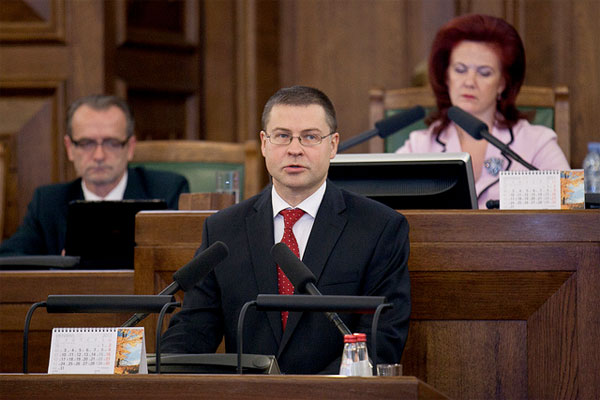
Valdis Dombrovskis uzrunā Saeimu

Prime Minister Valdis Dombrovskis addresses the Saeima before its vote to confirm Latvia’s new government. The parliament on a 57-38 vote Oct. 25 supported the three-party coalition offered by Dombrovskis. (Photo by Ernests Dinka, courtesy of the Saeima Chancellery)

Latvia’s new three-party coalition government, which will be headed by current Prime Minister Valdis Dombrovskis, has been confirmed by the country’s parliament.

After about two hours of debate Oct. 25, the Latvian parliament confirmed the government on a 57-38 vote. While the new government seemed assured of at least 56 votes, it earned one more when Ingmārs Līdaka, a member of the Union of Greens and Farmers (Zaļo un Zemnieku savienība, or ZZS), appeared to break from his caucus to support Dombrovskis.

However, according to Latvian media reports, Līdaka apparently voted in favor by mistake. ZZS head Augusts Brigmanis told the LETA news agency that Līdaka tried to correct the error after the vote was already recorded.

Also backing the new government were all MPs from Dombrovskis’ centrist party Unity (Vienotība), the Zatlers Reform Party (Zatlera Reformu partija, or ZRP) and the right-wing National Alliance (Nacionālā apvienība “Visu Latvijai!” – “Tēvzemei un Brīvībai/LNNK”). The three parties makes up the new coalition government. An additional six votes came from former ZRP members who broke with the party to create an independent caucus.

The 38 votes against the new government came as expected from MPs representing the centre-left and Russian-oriented Harmony Centre (Saskaņas Centrs) and the conservative ZZS.

Three MPs—Viktors Jakovļevs of Harmony Centre as well as Ilona Jurševska and Kārlis Seržants of the Union of Greens and Farmers—did not vote.

The new government includes:

  • Justice Minister Gaidis Bērziņš (National Alliance), 41, a practicing lawyer and a lecturer in law at the University of Latvia. Bērziņš was the minister of justice from 2006-2009.
  • Health Minister Ingrīda Circene (Unity), 54, who previously served in the post during former Prime Minister Einars Repše’s government from 2002-2004.
  • Culture Minister Žaneta Jaunzeme-Grende (National Alliance), 47, former chairperson of the Latvian Chamber of Commerce and Industry.
  • Interior Minister Rihards Kozlovskis (ZRP), 42, who currently is an attorney for SIA BBF Consulting.
  • Education Minister Robert Ķīlis (ZRP), 43, an associate professor of economics anthropology at the Stockholm School of Economics in Rīga.
  • Defense Minister Artis Pabriks (Unity), 45, who will continue in the position from the previous government.
  • Economics Minister Daniels Pavļuts (ZRP), 35, who currently heads corporate relations for the Latvian branch of the Swedish-owned bank Swedbank.
  • Foreign Minister Edgars Rinkēvičš (ZRP), 38. He previously was chief-of-staff for former President Valdis Zatlers.
  • Transportation Minister Aivis Ronis, 43, a former diplomat who has been deemed nonpartisan. Currently president of the Latvian Association of Private Banks, Ronis has served in various diplomatic posts and was foreign minister in 2010.
  • Edmunds Sprūdžs (ZRP), 31, minister for environmental protection and regional development. Sprūdžs originally was ZRP’s candidate for prime minister.
  • Agriculture Minister Laimdota Straujuma (Unity), 60, who currently is an assistant state secretary in the Ministry for Environmental Protection and Regional Development.
  • Finance Minister Andris Vilks (Unity), 48, who will continue in the job from the previous government.
  • Welfare Minister Ilze Vinķele (Unity), 39, who has served as the Ministry of Finance’s parliamentary secretary and currently is pursuing a doctorate in political science at the University of Latvia.

Confirmation of the new government followed the Sept. 17 special parliamentary election, which was called after Latvian voters overwhelmingly approved a July referendum to dissolve the 10th Saeima. The 11th Saiema began work Oct. 17.

Andris Straumanis is a special correspondent for and a co-founder of Latvians Online. From 2000–2012 he was editor of the website.