Another political party can’t bear to wait, names prime minister candidate

Latvian voters do not elect the country’s prime minister. They elect the parliament, which confirms the president’s choice to lead the government. But that hasn’t stopped political parties from putting forth their candidates for the ministru prezidents in an effort to sway voters.

The latest name on the list? Laimes Lācis—as in the 1923 play by Latvian writer Andrejs Upīts. The big, white bear is the candidate of Pēdēja partija, No. 11 on the list of parties vying for seats in the parliament. The party is not exactly taking the election seriously, but its campaign is an overall commentary on the state of politics in Latvia.

Party officials unveiled their candidate for the prime ministership during a Sept. 7 press conference in Rīga.

“The parties’ pre-election show, where prime ministerial candidates of various patinas get pushed to the forefront like dolls, equally well satisfies both the public and the media,” the party announced the day before on its website. That is why Pēdējā partija—whose motto is Nezinu. Neesmu izlēmis (I don’t know. I haven’t decided.)—decided to also put forth its candidate.

According to the bear’s curriculum vitae, he was born in 1923, his father is Upīts and his mother is unknown. Lācis is related to the late Communist and writer Vilis Lācis; to Russia’s President Dmitry Medvedev (medved is Russian for “bear”); the unsavory cartoon character Pedobear; the former president of Latvia, Vaira Vīķe-Freiberga; and U.S. President Barack Obama. He claims to have been with Latvian explorer Aleksandrs Laime when the latter in 1955 became the first Westerner to reach Venezuela’s Angel Falls on foot.

Laimes Lācis is going up against a number of well-known candidates for prime minister. The Vienotība coalition wants to see the incumbent, Valdis Dombrovskis, keep his job. Harmony Centre (Saskaņas Centrs) is offering up socialdemocrat Jānis Urbanovičs. The Par labu Latviju! coalition wants businessman and Rīga Vice Mayor Ainārs Šlesers. The Union of Greens and Farmers (Zaļo un Zemnieku savienība) wants businessman and Ventspils Mayor Aivars Lembergs.

Needless to say, the bear is bound to be disappointed come Oct. 2, which is election day.

For more on the omnivore, er, candidate, see his website, premjers.lv, follow his Twitter feed, twitter.com/premjers, or visit his Facebook page.

And for some extra fun, listen to “Galva ķīlā,” a song devoted to the party recorded by musicians Ansis Ataols Bērziņš and Juris Riekstiņš. The tune is the Italian revolutionary song “Bandierra rosa,” but the lyrics are in Latvian, Latgallian and Russian. The song is available on the social network draugiem.lv.

Andris Straumanis is a special correspondent for and a co-founder of Latvians Online. From 2000–2012 he was editor of the website.

Kremer dedicates new album to those who would not be silenced

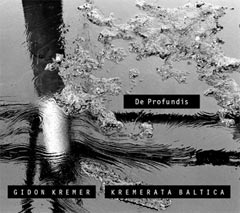
The latest album by Latvia-born violinist Gidon Kremer and his Kremerata Baltica Chamber Orchestra is due out Sept. 14, recording label Nonesuch Records has announced.

Titled De Profundis, the compact disc is to include 12 tracks selected from Kremer’s performing repertoire that “all hold very special meaning to him, and are connected to each other on a deep, intuitive level,” the U.S.-based recording label announced in a press release.

Kremerata Baltica, founded in 1996, is made up of young musicians from Estonia, Latvia and Lithuania. The orchestra has performed around the world.

De Profundis will feature works by Jean Sibelius, Estonian composer Arvo Pärt, Lithuanian composer Raminta Šerkšnytė, Robert Schumann, Michael Nyman, Franz Schubert, Stevan Kovacs Tickmayer, Dmitri Shostakovich, Lera Auerbach, Astor Piazzolla, Latvian composer Georgs Pelēcis and Alfred Schnittke.

“The artists featured on this record affirm a deep-rooted personal expression that can resonate within anyone,” Kremer said in the press release. “Their spiritual missive can sustain humans by appealing to their profoundest emotions, by letting them open up, become more conscious, rather than ‘forget themselves.’ Each of the 12 pieces selected for this album sends its own individual message to the listener, one that my colleagues from Kremerata Baltica and I have tried to illuminate.”

Kremer, who is the artistic director for Kremerata Baltica, has dedicated the recording to all those who refuse to be silenced, according to Nonesuch, and especially to Mikhail Khodorkovsky—the Russian businessman and philanthropist convicted of fraud and sentenced to a labor camp in Siberia in a case that critics have said is an attempt by Russian leader Vladimir Putin to silence opponents. The Estonian composer Pärt dedicated his “Symphony no. 4” to Khodorkovsky.

The tracks on the album are to include:

  1. Scene with Cranes (Jean Sibelius)
  2. Passacaglia (Arvo Pärt)
  3. De Profundis (Raminta Šerkšnytė)
  4. Fugue No. 6, from Six Fugues on the Name B.A.C.H., Op. 60 (Robert Schumann)
  5. Trysting Fields (Michael Nyman)
  6. Minuet No. 3 and Trios in D Minor, D. 89 (Franz Schubert)
  7. Lasset Uns den Nicht Zerteilen (Stevan Kovacs Tickmayer / J. S. Bach)
  8. Adagio, from Lady Macbeth of the Mtsensk District (Dmitri Shostakovich)
  9. Sogno di Stabat Mater bzw. Dialogues on Stabat Mater (alter Titel) (Lera Auerbach)
  10. Melodía en La menor (Canto de Octubre) (Astor Piazzolla)
  11. Flowering Jasmine (Georgs Pelēcis)
  12. Fragment (from an unfinished cantata) (Alfred Schnittke)

For further information on Kremerata Baltica, visit www.kremerata-baltica.com.

De Produndis

De Profundis, the latest album from Gidon Kremer and his Kremerata Baltica, is due out Sept. 14.

Andris Straumanis is a special correspondent for and a co-founder of Latvians Online. From 2000–2012 he was editor of the website.

Eolika, Latvia’s answer to ABBA, releases 30th anniversary album

A collection of hit songs by Eolika, once called Latvia’s answer to Swedish pop superstars ABBA, has been released in Rīga as the foursome marks its 30th anniversary.

Formed in 1980 by composer Boriss Rezņiks, Eolika consists of singers Olga Rajecka, Ilona Stepānova, Dainis Dobelnieks and Viktors Zemgals. The group was known throughout the Soviet Union and drew thousands to its concerts, according to a press release from recording company MICREC.

One of Eolika’s most memorable concerts took place in Afghanistan when the quartet sang for Baltic troops who were part of the Soviet invasion of that country.

The quartet was most active from 1980-1986. Rajecka in 1986 left to join Turaides roze, a project organized by composer Imants Kalniņš. Within a few years, Eolika dissolved, according to MICREC, only to reunite in 1996 to tour and release an album of its classics.

This year, the quartet has reunited again to mark its anniversary with a tour around Latvia. One highlight of the tour will be an Aug. 30 show in the Dzintari Concert Hall in Jūrmala.

The anniversary compact disc is titled simply Jubilejas izlase. Songs on the album include:

  1. Pasaule, pasaulīt
  2. Tava atnākšana
  3. Zemeņu lauks
  4. Es neesmu Džeina Fonda
  5. Mežrozīte
  6. Raimonda Paula dziesmu popūrijs
  7. Noktirne
  8. Lielā zive
  9. Maziņš papagailis
  10. Salamandra
  11. Karavāna
  12. Pienenīte
  13. Zem saules vai mēness
  14. Kā es gaidīju
  15. Vēl tu vari
  16. Meitene no sapņa
  17. Lūgums
  18. Šajā brīdī

The last three tracks—“Meitene no sapņa”, “Lūgums” and “Šajā brīdī”—are new songs released this year. All the others have been previously released.

For more on Eolika’s anniversary tour, visit the group’s website, eolika.lv.

Eolikas sastāvs

Eolika consists of (left to right) Ilona Stepānova, Dainis Dobelnieks, Viktors Zemgals and Olga Rajecka. (Publicity photo)

Eolikas jubilejas albums

Eolika’s 30th anniversary album is called Jubilejas izlase.

Andris Straumanis is a special correspondent for and a co-founder of Latvians Online. From 2000–2012 he was editor of the website.